Sewer Line Installation & Replacement · Atlanta, GA
Sewer line installation and replacement in Atlanta for new infill homes, teardowns and worn-out laterals.
- Georgia DPH-certified installer & pumper
- Residential & commercial
- Local shop in Oxford, GA
Get a free estimate
or call (678) 863-5620The short answer
What does sewer line installation involve in Atlanta, GA?
A new Atlanta building sewer usually needs Watershed Management's Sewer Capacity Certification ($600 for a single-family home), a plumbing-code-compliant lateral from the house to the city connection, and a cleanout. Replacements follow the same route. The owner pays for and owns the whole lateral; the city owns the public sewer.↗↗
Reviewed by Atlanta Water & Sewage Solutions · Last updated
At a glance
The Atlanta story
A city that keeps building on old lots
Atlanta added housing fast in the last fifteen years: Census estimates count 51,586 units built from 2010 to 2019 and another 20,985 since 2020. Much of that went onto lots that already had a house, a lateral and a connection that were never sized or laid for what's replacing them.↗
The Beltline accelerated it, and former warehouses on the westside and eastside turned into housing. For a builder, that means a sewer question on every permit: can the old line be reused, or does the new house get a new building sewer to the street?↗
Our usual answer on a teardown is to camera the old lateral before demolition. If it's cracked, bellied or rooted, replacing it while the lot is open costs far less than digging up new landscaping later.
On the record
- 72,571 Atlanta housing units were built in 2010 or later (ACS 2020-2024, B25034).↗
Permits · City of Atlanta Department of Watershed Management — Site Development / Sewer Capacity Certification
Atlanta's sewer capacity check comes before the building permit
- 01
Estimate the project's sewage flow using the city's Standard Sewage Flow Rates document, then apply for Sewer Capacity Certification.↗
- 02
The flat certification fee is $600 for single-family homes and commercial flows under 2,500 gallons per day, and $1,500 for commercial flows at or above that.↗
- 03
If capacity is short, an analysis of proposed options costs a $2,245 flat rate, and capacity-limited basins can carry extra fees.↗
- 04
Before any house connection in the city system is used, all provisions of the city's plumbing code must be met.↗
More about Atlanta
City code details that change how a line is laid
Chapter 154 of the Atlanta code is mostly about public sewers, but several sections reach onto private lots and into the way we plan an installation.
- In new developments, house connections run one joint (three feet) past the property side of the sidewalk, with a city standard cleanout at the property line.↗
- Nobody may build over, cover or fill over a city sewer without the commissioner's written permission, which matters when an addition or garage lands near an easement.↗
- City design criteria keep water pipe and sanitary sewer out of the same trench, with ten feet of horizontal separation where practical.↗
- A shared private treatment system for a cluster of lots isn't an alternative: Sec. 154-155 bans private decentralized wastewater systems in the city.↗
Sewer or septic?
Why a septic option rarely exists inside the city
With city sewer in nearly every street, a new house in Atlanta is designed around its connection point. The depth of the public line at the street, the finished floor elevation and any basement fixtures set the slope, and on steep in-town lots that sometimes means an ejector pump for the lowest level.
More about Atlanta
Installation, start to finish
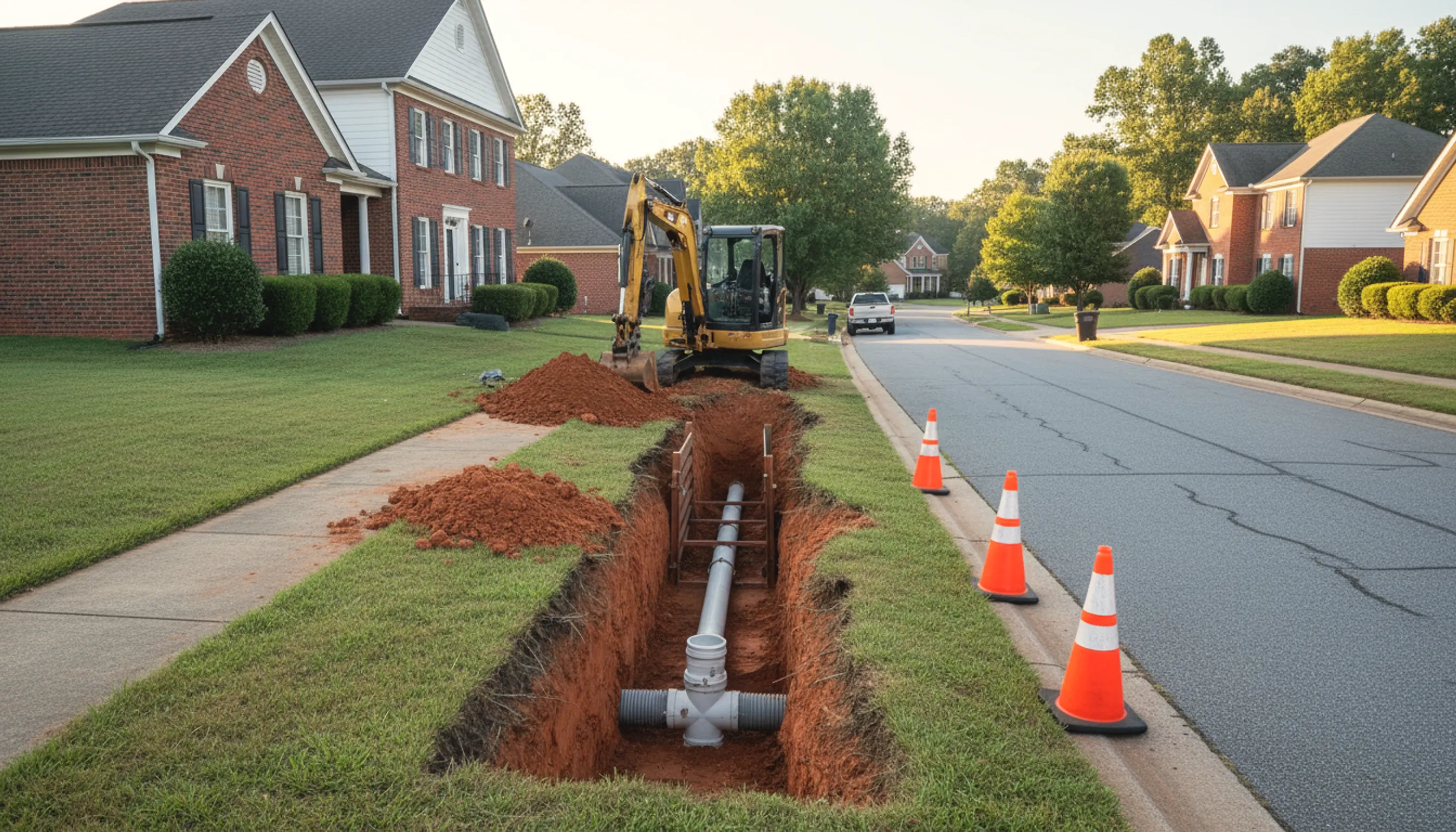
We locate the city connection or stub and shoot grades from it back to the foundation. Georgia 811 marks utilities before we dig. The trench goes in on a steady fall, the pipe sits on bedding, and a two-way cleanout goes where the code and the site allow easy access.
For replacements, trenchless bursting can pull new pipe through the old path when the route is sound and the yard is worth saving; open cut is better when the line has a belly or a bad connection that needs to be seen. Commercial buildings add larger diameters, grease interceptor tie-ins and coordination with the site plan.
We locate the city connection or stub and shoot grades from it back to the foundation.
What it costs
Published installation ranges
New sewer line, installed
$40–$180 per linear foot
Typical market range — HomeGuide — Sewer Line Installation Cost (updated December 2025), 2025
New line up to 40 feet, total
$1,600–$7,200
Typical market range — HomeGuide — Sewer Line Installation Cost (updated December 2025), 2025
Full lateral replacement, Atlanta market
$55–$250 per linear foot
Typical market range — Angi — How Much Does Sewer Line Replacement Cost in Atlanta, GA? (updated April 2026), 2026
Sewer line permits
$400–$1,600
Typical market range — HomeAdvisor — Sewer Line Installation Cost (updated June 17, 2026), 2026
What moves the price
These are third-party typical market ranges, not our prices. Every job is quoted after we see it — estimates are free.
Free estimate: (678) 863-5620- 01Capacity certification and any capacity-limited basin fees
- 02Depth of the city connection versus the house's lowest drain
- 03Setback from the street on deep in-town lots
- 04Sidewalk and curb work at the property line
- 05Trenchless versus open-cut replacement
FAQ
Atlanta sewer installation questions
Straight answers, with the rule or record behind them. Still unsure? Call and ask the crew that digs.
(678) 863-5620Do I need Sewer Capacity Certification for a new house in Atlanta?
Generally yes: DWM reviews each new development connecting to city sewer. DWM's analysts decide if yours needs the review; the single-family fee is a $600 flat rate.
Source: Construction Site Development | City of Atlanta Department of Watershed Management
What if the city says there isn't enough sewer capacity?
DWM offers an analysis of proposed options for a $2,245 flat rate, and projects in capacity-limited basins may owe additional fees. Commercial flows of 2,500 gallons a day or more start at $1,500.
Source: Construction Site Development | City of Atlanta Department of Watershed Management
Who owns the new sewer line once it's installed?
You do. ATL311 puts the entire service lateral on the property owner, from the building to the city sewer.
Can my new garage go over the city sewer easement?
Only with written permission from the Watershed commissioner, who has to be satisfied the sewer won't be overloaded or blocked from maintenance.
Where does the cleanout go on a new Atlanta lot?
In new developments the code calls for a city standard cleanout at the property line, with the connection extended three feet past the sidewalk.
Can a small cluster of new homes share a private treatment system?
Not inside Atlanta. Private decentralized wastewater systems serving more than one lot are prohibited by Sec. 154-155.
What does a new sewer line cost?
HomeGuide lists $40–$180 per foot installed; Angi's Atlanta figure for a full lateral is $55–$250 per foot. Those aren't our prices.
Source: HomeGuide — Sewer Line Installation Cost (updated December 2025)
Sources
Where these facts come from
Rules, costs and local facts on this page link to the agency, code or publisher that states them. Cost figures are third-party market ranges, not our prices — estimates are free.
Reviewed by Atlanta Water & Sewage Solutions · Last updated
- 1Construction Site Development | City of Atlanta Department of Watershed Management
- 2ATL311 — What is a Sewer Service Lateral?
- 3Census Reporter API — ACS 2020-2024 table B25034 (year structure built), Atlanta city
- 4Atlanta - Wikipedia
- 5Atlanta Code Ch. 154, Art. IV, Div. 1 — Sewer Construction, Generally (Secs. 154-141–154-155) (Municode, Supp. 107)
- 6Ga. Comp. R. & Regs. 511-3-1 On-Site Sewage Management Systems
- 7HomeGuide — Sewer Line Installation Cost (updated December 2025)
- 8Angi — How Much Does Sewer Line Replacement Cost in Atlanta, GA? (updated April 2026)
- 9HomeAdvisor — Sewer Line Installation Cost (updated June 17, 2026)
Ready when you are
Building on an Atlanta lot? Plan the sewer before the slab.
Call (678) 863-5620 to camera the old line and price a new building sewer or full replacement.
(678) 863-5620- Georgia DPH-certified installer & pumper
- Residential & commercial
- Oxford, GA
Free estimate
or call (678) 863-5620