24/7 Emergency? (678) 863-5620
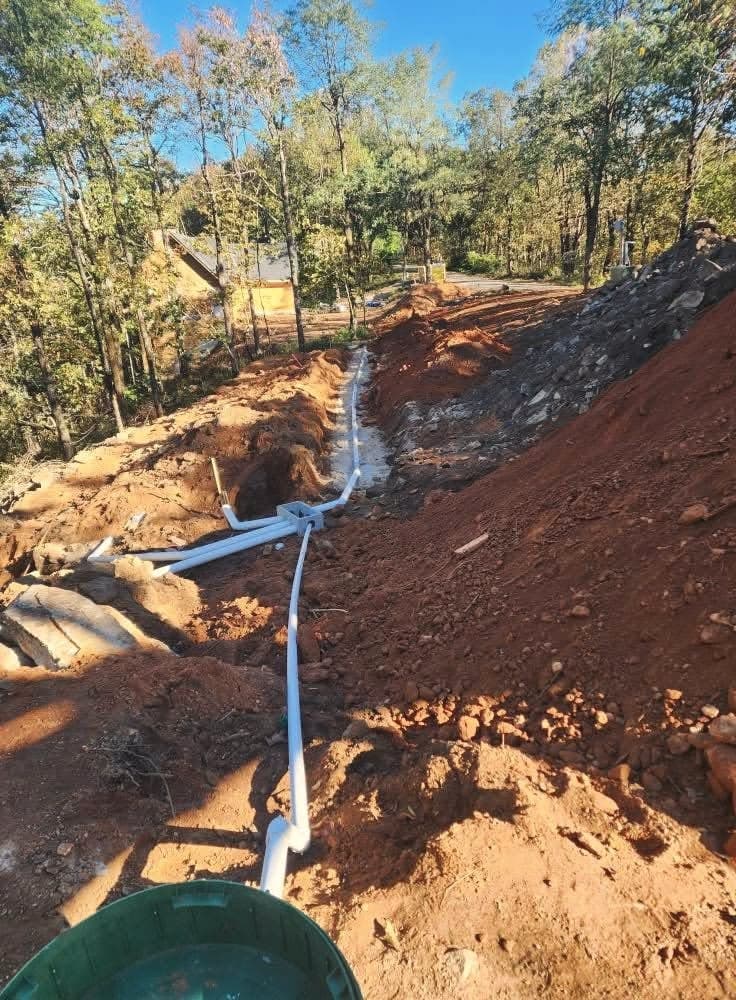
From our job files: a freshly graded red clay backyard with a tracked skid steer beside the fence

EXCAVATION · GRADING · DRAINAGE · METRO ATLANTA

Excavation contractor for grading and drainage in metro Atlanta

Trenching for utilities, grading that sends water away from your foundation and drain field, and French drains that carry it off. The dirt work is done by a DPH-certified septic installer based in Oxford, GA, who knows where your system is before the machine starts.
  • Georgia DPH-certified installer & pumper
  • Residential & commercial
  • Emergency line answered 24/7

Get a free estimate

or call (678) 863-5620

Property type
What do you need?
Rather talk? (678) 863-5620
Where's the property?
Is sewage backing up inside? (optional)
Who should we call?

By submitting, you agree we may call or text you about this request. Msg & data rates may apply. Reply STOP to opt out. SMS terms.

The short answer

What does an excavation contractor do on a residential lot?

An excavation contractor digs trenches for water, sewer and drainage lines, grades soil so rain runs away from foundations and septic drain fields, and installs French drains. In Georgia, mechanized digging needs a Georgia 811 ticket first. Atlanta Water & Sewage Solutions, a DPH-certified septic installer in Oxford, GA, does this work across metro Atlanta.

Reviewed by Atlanta Water & Sewage Solutions · Last updated

Key facts

Excavation and grading in Georgia: the numbers that matter

Each row links to the agency, code or publisher it comes from. Tap a source to check it yourself.

Legal, septic-setback and cost facts for digging and grading on a metro Atlanta lot, each with its source.
TopicWhat it saysSource
Before any machine digsGeorgia 811 ticket at least 3 business days ahead; utilities get at least two full business days to markGeorgia 811 — The 811 Process
What counts as excavatingAny operation using mechanized equipment to move earth below grade — the law's list includes grading and trenchingGeorgia 811 — Laws & Policies (Georgia Underground Facility Protection Act, O.C.G.A. 25-9), 2022
Tolerance zone around marked linesThe facility's width plus 18 inches on either sideGeorgia 811 — Laws & Policies (Georgia Underground Facility Protection Act, O.C.G.A. 25-9), 2022
State erosion-control thresholdProjects under 1 acre are exempt from the state Erosion and Sedimentation Act unless within 200 feet of state waters or part of a larger plan; cities and counties may still regulateO.C.G.A. § 12-7-17 Exemptions, Georgia Erosion and Sedimentation Act (text via Onecle)
Stream buffer25-foot buffer along the banks of all state watersO.C.G.A. § 12-7-6 Best management practices; minimum requirements (text via Onecle)
Grading over a permitted septic systemGrading or filling after final inspection that may harm the system voids the county's approval (Rule 511-3-1-.03(4)(b))Georgia DPH Rules Chapter 511-3-1 On-Site Sewage Management Systems (Jan 2016), 2016
Typical excavation cost$2.50–$15.00 per cubic yard; equipment with operator $100–$300 per hour, per HomeGuide (2026)HomeGuide — How Much Does Excavation Cost? (Feb. 5, 2026), 2026
Typical French drain cost$10–$35 per linear foot or $500–$8,800 installed for a yard or curtain drain, per HomeGuide (2026)HomeGuide — How Much Does a French Drain Cost? (Feb. 5, 2026), 2026

Plain definitions

Dirt-work terms, defined

Excavation
Removing soil with machines to open a trench, a pit or a pad; Georgia's 811 law treats any mechanized digging below grade, including grading, as excavating.
Utility trenching
A narrow trench dug to bury a water service, sewer lateral, septic line, conduit or drain pipe, then backfilled and compacted.
Positive drainage
Ground shaped so surface water flows away from a house, a septic tank or a drain field instead of collecting against it.
French drain
A gravel-filled trench with a perforated pipe that intercepts groundwater or surface runoff and carries it to a safe outlet.
Silt fence
A fabric fence staked along the low side of bare soil to trap sediment in runoff until the ground is stabilized.
Lot clearing
Removing brush, small trees and debris so a lot can be graded or a system laid out; HomeGuide lists it among earth-moving jobs.

The whole story

Why water on a drain field kills a septic system

A drain field works by letting effluent soak slowly into unsaturated soil. Everything we do with a grading blade on a septic lot is about protecting that. When roof runoff, a driveway or a neighbor's slope dumps storm water across the field, the soil fills with rainwater first. Effluent from the tank has nowhere to go. It backs up toward the house or comes to the surface.

EPA is blunt about it: "Keep roof drains, sump pumps, and other rainwater drainage systems away from your drainfield area," because excess water interferes with treatment (EPA). Georgia's own rules make the same point at the tank: all openings, risers and manholes "shall be constructed so as to prevent the entrance of surface water" (Rule 511-3-1-.05(6)).

Most of what homeowners call a failed field after a wet spring is really a drainage problem that nobody fixed. A downspout was piped into the yard right above the lines. A new patio pitched water toward the field. A swale was filled in during landscaping. Regrading and a well-placed interceptor drain uphill can take that water off the field. The field itself may not need replacing. When it does, we're a DPH-certified installer, so the same crew handles the drain field repair instead of handing you off.

There's a legal side too. Rule 511-3-1-.03(4)(b) says grading, filling or landscaping on the lot after final inspection that may adversely affect the system "shall render the approval void." Grade carelessly over a permitted system and you can lose the paperwork as well as the field.

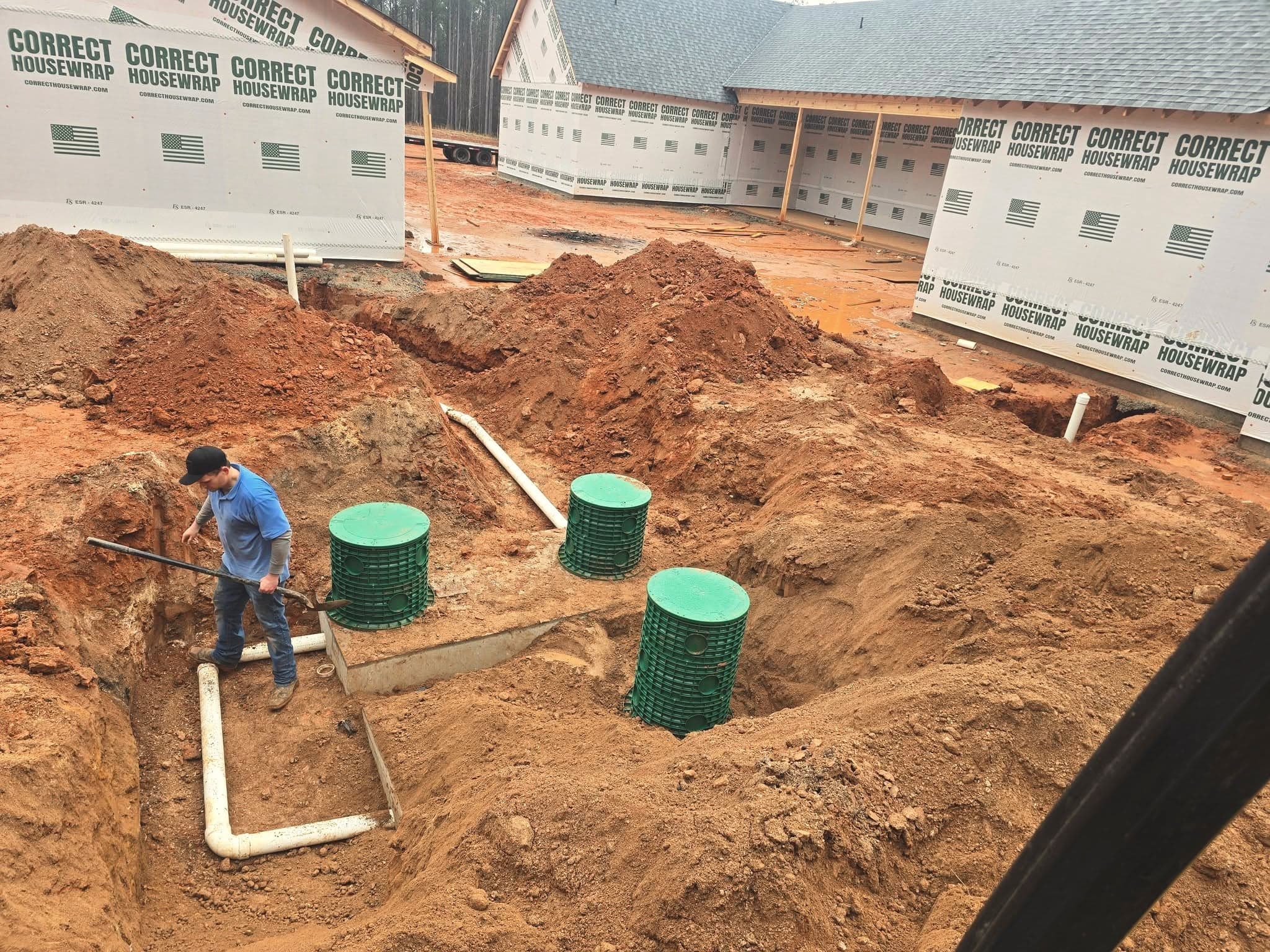
From our job files.

Warning signs

Signs your lot needs grading or drainage work

Water problems on red-clay lots show up in the same few places. If you see two or more of these, the fix is usually in the dirt, not the plumbing.

Water where it shouldn't be? Call (678) 863-5620

  • 1. Water stands against the foundation after rainThe ground slopes toward the house instead of away. Crawl spaces stay damp and mulch beds wash out along the wall.
  • 2. A soggy strip over the drain field after every stormRunoff from uphill or from gutters is crossing the field. Compare it with the signs a drain field is failing so you know which problem you have.
  • 3. Downspouts dump into the yard a few feet from the houseEvery inch of rain on a roof becomes concentrated flow. On a septic lot, EPA says to keep that water away from the drain field.
  • 4. Red clay washing onto the driveway or streetBare, sloped soil is eroding. On a bigger job that's a sediment-control issue under Georgia's erosion law, not just a mess.
  • 5. Ruts and ponding where you park or turnLow spots and compacted clay hold water. If the ruts are over the septic system, that's a separate problem: EPA says not to park or drive on a drain field.
  • 6. A yard that stays wet days after the rain stopsClay subsoil drains slowly. A French drain or curtain drain can intercept subsurface water before it reaches the house or the field.

Your options

Grading, French drain or both?

Most drainage problems are solved by one of three moves. The site decides which, and on a septic lot the setbacks decide where.

OPTION 01

Regrade for positive drainage

When it fits: Surface water is the problem: it runs toward the house or across the field because the ground is shaped wrong.

  • Fixes the cause instead of piping the symptom
  • No buried pipe to clog
  • HomeGuide: $1,000–$5,000 to regrade an average backyard
  • Needs somewhere lower for the water to go
  • Grading over a septic system must not change cover over the lines or tank

OPTION 02

French drain or curtain drain

When it fits: Water moves through the soil, or the lot can't be reshaped enough: a hillside home, a basement wall, a field downhill of a neighbor.

  • Intercepts subsurface water
  • Works on tight lots
  • HomeGuide: $10–$35 per linear foot for a yard or curtain drain
  • Needs a daylight outlet or approved discharge point
  • Perforated pipe can silt up without fabric and clean stone

OPTION 03

Swale plus pipe (combined)

When it fits: Heavy runoff from a large roof or driveway, plus soggy ground on the downhill side.

  • Handles storm peaks and slow seepage
  • Can route roof water past a drain field entirely
  • Most digging of the three
  • Outlet must not discharge onto a neighbor or into a buffer

On a septic lot we route drains downhill of, or around, the field. Georgia's rules keep a drain field 15 feet from a drainage ditch and a tank 15 feet from a drainage ditch or embankment.

Homes & businesses

Home lots and commercial sites

Residential

Homes

Residential work is usually a trench for a new water or sewer line, a French drain along a wet side yard, regrading around a foundation, or clearing an overgrown corner so a system can be laid out. Our job photos show drainage trenching with corrugated pipe, yard grading with a track loader, and front-yard excavation behind silt fence.

On a septic lot we find the tank and field first. We work around them, not over them.

  • Utility and drain trenching
  • Regrading around foundations and septic systems
  • French and curtain drains
  • Lot clearing for a system layout

Commercial

Commercial sites

Commercial excavation usually supports a utility: a new sewer or water service, a septic system for a building off the sewer grid, or drainage around a parking area. Disturbed area adds up fast on commercial lots. At 1 acre or within 200 feet of state waters, the state's small-project exemption from the Erosion and Sedimentation Act no longer applies.

We plan the dig around your hours and keep sediment on your site.

  • Utility trenching for new services
  • Grading for drainage around buildings
  • Erosion and sediment controls on bare soil
Commercial sewer and septic services

How the job runs

How we run an excavation or drainage job

Digging is the easy part. Knowing what's under the yard and where the water will go afterward is the work.
  1. 1

    Free on-site estimate

    We walk the lot in, ideally after a rain. We look at where water comes from, where it collects, and where it can legally go.

  2. 2

    Locate the septic system and private lines

    If you're on septic, we find the tank, distribution box and field lines before we plan a single cut. County permit records help; a probe and a shovel confirm.

    Georgia DPH Rules Chapter 511-3-1 On-Site Sewage Management Systems (Jan 2016)

  3. 3

    Georgia 811 ticket

    We submit a locate ticket at least 3 business days ahead and wait until every utility has marked or cleared. Then we respect the tolerance zone around each mark.

    O.C.G.A. 25-9Georgia 811 — The 811 Process

  4. 4

    Set erosion controls

    Silt fence goes on the low side of any bare soil before we strip it. Georgia's minimum practices call for keeping disturbed area and exposure time to a practicable minimum.

    O.C.G.A. 12-7-6O.C.G.A. § 12-7-6 Best management practices; minimum requirements (text via Onecle)

  5. 5

    Dig, grade and lay pipe

    Trenches get the right fall for the pipe. Grades get shaped to shed water away from the house and the field, and drains get fabric, clean stone and pipe.

  6. 6

    Backfill and compact

    Red clay settles if it goes back in loose. We place and compact it in lifts so the trench line doesn't sink into a ditch next spring.

  7. 7

    Stabilize the surface

    Seed, straw or other cover goes down as soon as grading is done, because Georgia law says disturbed soil shall be stabilized as quickly as practicable.

    O.C.G.A. § 12-7-6 Best management practices; minimum requirements (text via Onecle)

Permits & the Georgia rules

Georgia rules for digging and grading

Three sets of rules can apply to one backyard job: the 811 law for anything mechanized, the Erosion and Sedimentation Act for bigger or waterside disturbances, and DPH's septic rules if there's a system on the lot.
  1. 01

    Submit a Georgia 811 ticket at least 3 business days before mechanized digging and wait for every utility to mark or clear.

  2. 02

    Start within 30 calendar days of the ticket's effective date; longer jobs need a new locate request.

  3. 03

    Georgia 811 says notification isn't legally required for small, non-mechanized digging, but it encourages residents to call anyway.

  4. 04

    Check the land-disturbance threshold: under 1 acre is exempt from the state Act unless within 200 feet of state waters or part of a larger plan; a city or county issuing authority can still regulate.

  5. 05

    Stay out of the 25-foot buffer along state waters unless a variance applies.

  6. 06

    On a septic lot, keep drains and cuts outside the tank and field setbacks, and don't change the system after final inspection without Environmental Health involvement.

Georgia rule O.C.G.A. 25-9 (definition of excavating)

"Excavating" means any operation using mechanized equipment or explosives to move earth, rock, or other material below existing grade.
Read the rule

Georgia rule Rule 511-3-1-.03(4)(b)

Grading, filling … or construction activities on the lot subsequent to final inspection … which may adversely affect the on-site sewage management system shall render the approval void.
Read the rule

Georgia rule O.C.G.A. 12-7-6(b)(15)(A)

There is established a 25 foot buffer along the banks of all state waters
Read the rule

Georgia rule Rule 511-3-1-.07(3)

less than fifteen feet (15') from an embankment, swimming pool foundation, drainage ditch or trash pits
Read the rule

How it varies by county

  • Newton, Gwinnett and Rockdale

    GNR Public Health requires a Level 3 soil report for all septic permits since Feb. 7, 2022, including additions that modify a system. Grading that forces a system change starts there.

  • Newton County

    GNR lists a $150 site evaluation for an addition that doesn't modify the septic system (Category 1), useful when a patio or regrade sits near the field.

  • Walton County

    Walton Environmental Health evaluates existing systems for pools and additions; any addition to an existing system needs a Level III soil report and a $200 final inspection fee.

  • Gwinnett County

    Gwinnett DWR says about 30 percent of the county's population is on septic, so drainage work there often means working around a system.

Soil & terrain

Grading in Piedmont red clay

Under the thin topsoil of an east-metro yard, a grading blade usually meets Piedmont red clay. NRCS describes the Cecil series, common across the region, as well drained with medium runoff, and its subsoil as red clay on Piedmont ridges and side slopes. That clay is what you are really shaping.

Clay holds a shape well, so a swale cut into it keeps its line. It also compacts hard under tracks and tires, which slows infiltration. And it washes badly when bare, which is why the silt fence goes up first. For your exact soils, look up your parcel on the USDA Web Soil Survey.

Backfill matters more in clay than in sand. A trench filled loose will settle for months. We compact in lifts and crown the trench slightly so it finishes flush.

  1. Cecil

    Well drained; red (10R 4/8) clay subsoil; Piedmont uplands; medium runoff class.

  2. Your parcel

    Map-unit soils, slopes and drainage class for any address.

  3. Soil series · USDA NRCS

What it costs

What excavation, grading and drainage cost: published ranges

These are national market ranges from HomeGuide's 2026 guides, labeled with source and year. They aren't a quote. Access, slope, clay and what's buried in the way move the number more than anything else.

What moves the price

These are published third-party market ranges and public fee schedules, not our prices. We give free on-site estimates.

Free estimate: (678) 863-5620
  1. 01AccessA fenced backyard reached through a 6-foot gate needs a smaller machine and more hours than an open front yard.
  2. 02Clay and rockDense Piedmont clay is slow to dig and must be compacted on the way back. HomeGuide lists rock or ledge removal at $1,000 to $20,000+.
  3. 03Where the water can goA drain needs an outlet. A long run to reach daylight, or a route around a septic field, adds footage.
  4. 04Hauling dirt in or outHomeGuide lists dirt removal at $140–$230 per cubic yard and fill dirt at $5–$25 per cubic yard.
  5. 05Permits and inspectionsA septic-lot job that touches the system brings Environmental Health fees, such as GNR's $150 addition evaluation in Newton or Walton's $200 final inspection fee.

Worth knowing

One machine, one crew, the whole run

A lot of drainage calls start as something else. A backup, a wet spot in the field, a leak by the meter. Once the trench is open, the question becomes where the water and the pipe go next. Because we install septic systems, repair sewer lines and lay water services, the trench we dig for drainage can also take a new line. The field repair and the regrade that protects it can happen in the same mobilization, and you don't pay two outfits to bring machines.

The dirt work on this page is in service of the lines and the systems: getting pipe in the ground right, and keeping water off the parts that can't take it. If your project is something else, ask. We'll tell you straight whether it's a job for us.

A lot of drainage calls start as something else.

FAQ

Excavation, grading and drainage questions

Straight answers, with the rule or record behind them. Still unsure? Call and ask the crew that digs.

(678) 863-5620

Do I need to call 811 before regrading my yard in Georgia?

If machines are involved, yes. Georgia's Underground Facility Protection Act defines excavating as any operation using mechanized equipment to move earth below grade, and it names grading and trenching. File the ticket 3 or more business days out. Hand-digging a garden isn't legally required to be called in, though 811 encourages it.

Source: Georgia 811 — Laws & Policies (Georgia Underground Facility Protection Act, O.C.G.A. 25-9)

Can I grade or add fill over my septic drain field?

Not without care. Georgia Rule 511-3-1-.03(4)(b) says grading, filling or landscaping after the county's final inspection that may adversely affect the system voids the approval. Added fill or compaction over the lines can also stop the soil from absorbing effluent. We regrade around the field and route water away from it.

Source: Georgia DPH Rules Chapter 511-3-1 On-Site Sewage Management Systems (Jan 2016)

Where should my downspouts drain on a septic property?

Away from the tank and the drain field. EPA says to keep roof drains, sump pumps and other rainwater drainage systems away from the drain field area because excess water interferes with treatment. We usually pipe downspouts to a daylight outlet downhill of the field or into a swale that carries water around it.

Source: US EPA — How to Care for Your Septic System

How much does a French drain cost in the Atlanta area?

HomeGuide's 2026 guide puts a yard or curtain French drain at $10–$35 per linear foot, or $500–$8,800 installed on average. An interior basement drain runs much more. These are national market ranges, not our prices. Length, depth and where the outlet can go set the real number, and our estimates are free.

Source: HomeGuide — How Much Does a French Drain Cost? (Feb. 5, 2026)

Do I need a land disturbance permit for a small grading job in Georgia?

Not under the state Erosion and Sedimentation Act if it disturbs less than 1 acre, is not within 200 feet of state waters, and isn't part of a larger development plan (O.C.G.A. 12-7-17). Your city or county can still regulate it, and the 25-foot buffer along state waters still applies. We check with the local office.

Source: O.C.G.A. § 12-7-17 Exemptions, Georgia Erosion and Sedimentation Act (text via Onecle)

How close can a drainage ditch be to a septic tank or drain field?

Georgia's septic rules keep a tank at least 15 feet from a drainage ditch or embankment (Rule 511-3-1-.05(2)) and a drain field at least 15 feet from an embankment or drainage ditch (Rule .07(3)). When we cut a swale or ditch on a septic lot, we lay it out from those distances first.

Source: Georgia DPH Rules Chapter 511-3-1 On-Site Sewage Management Systems (Jan 2016)

Why does red clay make drainage problems worse?

Clay subsoil takes in water slowly and compacts hard under equipment, so rain runs off the surface or sits in low spots. NRCS describes the common Cecil series as having a red clay subsoil in the Piedmont uplands. Shaping the surface so water leaves the site is usually cheaper than trying to soak it in.

Source: USDA NRCS Official Series Description — Cecil series

Will you mark my private lines before digging?

We locate them ourselves. Georgia 811 marks utility-owned lines, but a utility's facility generally ends at the connection to yours, so your water service, septic lines and irrigation usually aren't marked. We find the septic system from records and probing, and trace private lines before the machine goes in.

Source: Georgia 811 — Laws & Policies (Georgia Underground Facility Protection Act, O.C.G.A. 25-9)

Ready when you are

Need excavation? Call the crew that digs.

Trenching for utilities, grading that sends water away from your foundation and drain field, and French drains that carry it off. The dirt work is done by a DPH-certified septic installer based in Oxford, GA, who knows where your system is before the machine starts.

(678) 863-5620
  • Georgia DPH-certified installer & pumper
  • Residential & commercial
  • Oxford, GA

Property type
What do you need?
Rather talk? (678) 863-5620
Where's the property?
Is sewage backing up inside? (optional)
Who should we call?

By submitting, you agree we may call or text you about this request. Msg & data rates may apply. Reply STOP to opt out. SMS terms.

Call nowFree Estimate