24/7 Emergency? (678) 863-5620

SEPTIC TANK PUMPING · METRO ATLANTA

Septic pumping, on schedule

Georgia's health department defines a pump-out as removing all the liquid, sludge and scum through the tank's lids, then checking the tees and writing up what was found. That's the job we do as a DPH-approved septic tank pumper, and we'll help you set a schedule so the next one isn't an emergency.
  • Georgia DPH-certified installer & pumper
  • Residential & commercial
  • Emergency line answered 24/7

Get a free estimate

or call (678) 863-5620

Property type
What do you need?
Rather talk? (678) 863-5620
Where's the property?
Is sewage backing up inside? (optional)
Who should we call?

By submitting, you agree we may call or text you about this request. Msg & data rates may apply. Reply STOP to opt out. SMS terms.

The short answer

How often should a septic tank be pumped in Georgia?

Most Georgia septic tanks need pumping every 3 to 7 years, per UGA Extension; Georgia DPH's manual and Gwinnett County both advise every 3 to 5. A proper pump-out removes all liquid, sludge and scum through each compartment's lid. Atlanta Water & Sewage Solutions, a DPH-approved pumper in Oxford, GA, does septic tank pumping across metro Atlanta.

Reviewed by Atlanta Water & Sewage Solutions · Last updated

Key facts

Septic tank pumping in Georgia: the facts that matter

Each row links to the agency, code or publisher it comes from. Tap a source to check it yourself.

How often Georgia sources say to pump, what the state counts as a pump-out, and who may do it.
TopicWhat it saysSource
How often (UGA Extension)Inspected and pumped periodically, ideally every 3 to 7 yearsUGA Extension Bulletin B1421, septic system care (rev. Oct 18, 2024), 2024
How often (Georgia DPH Manual)About once every 3 to 5 years is advisable to remove accumulated solidsGeorgia DPH Manual for On-Site Sewage Management Systems (2026), incl. Section I Septage Removal and Disposal, 2026
How often (Gwinnett County)Pump and inspect every 3 to 5 years by a licensed septic contractorGwinnett County DWR — Septic Tanks, 2026
What a pump-out isComplete removal of the contents, including the liquid, sludge and scumGeorgia DPH Manual for On-Site Sewage Management Systems (2026), incl. Section I Septage Removal and Disposal, 2026
How the tank is openedThrough the lids or access ports; breaking holes in a tank or lid risks the pumper's permitGeorgia DPH Manual for On-Site Sewage Management Systems (2026), incl. Section I Septage Removal and Disposal, 2026
Who may pumpOnly a DPH-certified sewage pumper holding a county septage removal permit (valid one year)Georgia DPH Rules Chapter 511-3-1, On-Site Sewage Management Systems (Jan 2016), 2016
AdditivesGeorgia DPH says additives are not beneficial and can be detrimentalGeorgia DPH — Don't Flush Your Money Down the Drain: Additives and Your On-site Sewage Management System
Gwinnett creditPumping earns a 10% stormwater utility fee credit for five yearsGwinnett County DWR — Stormwater Utility Fee Credits, 2026
Our credentialAtlanta Water & Sewage Solutions is on the Georgia DPH Approved Septic Tank Pumper list dated 9/18/2026Georgia DPH Approved Septic Tank Pumpers list (dated 9/18/2026), 2026

Plain definitions

What's inside the tank, in plain terms

Sludge
The heavy solids that settle to the bottom of the tank; bacteria can only shrink it by about 40 percent, so the rest has to be pumped out.
Scum
The layer of grease, oils and light solids that floats on top of the liquid.
Clear zone
The middle layer of partly treated liquid that leaves the tank through the outlet tee toward the drain field.
Compartment
One of the two chambers Georgia requires in new tanks; the first holds at least two-thirds of the capacity and catches most of the solids.
Effluent filter
An approved screen on the tank's outlet end that holds back solids before liquid leaves for the drain field.
Riser
A sealed collar that brings a buried tank opening up to within 12 inches of the ground; Georgia requires one where the tank has more than 12 inches of soil cover.
Septage
The mix of partly treated or untreated sewage, sludge and scum pumped out of a septic tank and hauled to an approved disposal site.

The whole story

Why the schedule matters more than the pump-out

A septic tank is a settling basin. Wastewater sits long enough for heavy solids to sink and grease to float, and bacteria digest part of what settles. The Georgia DPH Manual is specific about the limit: only about 40 percent of the sludge volume gets reduced that way. The rest builds up.

When sludge rises high enough, the manual warns, settled solids get stirred back into suspension and wash out to the drain field, where they clog the soil. A tank can be pumped in an afternoon. A clogged field usually means digging, a repair permit and new trench. Pumping on schedule is the cheapest thing a septic owner does.

The timing isn't one-size. UGA Extension's bulletin says every 3 to 7 years, DPH's manual says about every 3 to 5, and Gwinnett County says 3 to 5. The spread comes down to four factors: how big the tank is, how many people live in the house, whether a garbage disposal feeds it, and what goes down the drains. A retired couple on a 1,000-gallon tank sits at the long end. A family of six with a disposal on the same tank sits well inside the short end.

We don't publish a household-size chart because no Georgia agency we can cite publishes one. Instead, we measure. When we open your tank we look at how thick the sludge and scum are against the tank depth, and we'll tell you whether your next pump-out should come sooner or later than the last gap. Write the date on your permit copy or your homeowner septic checklist.

Some county processes run on that date too. Walton County's existing-system evaluation (for a refinance, purchase, pool or bedroom addition) asks for proof the tank was pumped within the last 5 years. A dated pump-out record is worth keeping.

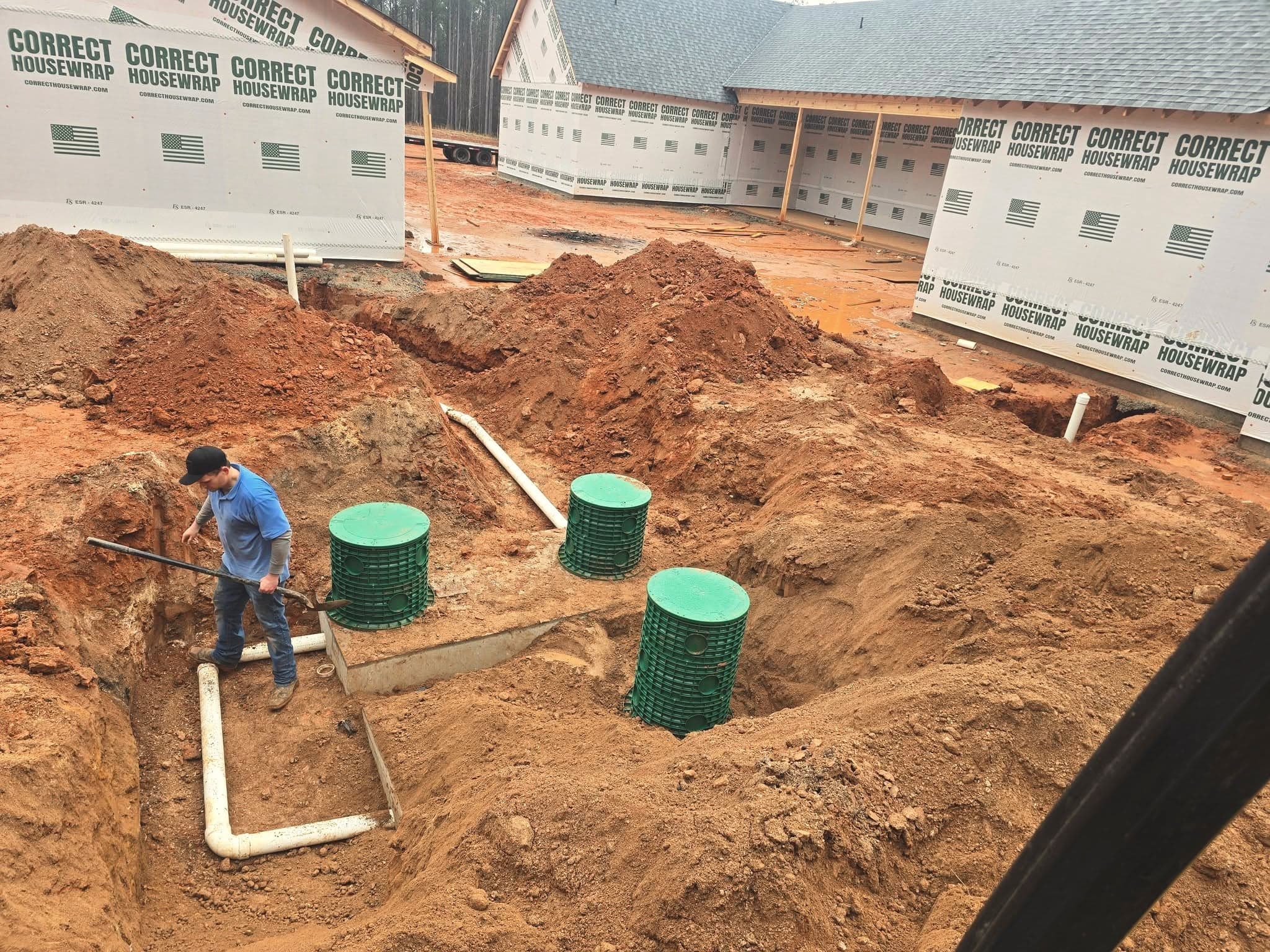
From our job files.

Warning signs

Signs your tank is overdue

Any one of these can mean the tank is full or the outlet is blocked. Two or more together, and it's time to pump before it's time to repair.

Seeing two or more? Call (678) 863-5620

  • 1. Slow drains through the whole houseOne slow sink is a plumbing clog. Every fixture slowing at once points to the tank or the line out to it.
  • 2. Gurgling toilets or drainsAir pushed back through the plumbing as the tank or outlet struggles to take flow.
  • 3. Sewage odor near the tank or fieldGases normally vent through the house plumbing vent. Smell at ground level near the lids or field says something is backed up or open.
  • 4. Wet, soggy or greener grass over the fieldEffluent reaching the surface is a violation of Rule 511-3-1-.17(1) and can mean solids have already reached the field.
  • 5. Alarm on a pump tank or aerobic unitAn alarm isn't always a full tank, but it always needs a look. See septic alarm going off.
  • 6. You don't know the last pump dateIf it's past 5 years or unknown, measure it. That's the cheapest way to find out.

How the job runs

What a proper Georgia pump-out includes

Georgia DPH's septage-removal standards (Manual Section I) spell out the minimum. Here's how a visit runs, step by step, and why each step is there.
  1. 1

    Find the tank and every lid

    We start with your county permit drawing if you have one; permit records often show the tank location. Then we probe and dig to the lids. Georgia tanks must have access openings over the inlet and outlet tees and over each compartment, so there's usually more than one lid to uncover.

    DPH Manual D, septic tank access openingsGeorgia DPH Manual for On-Site Sewage Management Systems (2026), incl. Section I Septage Removal and Disposal

  2. 2

    Open through the lids, never through the tank

    DPH says access to the tank contents is by removing the lids or access ports. Pumpers who break holes in a tank or lid face permit suspension or revocation. A riser lid at grade is the easy version of this step.

    DPH Manual I.2.CGeorgia DPH Manual for On-Site Sewage Management Systems (2026), incl. Section I Septage Removal and Disposal

  3. 3

    Pump every compartment, not just the outlet side

    The first compartment holds most of the sludge, and it's at least two-thirds of the tank. Pumping only through a riser over the outlet or effluent filter leaves the worst of it behind. Georgia defines septage removal as the complete removal of liquid, sludge and scum, so we pump each compartment through its own opening.

    DPH Manual I.2.D; Rule 511-3-1-.05(4)Georgia DPH Manual for On-Site Sewage Management Systems (2026), incl. Section I Septage Removal and Disposal

  4. 4

    Check the inlet and outlet tees

    The tees keep scum and sludge in the tank. DPH requires the pumper to inspect them for blockage and damage and to notify the owner in writing if they're missing or damaged. Missing or damaged tees should be replaced.

    DPH Manual I.2.EGeorgia DPH Manual for On-Site Sewage Management Systems (2026), incl. Section I Septage Removal and Disposal

  5. 5

    Clean the effluent filter

    Georgia requires an approved filter on the outlet end of the tank. We pull it, rinse it back into the tank (never onto the yard) and reseat it. A clogged filter can back the house up even when the tank isn't full.

    Rule 511-3-1-.05(1)Georgia DPH Rules Chapter 511-3-1, On-Site Sewage Management Systems (Jan 2016)

  6. 6

    Put the yard back

    DPH requires excavated soil to be replaced. If the lids are deep, this is the moment to talk about risers so the next visit doesn't start with a shovel.

    DPH Manual I.2.FGeorgia DPH Manual for On-Site Sewage Management Systems (2026), incl. Section I Septage Removal and Disposal

  7. 7

    Write it up and haul it legally

    The pumper gives the owner written notes on the tank's condition, including damage or missing parts, with a copy to the local Environmental Health office, and keeps a manifest of where the load was serviced and where it was disposed of. Septage goes only to a treatment plant, a septage facility or a permitted land site regulated by Georgia EPD.

    DPH Manual I.2.G–H, I.3Georgia DPH Manual for On-Site Sewage Management Systems (2026), incl. Section I Septage Removal and Disposal

Permits & the Georgia rules

Who's allowed to pump a septic tank in Georgia

The homeowner doesn't pull a permit for a routine pump-out; the pumper carries the permits. DeKalb Public Health says a pump-out alone needs no permit, and only a DPH-certified contractor may pump the tank. Here's what the pumper must hold.
  1. 01

    The pumping company files for a septage removal permit in the county where its base of operations is located, at least 10 days before it starts pumping.

  2. 02

    The application shows how septage is removed, transported and disposed of, with written acceptance from a treatment plant, septage facility or permitted land site.

  3. 03

    The permit is valid for 12 months and can be denied, suspended or revoked if removal and disposal don't follow Chapter 511-3-1.

  4. 04

    Individual pumpers must hold DPH certification, renewed every two years with continuing education.

  5. 05

    Check any pumper against the DPH Approved Septic Tank Pumper list; ours is listed, dated 9/18/2026.

Georgia rule 511-3-1-.11(1)

No person shall engage in the removal or disposal of the contents of septic tanks… without having first obtained a septage removal permit
Read the rule

Georgia rule 511-3-1-.16(1)

No person shall perform services as a… sewage pumper unless that person is currently certified by the Department
Read the rule

Georgia rule 511-3-1-.17(2)

The property owner shall be responsible for properly operating and maintaining the on-site sewage management system
Read the rule

How it varies by county

  • DeKalb

    DeKalb Public Health: a pump-out alone needs no permit, and only a DPH-certified contractor may pump the tank.

  • Walton

    An existing-system evaluation (refinance, purchase, pool, bedroom addition) requires proof the tank was pumped within the last 5 years.

  • Gwinnett

    Gwinnett DWR advises pumping and inspection every 3 to 5 years and credits pumping on the stormwater utility fee. GNR Environmental Health investigates complaints of failing systems in Gwinnett, Newton and Rockdale.

  • Jasper

    Jasper County Environmental Health advises pumping about every 3 to 5 years for an average family (2–4 people on a 1,000-gallon tank) and discourages additives.

Worth knowing

Lids, risers and the effluent filter

On older metro Atlanta tanks the lids are often a foot or more under the lawn, and nobody remembers where. Finding and uncovering them is a real part of the job. Angi's Atlanta cost page says a hard-to-access tank can add $200 to $300. That's why the first question we ask is whether you have the county's permit drawing.

Current Georgia standards require a riser on any tank with more than 12 inches of soil cover, bringing access within 12 inches of the surface. Riser lids must be secured against unauthorized opening, either by weight on concrete lids or by stainless fasteners on plastic ones, and the whole assembly has to keep surface water out. Many older tanks were set before that standard and have none.

Adding risers during a pump-out makes sense because the lids are already uncovered. The catch is to put a riser over every compartment opening, not only over the outlet. A lone riser over the effluent filter is convenient for filter cleaning. It tempts a quick pump-out through the outlet side that never reaches the first compartment, where most of the sludge sits.

The effluent filter is the part owners forget. It's required on Georgia tanks, and when it plugs, water backs up into the house even though the tank has room. Cleaning it at every pump-out is standard. Aerobic units and pump tanks have more parts; see our aerobic septic maintenance guide.

If a pump-out turns up a broken tee, a cracked lid or a field that floods back into the tank, you don't have to start over with someone else. We're also on the DPH certified installer list, so the crew that pumped the tank can permit and dig the repair. It's one outfit from the house drain to the far end of the field.

On older metro Atlanta tanks the lids are often a foot or more under the lawn, and nobody remembers where.

Your options

Additives, garbage disposals and what not to flush

What goes into the tank decides how soon it fills. These are the three questions we get most, with what Georgia's agencies say.

OPTION 01

Septic additives

When it fits: Never needed. DPH says a system needs only the bacteria it receives from wastewater.

  • None per Georgia DPH: it calls additives "not beneficial"
  • Biological additives can break solids into particles that stay suspended and flow to the drain field
  • Acids in some chemical additives can corrode concrete tanks and distribution boxes
  • Georgia rule bans strong bases, acids and organic solvents in system operation

DPH's advisory is blunt: additives never eliminate the need for regular inspection and pumping. More in our septic additives guide.

OPTION 02

Garbage disposals

When it fits: Only with a tank sized for it. Georgia requires 50% more tank capacity when a garbage grinder is used.

  • Convenient in the kitchen
  • UGA Extension notes disposals increase pumping needs
  • Gwinnett County recommends avoiding them on septic
  • An undersized tank with a disposal fills with solids fast

OPTION 03

What not to flush or pour

When it fits: Every day. UGA Extension's list covers most of what we pull out of tanks.

  • Keeps the scum layer thin and the filter clear
  • Cooking oil and grease, coffee grounds, eggshells, bones and vegetable scraps
  • Paper towels and hygiene products
  • Household chemicals, paint, kitty litter and cigarette butts

Gwinnett also advises conserving water so the tank isn't overloaded, and pointing rainfall runoff away from the tank and field.

Homes & businesses

Home tanks versus commercial tanks

Residential

Homes

A typical three-bedroom, two-bath home often has a 1,000-gallon tank, per UGA Extension, and that's Georgia's minimum for up to four bedrooms. Newer tanks have two compartments; older ones may have one. Either way, the whole tank gets pumped.

In Gwinnett County, save the receipt: a dated receipt or paid invoice from a licensed hauler is what DWR's credit program asks for. More in our Gwinnett stormwater credit guide.

  • Pump every 3–7 years, sooner with a disposal or a full house
  • Clean the effluent filter every visit
  • Add risers while the lids are open

Commercial

Churches, shops and commercial septic

Commercial tanks are sized to daily flow, so pumping intervals depend on use: a church that fills on Sundays and a shop with a staff bathroom load a tank very differently. We set the schedule from measured sludge and scum, not a calendar guess.

Food service is its own category. Grease interceptors on public sewer run on local ordinances with fixed pumping intervals; talk to us about the sewer lines and laterals those connect to.

Commercial septic and sewer service

What it costs

What septic tank pumping costs around Atlanta

Published ranges vary widely by source, which is itself useful: it tells you how much tank size, access and condition move the bill. All figures below are third-party typical market ranges.

What moves the price

These are typical market ranges published by third parties (Angi, HomeGuide and Septic & Well Pro, 2026), not our prices. We give free on-site estimates, and we'll tell you before we dig for lids.

Free estimate: (678) 863-5620
  1. 01Tank sizePumping is priced by the gallon in many markets; a 1,500-gallon tank simply holds more.
  2. 02Finding and digging the lidsDeep or unknown lids add time. Risers take that cost off every future visit.
  3. 03Time since the last pump-outCompacted sludge and thick scum take longer to break up and remove.
  4. 04Grease loadAngi notes excess fats, oils and grease can add $200 to $800 in Atlanta.
  5. 05Disposal feesHaulers pay to discharge; the City of Monroe, for example, charges septic haulers $0.30 per gallon in its 2026 rates.

Where we do this

SEPTIC TANK PUMPING across the east metro

Every county runs its own permits and utilities. Start with your county's rules, or jump to your town.

FAQ

Septic tank pumping questions

Straight answers, with the rule or record behind them. Still unsure? Call and ask the crew that digs.

(678) 863-5620

Should both compartments of my septic tank be pumped?

Yes. Georgia DPH defines septage removal as the complete removal of the liquid, sludge and scum, and tanks must have access openings over each compartment for that reason. The first compartment holds at least two-thirds of the tank and most of the solids. Pumping only through an outlet-side riser leaves it behind.

Source: Georgia DPH Manual for On-Site Sewage Management Systems (2026), incl. Section I Septage Removal and Disposal

Do septic tank additives mean I can pump less often?

No. Georgia DPH's additives advisory answers that question with "Positively not!" Biological additives can break solids into small particles that stay suspended and flow to the drain field, where they can cause clogging. DPH says additives never eliminate the need for regular inspection and pumping.

Source: Georgia DPH — Don't Flush Your Money Down the Drain: Additives and Your On-site Sewage Management System

How do I get Gwinnett County's septic pumping credit?

Gwinnett DWR gives a 10 percent stormwater utility fee credit for five years when you pump your tank. Apply with the Stormwater Credits Application Form and a receipt from a licensed hauler, or call DWR at 678.376.7193. Total credits cap at 40 percent per property. If a city bills your stormwater fee instead of the county, ask the city.

Source: Gwinnett County DWR — Stormwater Utility Fee Credits

Does a garbage disposal change how often I pump?

It does. Georgia's rules require 50% more tank capacity when a garbage grinder is used, UGA Extension notes disposals increase pumping needs, and Gwinnett County recommends avoiding them on septic. If your tank wasn't upsized for the disposal, plan on a shorter interval.

Source: Georgia DPH Rules Chapter 511-3-1, On-Site Sewage Management Systems (Jan 2016)

What should I get in writing after a pump-out?

Georgia DPH requires the pumper to give you written documentation of the tank's condition, including any damage or missing parts, with a copy to the local Environmental Health office. Missing or damaged tees must be reported in writing. Keep the dated record for resale, county evaluations and, in Gwinnett, the stormwater credit.

Source: Georgia DPH Manual for On-Site Sewage Management Systems (2026), incl. Section I Septage Removal and Disposal

Do I need risers on my septic tank?

New Georgia installs need a riser wherever the tank has more than 12 inches of soil cover. Older tanks often have none, which means digging at every visit. Risers go on most easily while the lids are already uncovered for a pump-out. Put one over each compartment opening so the whole tank can be pumped.

Source: Georgia DPH Manual for On-Site Sewage Management Systems (2026), incl. Section I Septage Removal and Disposal

Can I find out when my tank was last pumped?

Start with your own records and the previous owner. The county Environmental Health office keeps the original permit and, under DPH's pumping standards, receives a copy of each pumper's condition report. Our guide to finding septic permit records walks through it. If the date is unknown, we measure the sludge.

Source: Georgia DPH Manual for On-Site Sewage Management Systems (2026), incl. Section I Septage Removal and Disposal

How can I check that a pumper is certified in Georgia?

Georgia requires sewage pumpers to be certified by the Department of Public Health and to hold a county septage removal permit. DPH publishes an Approved Septic Tank Pumper list; ours appears on the list dated 9/18/2026. Our contractor verification guide shows how to check anyone.

Source: Georgia DPH Approved Septic Tank Pumpers list (dated 9/18/2026)

Sources

Where these facts come from

Rules, costs and local facts on this page link to the agency, code or publisher that states them. Cost figures are third-party market ranges, not our prices — estimates are free.

Reviewed by Atlanta Water & Sewage Solutions · Last updated

  1. 1Georgia DPH Rules Chapter 511-3-1, On-Site Sewage Management Systems (Jan 2016) (2016)
  2. 2Georgia DPH Manual for On-Site Sewage Management Systems (2026), incl. Section I Septage Removal and Disposal (2026)
  3. 3Georgia DPH Approved Septic Tank Pumpers list (dated 9/18/2026) (2026)
  4. 4Georgia DPH Certified Septic Tank Installers list (dated 9/18/2026) (2026)
  5. 5Georgia DPH — Don't Flush Your Money Down the Drain: Additives and Your On-site Sewage Management System
  6. 6UGA Extension Bulletin B1421, septic system care (rev. Oct 18, 2024) (2024)
  7. 7Gwinnett County DWR — Septic Tanks (2026)
  8. 8Gwinnett County DWR — Stormwater Utility Fee Credits (2026)
  9. 9DeKalb Public Health — Septic Systems (2026)
  10. 10Walton County Environmental Health — Service Request Form (Northeast Health District) (2023)
  11. 11North Central Health District — Jasper County Environmental Health
  12. 12GNR Public Health — Septic Systems (Gwinnett, Newton & Rockdale) (2026)
  13. 13City of Monroe Wastewater Rates 2026 (septic hauler discharge) (2026)
  14. 14Angi — How Much Does It Cost to Pump a Septic Tank in Atlanta? (updated May 5, 2026) (2026)
  15. 15HomeGuide — How Much Does Septic Tank Pumping Cost? (2026 data) (2026)
  16. 16Septic & Well Pro — Septic Pumping Cost Georgia 2026 (updated April 10, 2026) (2026)

Ready when you are

Need septic tank pumping? Call the crew that digs.

Georgia's health department defines a pump-out as removing all the liquid, sludge and scum through the tank's lids, then checking the tees and writing up what was found. That's the job we do as a DPH-approved septic tank pumper, and we'll help you set a schedule so the next one isn't an emergency.

(678) 863-5620
  • Georgia DPH-certified installer & pumper
  • Residential & commercial
  • Oxford, GA

Property type
What do you need?
Rather talk? (678) 863-5620
Where's the property?
Is sewage backing up inside? (optional)
Who should we call?

By submitting, you agree we may call or text you about this request. Msg & data rates may apply. Reply STOP to opt out. SMS terms.

Call nowFree Estimate