24/7 Emergency? (678) 863-5620

SEWER CAMERA INSPECTION · METRO ATLANTA

Sewer camera inspection in metro Atlanta — see it before we dig

A camera run down your sewer lateral shows the root mass, the sag or the crushed joint, and marks where it sits in the yard and how deep. That's the difference between digging one hole and trenching the whole front lawn.
  • Georgia DPH-certified installer & pumper
  • Residential & commercial
  • Emergency line answered 24/7

Get a free estimate

or call (678) 863-5620

Property type
What do you need?
Rather talk? (678) 863-5620
Where's the property?
Is sewage backing up inside? (optional)
Who should we call?

By submitting, you agree we may call or text you about this request. Msg & data rates may apply. Reply STOP to opt out. SMS terms.

The short answer

What does a sewer camera inspection show?

A sewer camera inspection pushes a video camera through a building drain or sewer lateral to show roots, cracks, offset joints, sagging bellies and crushed or deformed pipe, and to locate the problem's position and depth. Atlanta Water & Sewage Solutions, a sewer and septic contractor in Oxford, GA, scopes the line before any metro Atlanta repair decision.

Reviewed by Atlanta Water & Sewage Solutions · Last updated

Key facts

Sewer camera inspection: the short version

Each row links to the agency, code or publisher it comes from. Tap a source to check it yourself.

What a sewer video inspection finds, what it costs on the open market, and who owns the pipe it looks at.
TopicWhat it saysSource
Typical market range$125 to $500 for a sewer camera inspection (typical market range per HomeGuide, 2025; not our price).HomeGuide — Sewer Camera Inspection Cost (Dec 19, 2025), 2025
No cleanout on the house$175 to $750, because the toilet is pulled and reset to reach the line (HomeGuide, 2025).HomeGuide — Sewer Camera Inspection Cost (Dec 19, 2025), 2025
Defects an inspection standard says to reportVisible cracks, root intrusion, offsets over ¼ inch, more than 1 inch of standing water, blockages, crushed or broken pipe.InterNACHI — Sewer Scope Inspection Standards of Practice
LocatingDrain cameras carry a transmitter so the problem can be pinpointed from above ground.HomeGuide — Sewer Camera Inspection Cost (Dec 19, 2025), 2025
Orangeburg pipeFiber-and-tar pipe that flattens under soil load and loses its round cross-section; Ann Arbor estimates its local use at roughly the early 1950s to early 1970s.City of Ann Arbor — Orangeburg Sewer Piping
Who owns the lateral (Gwinnett example)The property owner maintains the entire lateral, including the connection to the public sewer.Gwinnett County DWR — Sewer Lateral Ownership and Responsibility
Permit needed for the camera itself?No. Permits come in when the video leads to excavation or a connection change (local utility and plumbing rules).DeKalb County Planning & Sustainability — Watershed Packet (revised 5/6/25), 2025

Plain definitions

What the words on a sewer video report mean

Sewer camera inspection
A sewer camera inspection is a recorded video survey of a drain or sewer pipe made by pushing a waterproof camera on a flexible cable through the line from a cleanout or fixture.
Building drain
The building drain is the pipe under or inside the house that collects every fixture and carries it out through the foundation.
Sewer lateral
The sewer lateral is the buried pipe from the house to the public sewer main, or to the septic tank on a septic lot.
Cleanout
A cleanout is a capped riser pipe that gives straight access into the sewer line for cameras and clearing tools.
Offset joint
An offset is a joint where two pipe sections have shifted so their ends no longer line up, leaving a lip that catches paper and waste.
Belly
A belly is a sag in the pipe where the grade reverses, so water and solids sit in the low spot instead of draining.
Sonde / locating transmitter
A sonde is the transmitter in or behind the camera head whose signal is traced from the surface to mark the pipe's position and depth.

Warning signs

When you need a camera in the line

A camera inspection isn't a routine chore. It earns its cost at specific moments: when a line keeps failing, when you're about to own it, or when a repair is about to start.

Recurring clogs or buying an older home? Call (678) 863-5620

  • 1. The same drain clogs again within monthsSnaking clears the symptom. Repeat clogs usually mean something in the pipe keeps catching waste: a root mass, an offset joint or a belly.
  • 2. You're buying a house built before PVC laterals were standardHomeGuide says a sewer scope is recommended for homes older than 20 years, and it typically isn't part of a standard home inspection.
  • 3. Sewage backed up into the houseAfter the cleanup, a camera tells you whether the cause was a one-time blockage or a broken pipe that will do it again.
  • 4. Wet or sunken strip between the house and the streetA soft line in the lawn that follows the sewer route often sits over a break leaking into the soil.
  • 5. Before any sewer repair is pricedNo one should quote a dig, a spot repair or a full replacement on a line they haven't seen from the inside.
  • 6. Septic tank backing up at the house but the tank isn't fullIf the tank level is normal, the trouble may be in the inlet line between the house and the tank, which a camera can follow.

The whole story

What the video actually shows

The camera sees the inside wall of the pipe and not much else, but that's where nearly every sewer problem starts. Here is what we look for, and what each finding means for the fix.

**Roots.** Roots find a hairline crack or a loose joint and follow the moisture in. On video they show up as a curtain of fine hair at a joint, or a solid mass that stops the camera. HomeGuide notes root intrusion is common in older cast-iron and clay lines and less common in PVC. Where roots enter tells you where the joint has failed.

**Offsets.** Clay and cast-iron sections come in short lengths, so an old lateral has a joint every few feet. When soil settles, those joints shift. The InterNACHI sewer scope standard treats an offset over ¼ inch as needing correction. A single offset near the house is a small dig; offsets all the way to the street tell a different story.

**Bellies.** A belly shows as water pooled in the pipe with the camera half-submerged. The standard flags more than 1 inch of standing water. Bellies collect paper and grease and are the usual cause of a drain that clogs every few months no matter how often it's cleared.

**Cracks, breaks and crushed pipe.** Longitudinal cracks, missing pieces and pipe squeezed out of round, often where a driveway, a tree or a past utility dig loaded the line.

**Orangeburg deformation.** Orangeburg is a bituminous fiber pipe, plant fiber and asbestos soaked in tar. The City of Ann Arbor describes it flattening under earth pressure as it deteriorates, and notes inspectors have seen pipe that still looked round outside while the inside had gone out of round. On video it reads as an oval, blistered or delaminating wall. Orangeburg doesn't get spot-repaired well; when you see it, plan on replacing that run.

**Material changes.** Older laterals are often a patchwork: cast iron through the foundation, clay or Orangeburg across the yard, a PVC section where someone fixed a break years ago. The video shows where each change happens, which is often where the next failure is.

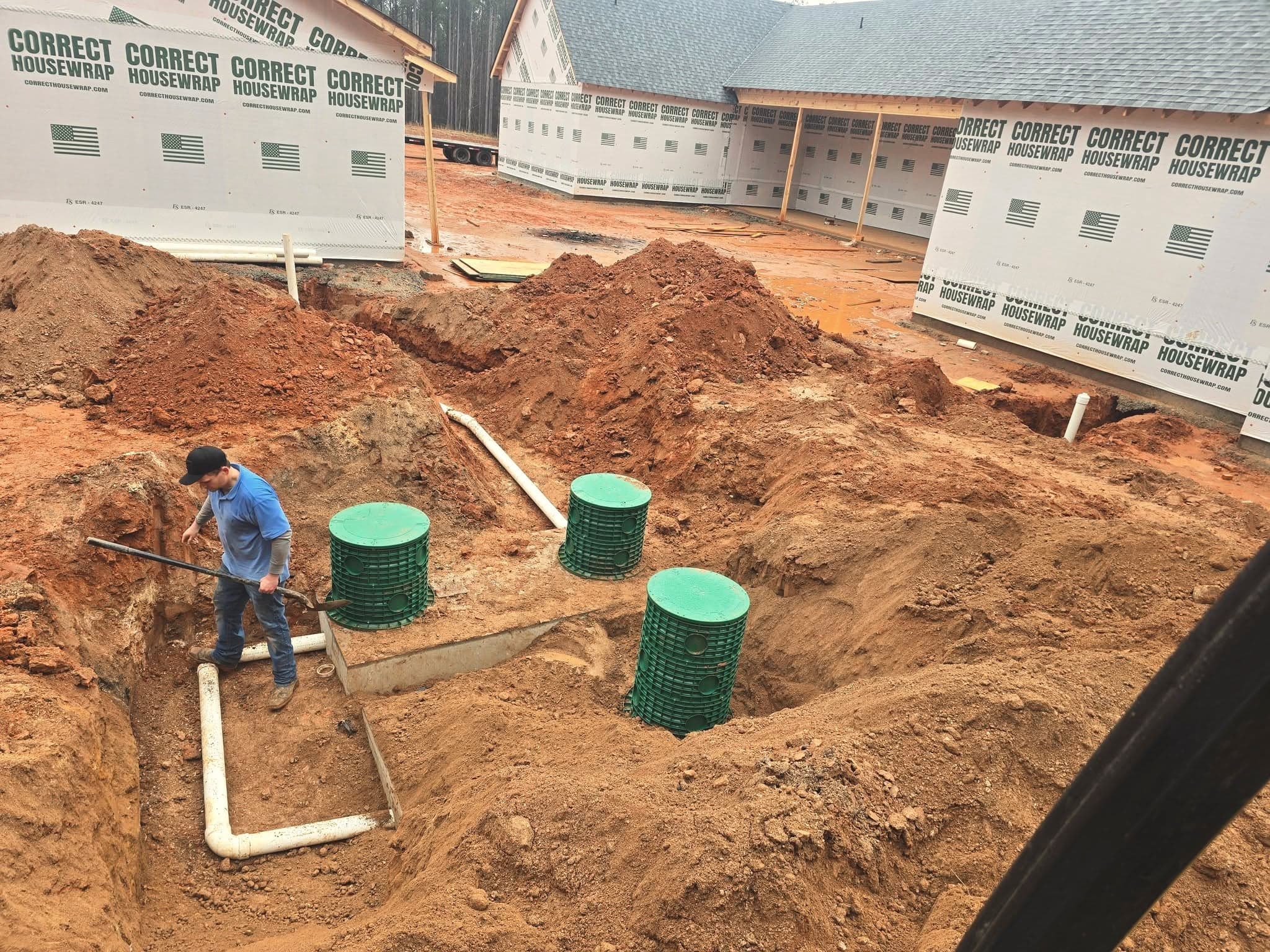
From our job files.

Worth knowing

Locating: why the camera decides where the hole goes

Finding a defect is half the job. The other half is knowing where it is from the top of the ground. Drain cameras carry a transmitter, and a receiver traced over the yard marks the camera head's position and depth. HomeGuide describes the same thing: the transmitter lets the problem be pinpointed from above ground.

The camera cable also counts footage from the cleanout. Put the footage and the locate together and you get a paint mark on the lawn with a depth written next to it. In practice that answers the questions that drive the price of a sewer repair: Is the break under the driveway or beside it? Is it 3 ft down or 8 ft down in red clay? Is it on your side of the right-of-way or the utility's?

That last question matters in money. In Gwinnett, the owner maintains the whole lateral including the connection to the county sewer. In Rockdale, the county's side ends at the street right-of-way, and the cleanout there belongs to you. A marked, measured video is how you settle it without arguing.

Then the same crew that located it can dig it. We do the excavation, the spot repair or the replacement, and the backfill, so the paint mark from the camera run turns straight into a trench of the right length in the right place, not a second company re-diagnosing the line.

Finding a defect is half the job.

Your options

After the video: the three decisions it usually leads to

A camera inspection is diagnostic. It doesn't fix anything, and HomeGuide notes its cost doesn't include repairs. Here's how findings typically sort out.

OPTION 01

Clear and monitor

When it fits: Soft blockage, light root hair at one joint, or grease buildup in otherwise sound pipe.

  • Least disruptive
  • No excavation
  • Video baseline for next time
  • Roots come back through the same joint
  • Doesn't fix a belly or an offset

Clearing may mean snaking or hydro-jetting; ask us and we'll tell you how that gets done on your line.

OPTION 02

Spot repair

When it fits: One broken section, a single bad offset or one root-entry joint in pipe that's otherwise in decent shape.

  • One excavation at the marked spot
  • Keeps sound pipe in place
  • Faster yard recovery
  • Leaves older pipe on either side
  • Not worth it if defects repeat down the line

OPTION 03

Replace the run

When it fits: Orangeburg, repeated offsets, long bellies, or breaks at several points along the lateral.

  • New pipe at a proper grade
  • Ends the repeat-call cycle
  • Cleanout added if missing
  • Biggest excavation
  • Permits and utility coordination more likely

We excavate and replace. If a trenchless method might fit your line, it's an option we'll talk through with you. See sewer line repair.

How the job runs

How we scope a sewer line

  1. 1

    Find the access point

    Usually an outside cleanout. Gwinnett laterals may have one at the right-of-way and one near the house. With no cleanout, access comes through a toilet flange or roof vent, which is slower.

    Gwinnett County DWR — Sewer Lateral Ownership and Responsibility

  2. 2

    Clear it if the camera can't pass

    A heavy blockage stops the camera cold. The line has to be opened before the video can go past it, then scoped again.

    HomeGuide — Sewer Camera Inspection Cost (Dec 19, 2025)

  3. 3

    Run the line and record

    The camera goes from the access point toward the main or the septic tank, recording the full run while footage is counted from the start.

  4. 4

    Locate every finding

    At each defect we stop, trace the transmitter from the surface and mark position and depth on the ground.

  5. 5

    Identify the material

    Cast iron, clay, Orangeburg, PVC, ABS: we note each transition, because the repair method depends on what the pipe is.

    InterNACHI — Sewer Scope Inspection Standards of Practice

  6. 6

    Walk you through it

    You see the video, the marks on the lawn and a plain-language summary: what's wrong, where, how deep, whose side of the property line, and what we'd recommend.

  7. 7

    Estimate the fix on the spot

    If a repair is needed, we give you a free estimate for the dig, the repair and the backfill, and tell you whether it needs a utility or county permit.

Who owns what

Whose pipe is on the video?

The camera doesn't stop at your property line, but your responsibility might. These are the published rules for utilities around our Oxford base.
Cross-section: house, building drain, sewer lateral, cleanout, property line, tap and public sewer mainSTREETPROPERTY LINECLEANOUTTAPPUBLIC SEWER MAINSEWER LATERALBUILDING DRAINPROPERTY OWNERUTILITY
Green = sewer (APWA uniform color code)Typical handoff here: Property line
  • Gwinnett County DWR

    The owner maintains the entire lateral, including the connection to the public sewer. A cleanout at the right-of-way is the county's; one nearer the house is the owner's.

    Where the line sits: Connection to the public sewer

  • Gwinnett County DWR (blockages)

    DWR clears blockages in the main or the right-of-way part of the lateral; if the only blockage is in the right-of-way, the owner may file a reimbursement claim, but DWR must see the excavated lateral before repair.

    Where the line sits: Right-of-way

  • Newton County Water & Sewerage Authority

    The owner maintains the private sewer service line from the building to the connection with the public main; since 2021 customers pay to clear blockages from the building through the tap.

    Where the line sits: Tap at the main

  • City of Covington

    Customers maintain and keep clean the sewer pipes from their plumbing to the city street line or the sewer main, whichever is nearer.

    Where the line sits: Street line or main, whichever is nearer

  • Rockdale Water Resources

    The county maintains service lines from the main to the right-of-way; the customer owns the line from there to the building, including the required right-of-way cleanout.

    Where the line sits: Right-of-way cleanout

  • DeKalb County Watershed Management

    The owner maintains the building sewer connection on private property; the county maintains it within county rights-of-way and sewer easements.

    Where the line sits: Property line / right-of-way

  • City of Monroe

    The building sewer runs from the building drain to the public sewer; owners bear its installation and connection costs and maintain connections serving their utility service.

    Where the line sits: Public sewer main

Permits & the Georgia rules

When the video turns into a dig: permits to expect

Scoping a line needs no permit. The repair it points to may. Which one depends on whether the line goes to a public sewer or to a septic tank.
  1. 01

    Sewered lot in DeKalb: a plumbing permit by a licensed sewer or plumbing contractor is required before a private sewer line is installed.

  2. 02

    Monroe: a city permit is required to connect to or open any public sewer.

  3. 03

    Gwinnett: if the break may be in the right-of-way and you want to claim reimbursement, DWR has to see the excavated lateral before it is repaired.

  4. 04

    Septic lot: if the camera traces the problem into the tank or field, that repair is permitted and inspected by county Environmental Health under 511-3-1.

Georgia rule 511-3-1-.03(2)(c)

Repairs, replacement, or additions to existing systems must be permitted and inspected.
Read the rule

Georgia rule 511-3-1-.03(1)(a)

Connection shall be made to a public or community sewage treatment system if such system is available within two hundred feet (200') of the property line…
Read the rule

How it varies by county

  • Newton County

    NCWSA customers own the line from the building through the tap, so a break found anywhere along the run is usually the owner's repair.

  • Rockdale County

    The right-of-way cleanout required by county code is the natural camera entry point and the ownership marker.

  • Gwinnett County

    DWR runs its own cameras and smoke tests on public lines and notifies owners if a defect is found on their property.

Worth knowing

Camera work on septic lots

On a septic lot there is no city main at the end of the pipe, but the building drain and the line to the tank fail the same ways a sewer lateral does. When a house backs up and the tank level is normal, the problem is often upstream of the tank: a root-choked joint, a sag or a broken pipe under a patio.

A camera run from the house cleanout toward the tank answers that, and the locate can also help find a buried tank inlet on a property with no records. If the video shows the pipe is fine all the way to the tank, attention moves to the tank's inlet baffle. The DPH Manual notes that deteriorated baffles or tees often end up on the tank floor. From there it becomes a septic inspection question, not a sewer question.

From our job files.

Homes & businesses

Houses vs commercial buildings

Residential

Homes

A typical residential scope is a single lateral run from one cleanout to the street or the tank. The questions are simple: what's wrong, where is it, and is it mine?

Buying a house? A scope before your due-diligence period ends gives you a video to negotiate with instead of a guess.

  • Recurring clogs
  • Pre-purchase scope
  • Post-backup diagnosis

Commercial

Restaurants, retail and multi-unit

Commercial lines are longer and often larger, with more connections and more grease. Grease buildup narrows the pipe and can hide defects until the line is cleared.

Scheduling around business hours matters as much as the video itself; tell us your hours and we'll plan the work around them.

  • Grease-heavy laterals
  • Multiple tie-ins
  • Planning around open hours
Commercial sewer repair

What it costs

What a sewer camera inspection typically costs

These are published third-party market ranges, not our prices. We give free on-site estimates for any repair the video points to.

What moves the price

Ranges above are published third-party typical market ranges (HomeGuide, Septic & Well Pro), not Atlanta Water & Sewage Solutions prices. Call (678) 863-5620 for a free on-site estimate.

Free estimate: (678) 863-5620
  1. 01AccessAn outside cleanout is fastest. No cleanout means working through a toilet or vent, which is why HomeGuide's no-cleanout range runs higher.
  2. 02Blockage firstIf the line is packed, it has to be opened before the camera can pass.
  3. 03Line length and depthLong rural laterals and deep lines take longer to run and to locate.
  4. 04What you need on paperA recorded video and marked locate for a buyer or a utility claim takes more time than a quick look.

FAQ

Sewer camera inspection questions

Straight answers, with the rule or record behind them. Still unsure? Call and ask the crew that digs.

(678) 863-5620

Is a sewer scope worth it before buying a house in metro Atlanta?

On an older house, usually yes. HomeGuide recommends a sewer inspection for homes older than 20 years and notes a standard home inspection typically doesn't include one. HomeGuide puts a 40-ft sewer line replacement at $2,000 to $10,000; a scope costs a fraction of that and gives you a video to negotiate with before your due-diligence period ends.

Source: HomeGuide — Sewer Camera Inspection Cost (Dec 19, 2025)

Can a camera tell if my pipe is Orangeburg?

Often. Orangeburg tends to show as an oval, blistered or delaminating wall where soil pressure has flattened it. The City of Ann Arbor notes a video scan may give clues sufficient to identify the pipe type. It isn't always certain; sometimes confirmation comes when the pipe is exposed.

Source: City of Ann Arbor — Orangeburg Sewer Piping

How deep can the camera locate my sewer line?

The transmitter in the camera head is traced from the surface to mark position and depth at each defect. Depth varies from lot to lot and along a single run; the locate tells you the actual depth at your problem spot, which is what drives the size and cost of the dig.

Source: HomeGuide — Sewer Camera Inspection Cost (Dec 19, 2025)

Will you give me the video?

Ask for a copy when you book, and we'll tell you how it's delivered. A recorded run with footage counts and marked locations is useful for a home purchase, for a Gwinnett right-of-way reimbursement claim, and for comparing quotes on the repair.

Why can't the camera get past the clog?

A camera needs an open pipe to travel through. A heavy root mass or a packed blockage stops it, and HomeGuide notes the scope can't move forward until the obstruction is cleared. The line gets opened first, then scoped again to see what caused the blockage.

Source: HomeGuide — Sewer Camera Inspection Cost (Dec 19, 2025)

Does the city or county pay if the break is on their side?

It depends on the utility. Gwinnett DWR clears blockages in the right-of-way portion and allows a reimbursement claim, but must see the excavated lateral before repair. NCWSA customers own the line through the tap at the main. A located video is the evidence either way.

Source: Gwinnett County DWR — Lateral policy homeowner handout

Is a sewer camera inspection different from a septic inspection?

Yes. A camera inspection looks inside pipes: the building drain and the line to the street or the tank. A septic inspection opens and pumps the tank, checks the baffles and distribution box, and probes the drain field. On a septic lot you sometimes need both.

Do I need a permit for a sewer camera inspection?

No permit is needed to scope a line. Permits come in when the video leads to work: DeKalb requires a plumbing permit before a private sewer line is installed, Monroe requires a city permit to open a public sewer, and septic repairs are permitted by county Environmental Health.

Source: DeKalb County Planning & Sustainability — Watershed Packet (revised 5/6/25)

Ready when you are

Need sewer camera inspection? Call the crew that digs.

A camera run down your sewer lateral shows the root mass, the sag or the crushed joint, and marks where it sits in the yard and how deep. That's the difference between digging one hole and trenching the whole front lawn.

(678) 863-5620
  • Georgia DPH-certified installer & pumper
  • Residential & commercial
  • Oxford, GA

Property type
What do you need?
Rather talk? (678) 863-5620
Where's the property?
Is sewage backing up inside? (optional)
Who should we call?

By submitting, you agree we may call or text you about this request. Msg & data rates may apply. Reply STOP to opt out. SMS terms.

Call nowFree Estimate