24/7 Emergency? (678) 863-5620

COMMERCIAL SEWER · SEPTIC · WATER LINES · METRO ATLANTA

Commercial sewer & septic — keep the doors open.

Georgia sizes a business septic system by the people it serves and the peak flow they create, and every repair is permitted and inspected by the county. We plan the dig, the permit and the backfill so the parking lot, the kitchen and the restrooms are down for as short a stretch as the work allows.
  • Georgia DPH-certified installer & pumper
  • Commercial properties
  • Emergency line answered 24/7

Get a free estimate

or call (678) 863-5620

Property type
What do you need?
Rather talk? (678) 863-5620
Where's the property?
Is sewage backing up inside? (optional)
Who should we call?

By submitting, you agree we may call or text you about this request. Msg & data rates may apply. Reply STOP to opt out. SMS terms.

The short answer

What does commercial septic service involve in Georgia?

Commercial septic service in metro Atlanta means permitted, inspected repairs on systems sized for a business's peak flow, planned to keep closures short. Georgia Rule 511-3-1 requires pretreatment for high-strength waste and engineer-sealed plans above 2,000 gallons per day. Atlanta Water & Sewage Solutions, a DPH-certified installer and pumper in Oxford, GA, handles the permit.

Reviewed by Atlanta Water & Sewage Solutions · Last updated

Key facts

Commercial systems in Georgia: the numbers that drive the job

Each row links to the agency, code or publisher it comes from. Tap a source to check it yourself.

Key Georgia rules, design flows and county fees for commercial sewer and septic work, each with its source.
TopicWhat it saysSource
Who must have a systemAny building designed for human occupancy or congregation without public sewer, sized for everyone who uses it for two hours or more (Rule 511-3-1-.03(1)).Georgia DPH Rules Chapter 511-3-1, On-Site Sewage Management Systems (Jan 2016), 2016
Engineer thresholdPlans for a system producing more than 2,000 gallons per day must carry a Georgia-licensed engineer's registration number and signature (Rule .03(6)).Georgia DPH Rules Chapter 511-3-1, On-Site Sewage Management Systems (Jan 2016), 2016
High-strength wasteBOD5 and TSS above 200 mg/L must be pretreated to 200 mg/L or below before a conventional or chamber system (Rule .03(1)(c)).Georgia DPH Rules Chapter 511-3-1, On-Site Sewage Management Systems (Jan 2016), 2016
Grease trap triggerRequired for commercial or industrial establishments on septic when the county expects grease above 50 mg/l (Rule .12).Georgia DPH Rules Chapter 511-3-1, On-Site Sewage Management Systems (Jan 2016), 2016
Conventional tank size rangeNo less than 1,000 and no more than 10,000 gallons of septic tank design capacity (Rule .03(5)).Georgia DPH Rules Chapter 511-3-1, On-Site Sewage Management Systems (Jan 2016), 2016
Commercial permit fee — Newton (GNR)Site Evaluation, Permit, and Initial Inspection — Commercial: $600 (effective Jan 1, 2026).GNR Environmental Health Fee Schedule — Newton County (effective Jan 1, 2026), 2026
Commercial permit fee — DeKalbCommercial installation permit: $400 under 2,000 GPD, $600 over 2,000 GPD (effective Jan 1, 2024).DeKalb Public Health Environmental Health Division Fee Schedule (effective January 1, 2024), 2024
Our certificationsListed by Georgia DPH as a Certified Septic Tank Installer and an Approved Septic Tank Pumper (lists dated 9/18/2026).Georgia DPH Certified Septic Tank Installers list (9/18/2026), 2026

Plain definitions

Commercial terms, in one sentence each

Design sewage flow
The gallons per day a commercial system must be built for, taken from the DPH sewage flow schedule and calculated on peak flow rather than long-term averages (Rule 511-3-1-.13).
High-strength wastewater
Wastewater whose BOD5 and total suspended solids run above 200 mg/L — typical of kitchens, food service and some clinics — which Georgia requires to be pretreated before it reaches a conventional or chamber system.
Grease trap (on septic)
A watertight tank that intercepts and congeals grease so it can be removed, with its effluent sent to a septic tank and never straight to the drain field (Rule 511-3-1-.12).
Building sewer
The private pipe that carries a building's wastewater from the building drain to the public sewer or to the septic tank; on a commercial lot it often runs under paving.
Engineered site plan
A sealed design prepared to DPH's Engineered Site Plan Checklist, required for any on-site system with a design flow above 2,000 gallons per day.
Equivalent residential unit (ERU)
A utility's yardstick for converting a business's sewer demand into house-sized units; Covington sets one residential ERU at 350 gallons per day when it calculates nonresidential sewer taps.

Start here

What changes by property type

A church and a diner can sit on the same road and need completely different systems. These notes come from the state's own sewage flow schedule and county rules — they explain how each property type is treated, not a list of jobs we've done.
  • 01

    Restaurants

    DPH's flow schedule assigns 50 gallons per day per seat to a restaurant open less than 24 hours and 75 per seat to one open 24 hours, so an 80-seat dining room is sized at 4,000 gpd on paper — past the 2,000 gpd engineer line. The schedule flags food service for pretreatment when BOD5 and TSS run above 200 mg/L, and the sewer utilities around here have their own grease rules. See our page on grease trap sewer lines.

    Restaurant sewer lines and grease
  • 02

    Churches

    The schedule counts sanctuary seats: 5 gpd per seat without a kitchen, 7 with one. A 300-seat sanctuary with a fellowship-hall kitchen works out to 2,100 gpd, just over the line where Rule .03(6) calls for engineer-sealed plans. Sunday peaks, not weekday averages, set the size.

  • 03

    Schools & daycares

    Day schools run 12 gpd per person with toilets only, 16 with a cafeteria and 20 with a cafeteria and gym. Daycares are 15 per person without meals and 20 with them. Gwinnett's FOG ordinance also reaches daycares and schools with commercial kitchens.

    Commercial septic repair
  • 04

    Offices & retail

    Office and shop workers are figured at 25 gpd each without showers, plus 5 with a kitchen. Freestanding retail and convenience stores use the larger of 400 gpd per restroom or 100 per toilet or urinal, and shopping centers 100 gpd per 1,000 ft² of enclosed space.

    Commercial sewer repair
  • 05

    Industrial & shop buildings

    Workers with showers and no industrial waste are figured at 35 gpd each. Process water is a different animal: any facility whose waste stream runs above 200 mg/L BOD5 and TSS must pretreat it before a conventional or chamber system. Wash bays and shop floor drains are exactly where that question comes up.

  • 06

    HOAs & multi-unit

    DPH's design basis for a central septic tank serving multi-family housing is 1,000 gallons per unit, with the absorption field sized on bedrooms. On sewer, each building or unit's private lateral usually belongs to the owner or association up to the point the utility's rules take over.

    Commercial water lines

Start here

Commercial services

Five commercial pages go deeper. Each one covers the Georgia rules, the local utility's ownership line and what the work looks like on a business lot.
  • 01

    Commercial sewer repair

    Broken or bellied building sewers, root intrusion and offset joints under parking lots and drive-throughs — located, excavated, repaired and inspected.

    Commercial sewer line repair
  • 02

    Commercial septic repair

    Failing tanks, distribution boxes, pumps and drain fields on churches, schools, shops and rural businesses, with the county repair permit handled for you.

    Commercial septic system repair
  • 03

    Commercial septic installation

    New systems for business lots off the sewer main, sized from the state flow schedule, permitted with Environmental Health and built to the approved design.

    Commercial septic system installation
  • 04

    Grease trap sewer lines

    The lines into and out of a grease interceptor, FOG-choked laterals and the local grease ordinances that decide what gets installed where.

    Grease trap sewer line repair
  • 05

    Commercial water lines

    Service lines from the meter to the building, larger-diameter runs and the trenching under pavement that comes with them.

    Commercial water line repair

The whole story

Why a business system fails differently than a house

A house on septic sends out a fairly steady, fairly weak stream. A business does neither. A church fills on Sunday morning and sits nearly empty Tuesday. A daycare runs 50 hand-washes and a lunch rush before noon. A restaurant pushes hot, greasy dishwater through the line right when the dining room is busiest. Georgia's rules are written around that: Rule 511-3-1-.13 says design flow is figured on peak flow and not on long-term averages. A system sized for the average day is the one that surfaces in the lot on Easter Sunday.

Strength matters as much as volume. The DPH manual notes that commercial septic effluent, such as a restaurant's, can be much stronger than a home's and clog the gravel-and-sand interface of a drain field faster, which is why the manual tells designers to lower loading rates for it. That is the reason Rule .03(1)(c) exists: above 200 mg/L of BOD5 and TSS, the waste has to be pretreated before it goes into a conventional or chamber system. On a failing commercial field, the first question we ask is not how big the new field should be — it's what has been going into the old one.

The other difference is the ground on top. Commercial laterals and tanks sit under asphalt, concrete aprons, dumpster pads and drive-through lanes. Every foot of trench means saw-cutting, hauling spoil and patching paving, and it means traffic has to go somewhere while the trench is open. That is where one crew for the whole run earns its keep on a business lot: the same outfit that finds the break digs it, repairs the pipe, calls in the county or utility inspection and backfills and compacts — so you aren't coordinating a locator, an excavator, a pipe contractor and a paving sub around your opening hours.

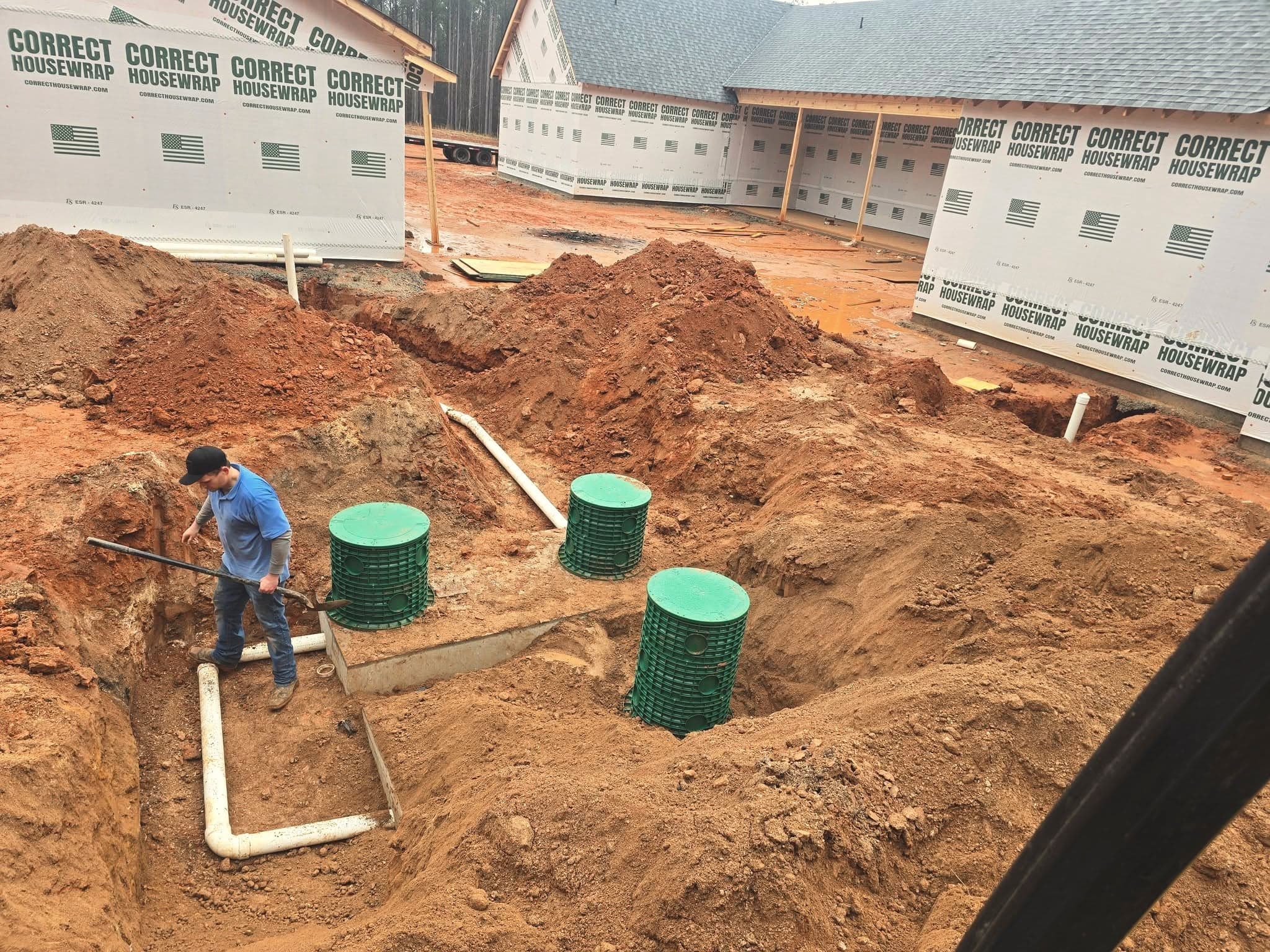
From our job files.

How the job runs

How a commercial job runs — scheduled around your business

Every commercial repair, replacement or addition to an on-site system is permitted and inspected by the county under Rule 511-3-1-.03. Sewer-side work answers to the city or county utility. Here is the order we work in.
  1. 1

    Free on-site estimate and a look at the records

    We walk the lot, find the cleanouts, tank lids and the route of the building sewer, and ask the questions that set the size: seats, meals, classrooms, employees, hours. If the county Environmental Health office has the original permit on file, the as-built drawing saves digging in the wrong place.

  2. 2

    Pin down the cause

    Slow restrooms can be a crushed lateral, a grease plug, a failed pump or a saturated field. Where a camera inspection of the line makes sense, we'll set it up and tell you what it shows before anyone digs.

  3. 3

    Design and permit

    For on-site systems we file the county permit application with the flow data Rule .03(2) asks for — the number of persons served or other sewage flow data. Above 2,000 gallons per day, the plans must be sealed by a Georgia-licensed engineer. In Gwinnett, Newton and Rockdale, GNR requires a Level 3 soil report for all septic permits.

    511-3-1-.03(2), .03(6)Georgia DPH Rules Chapter 511-3-1, On-Site Sewage Management Systems (Jan 2016)

  4. 4

    Schedule the disruption

    We plan trench routes, parking closures and any water or restroom shutoff with you in advance and schedule around your business hours wherever the permit and inspection calendar allows. If the repair can be staged — the lateral one day, the reconnection the next — we'll lay that out.

  5. 5

    Excavate, repair or replace

    Saw-cut and remove paving, dig to the pipe or tank, and do the work to the approved design: spot repair, full line replacement, tank or pump replacement, or new absorption field.

  6. 6

    Inspection before backfill

    Georgia bars backfilling or using an on-site system until the county has made a final inspection and issued written approval (Rule .03(4)). Utilities inspect sewer connections their own way — Monroe, for example, inspects new grease interceptors before backfill.

    511-3-1-.03(4)Georgia DPH Rules Chapter 511-3-1, On-Site Sewage Management Systems (Jan 2016)

  7. 7

    Backfill, compact, restore

    Compacted backfill under paving, a clean site and the paperwork you need for your records. In the company's own words: "We stand behind everything we do."

Permits & the Georgia rules

Georgia rules for commercial systems

The state rule is Chapter 511-3-1; the design details live in the DPH manual. County boards of health enforce both, and their commercial fees differ.
  1. 01

    Figure the design flow from Table 13.J of the DPH manual (seats, persons, rooms or floor area); facilities with several uses add the flows together, such as a grocery store with a food-service counter.

  2. 02

    If the flow tops 2,000 gallons per day, have a Georgia-licensed engineer prepare and seal the plans, soil data and absorption test data.

  3. 03

    Apply for the county construction or repair permit before any work starts; Georgia treats repairs, replacements and additions as permitted work, and permits run no more than 12 months.

  4. 04

    Add pretreatment where the waste stream is high-strength, and a grease trap where the county expects grease above 50 mg/l; its effluent goes to the septic tank.

  5. 05

    Call for the county inspection; nothing is backfilled or put in service until the final inspection and written approval.

  6. 06

    If public sewer is available within 200 feet of the property line or in an abutting right-of-way, connection is required instead; a failing system must connect immediately where sewer is available.

Georgia rule 511-3-1-.03(1)

sufficient for the number of persons normally expected to use or frequent the building, residence or other property for two hours or more
Read the rule

Georgia rule 511-3-1-.03(1)(c)

Any facility that produces a waste stream with BOD5 … and TSS … higher than 200 mg/L shall be required to pretreat the waste
Read the rule

Georgia rule 511-3-1-.03(6)

This information shall bear the registration number and signature of an engineer licensed in this State.
Read the rule

Georgia rule 511-3-1-.13

Calculations will be made on the basis of peak flow and not on long term averages.
Read the rule

How it varies by county

  • Newton, Gwinnett & Rockdale (GNR Public Health)

    Site Evaluation, Permit, and Initial Inspection — Commercial is $600 in all three GNR fee schedules for 2026, and GNR requires a Level 3 soil report for all septic permits since February 7, 2022.

  • DeKalb County

    DeKalb Public Health charges $400 for commercial lot plan review and site approval, then $400 for a commercial installation permit under 2,000 GPD or $600 over 2,000 GPD.

  • Walton County (Northeast Health District)

    Walton's 2024 schedule lists a $365 commercial repair permit and commercial septic inspections of $550 for 1–1,000 gpd and $850 for 1,001–2,000 gpd.

Who owns what

On sewer: where your line ends and the utility's begins

For a sewered business, the building sewer is usually the owner's problem up to a point the utility defines. Commercial sewer taps are also priced differently from homes.
Cross-section: house, building drain, sewer lateral, cleanout, property line, tap and public sewer mainSTREETPROPERTY LINECLEANOUTTAPPUBLIC SEWER MAINSEWER LATERALBUILDING DRAINPROPERTY OWNERUTILITY
Green = sewer (APWA uniform color code)Typical handoff here: The main
Cross-section: water main, meter box, water service line and houseSTREETPROPERTY LINEMETER BOXWATER MAINWATER SERVICE LINEPROPERTY OWNERUTILITY
Blue = potable water (APWA uniform color code)Typical handoff here: Meter
  • Newton County Water & Sewerage Authority

    The owner maintains the private sewer service line from the connection at the public main to the building; the commercial sewer fee is calculated by NCWSA's Engineering Division.

    Where the line sits: Connection to the public main (the tap)

  • City of Covington

    Nonresidential and over-4-inch sewer taps are calculated by the City Engineer, with one residential ERU equal to 350 gallons per day.

    Where the line sits: Property line / street sewer

  • City of Monroe

    Commercial redevelopment sewer connection is charged per ERU at $2,220.41.

    Where the line sits: Public sewer main

  • Gwinnett County DWR

    The property owner owns the private lateral from the building plumbing to the connection with the county system in the right-of-way, including that connection.

    Where the line sits: Right-of-way cleanout / sewer stub

  • Rockdale County

    The county owns the service line from the main to the street right-of-way; the customer owns the line from there to the building and the cleanout at the right-of-way limit.

    Where the line sits: Street right-of-way

Homes & businesses

Home system vs business system

Residential

A house

Sized by bedrooms: 1,000 gallons for one to four, 250 more for each extra bedroom, 50% more with a garbage grinder. Flow is domestic strength, and the county can accept plans from anyone it judges knowledgeable.

  • Bedroom-based tank size
  • Domestic-strength waste
  • No engineer needed under 2,000 gpd

Commercial

A business

Sized by use — seats, meals, students, employees, restrooms — from the DPH flow schedule, on peak flow. High-strength waste needs pretreatment, kitchens on septic may need a grease trap, and anything over 2,000 gpd needs an engineer's seal.

  • Use-based design flow
  • Pretreatment above 200 mg/L
  • Engineer-sealed plans over 2,000 gpd
  • Higher county permit fees
Residential sewer and septic services

What it costs

What commercial work costs — published market ranges

Nobody publishes a reliable 'commercial septic' price, because a church field and a restaurant interceptor have little in common. These are the closest published third-party ranges, with the county permit fees above.

What moves the price

These are published third-party market ranges, not our prices. Every commercial job is different; we give free on-site estimates.

Free estimate: (678) 863-5620
  1. 01PavingSaw-cutting, removing and patching asphalt or concrete over the line is often a large share of a commercial repair.
  2. 02Design flowCrossing 2,000 gallons per day brings in an engineer's sealed design and, in DeKalb, a higher permit fee.
  3. 03Waste strengthKitchens and some clinics may need pretreatment or a grease trap before the tank.
  4. 04SoilRed clay drains slowly, which can mean a larger field; GNR counties require a Level 3 soil report first.
  5. 05Utility tap feesCommercial sewer taps are calculated per project by NCWSA and Covington, and per ERU in Monroe.

FAQ

Commercial sewer and septic questions

Straight answers, with the rule or record behind them. Still unsure? Call and ask the crew that digs.

(678) 863-5620

How big does a septic system for a church need to be in Georgia?

The DPH sewage flow schedule uses 5 gallons per day per sanctuary seat without a kitchen and 7 with one. A 300-seat church with a kitchen works out to 2,100 gallons per day, which is over the 2,000 gpd point where Georgia requires engineer-sealed plans. The county sizes it on peak Sunday use, not the weekly average.

Source: Georgia DPH Manual for On-Site Sewage Management Systems (March 2026), Section J, Table 13.J Sewage Flow Schedule

When does a commercial septic system need an engineer in Georgia?

When the proposed system will produce more than 2,000 gallons per day, Rule 511-3-1-.03(6) requires the plans, specifications, soil data and absorption test data to carry the registration number and signature of a Georgia-licensed engineer. At or below 2,000 gpd, the county may accept plans from anyone it judges knowledgeable.

Source: Georgia DPH Rules Chapter 511-3-1, On-Site Sewage Management Systems (Jan 2016)

Does my business need pretreatment before the septic tank?

If your waste stream runs higher than 200 mg/L of BOD5 and TSS, Georgia Rule 511-3-1-.03(1)(c) requires pretreatment to bring it to 200 mg/L or below before it goes into a conventional or chamber system. The DPH manual flags food service, grocery, institutions, some retail and schools with cafeterias as operations where this applies.

Source: Georgia DPH Manual for On-Site Sewage Management Systems (March 2026), Section J, Table 13.J Sewage Flow Schedule

Can you keep my business open during a sewer or septic repair?

Often partly. We plan the trench route, parking closures and any restroom or water shutoff with you ahead of time and schedule around your hours wherever the permit and inspection calendar allows. Some work, like a tank replacement, needs the system out of service until the county's final inspection. Call (678) 863-5620 and we'll talk it through.

What does a commercial septic permit cost in Newton or Gwinnett County?

GNR Public Health's 2026 schedules list Site Evaluation, Permit, and Initial Inspection — Commercial at $600 in Newton, Gwinnett and Rockdale. The Level 3 soil report GNR requires is paid separately to a private soil classifier. DeKalb and Walton charge differently; see the county notes above.

Source: GNR Environmental Health Fee Schedule — Newton County (effective Jan 1, 2026)

My business is on septic but sewer runs down the road. Do I have to connect?

Under Rule 511-3-1-.03(1)(a), connection is required if public sewer is within 200 feet of your property line or in an abutting right-of-way, and a failing system must connect immediately if sewer is available. Local utilities add their own notice periods — Covington, for example, gives 90 days after official notice.

Source: Georgia DPH Rules Chapter 511-3-1, On-Site Sewage Management Systems (Jan 2016)

Does a restaurant on septic need a grease trap in Georgia?

Rule 511-3-1-.12 requires one for commercial or industrial establishments on septic when the county board of health determines grease may exceed 50 mg/l, which covers most commercial kitchens. The grease trap's effluent must go to a septic tank, never straight to the drain field. The DPH manual gives a 125-gallon minimum size.

Source: Georgia DPH Rules Chapter 511-3-1, On-Site Sewage Management Systems (Jan 2016)

Who is responsible for a broken commercial sewer lateral?

Usually the property owner, up to a point the utility sets. NCWSA puts the owner's line at the connection with the public main; Rockdale and DeKalb split it at the right-of-way. For a strip center or HOA, the lease or covenants decide who pays among owners and tenants.

Source: NCWSA — Customer vs. NCWSA Responsibilities

Are you certified to work on commercial septic systems?

Atlanta Water & Sewage Solutions appears on Georgia DPH's Certified Septic Tank Installer and Approved Septic Tank Pumper lists dated 9/18/2026, and has been a Georgia corporation since 2004. The installer certification is what lets a contractor install and repair on-site systems under Rule 511-3-1-.16.

Source: Georgia DPH Certified Septic Tank Installers list (9/18/2026)

Sources

Where these facts come from

Rules, costs and local facts on this page link to the agency, code or publisher that states them. Cost figures are third-party market ranges, not our prices — estimates are free.

Reviewed by Atlanta Water & Sewage Solutions · Last updated

  1. 1Georgia DPH Rules Chapter 511-3-1, On-Site Sewage Management Systems (Jan 2016) (2016)
  2. 2Ga. Comp. R. & Regs. 511-3-1 (rule index, Georgia Secretary of State)
  3. 3Georgia DPH Manual for On-Site Sewage Management Systems (March 2026), Section J, Table 13.J Sewage Flow Schedule (2026)
  4. 4Georgia DPH Certified Septic Tank Installers list (9/18/2026) (2026)
  5. 5Georgia DPH Approved Septic Tank Pumpers list (9/18/2026) (2026)
  6. 6Georgia Secretary of State eCorp business search (control no. 0451893)
  7. 7GNR Public Health — Septic Systems (2026)
  8. 8GNR Environmental Health Fee Schedule — Newton County (effective Jan 1, 2026) (2026)
  9. 9GNR Environmental Health Fee Schedule — Gwinnett County (effective Jan 1, 2026) (2026)
  10. 10GNR Environmental Health Fee Schedule — Rockdale County (2026)
  11. 11DeKalb Public Health Environmental Health Division Fee Schedule (effective January 1, 2024) (2024)
  12. 12DeKalb Public Health — Septic Systems
  13. 13DeKalb County Code Ch. 25, Art. IV, Div. 1 — Sewers and Sewage Disposal, Generally (Municode)
  14. 14Walton County Environmental Health Fees (effective August 1, 2024), Northeast Health District (2024)
  15. 15Northeast Health District — Environmental Health
  16. 16NCWSA Water and Sewer Fees (revised May 21, 2025; effective July 1, 2025) (2025)
  17. 17NCWSA — Customer vs. NCWSA Responsibilities
  18. 18Covington, GA Code of Ordinances § 13.16.040 (Municode)
  19. 19City of Monroe Wastewater Rates 2026 (2026)
  20. 20Gwinnett County DWR — Fats, Oil, and Grease (FOG)
  21. 21Gwinnett County DWR — Sewer Lateral
  22. 22Rockdale County Code of Ordinances, Ch. 98, Art. I, Div. 1 — Sec. 98-10 (Municode)
  23. 23Angi — How Much Does Sewer Line Replacement Cost in Atlanta, GA? (2026)
  24. 24HomeGuide — How Much Does Sewer Line Replacement Cost? (2026) (2026)
  25. 25Today's Homeowner — How Much Does Septic Tank Installation Cost? (updated April 11, 2025) (2025)
  26. 26Grease Trap Locator — Grease Trap Installation Cost (updated August 8, 2026) (2026)

Ready when you are

Need commercial sewer? Call the crew that digs.

Georgia sizes a business septic system by the people it serves and the peak flow they create, and every repair is permitted and inspected by the county. We plan the dig, the permit and the backfill so the parking lot, the kitchen and the restrooms are down for as short a stretch as the work allows.

(678) 863-5620
  • Georgia DPH-certified installer & pumper
  • Residential & commercial
  • Oxford, GA

Property type
What do you need?
Rather talk? (678) 863-5620
Where's the property?
Is sewage backing up inside? (optional)
Who should we call?

By submitting, you agree we may call or text you about this request. Msg & data rates may apply. Reply STOP to opt out. SMS terms.

Call nowFree Estimate