OPTION 01
Repair the failed section
When it fits: One break, one separated joint or one root-packed stretch, with the rest of the pipe sound on camera.
- Least digging
- The rest of the line stays in place
- Older pipe on either side can fail later
Serving metro Atlanta from Oxford, GA
Georgia DPH-certified septic installer & pumper24/7 Emergency? (678) 863-5620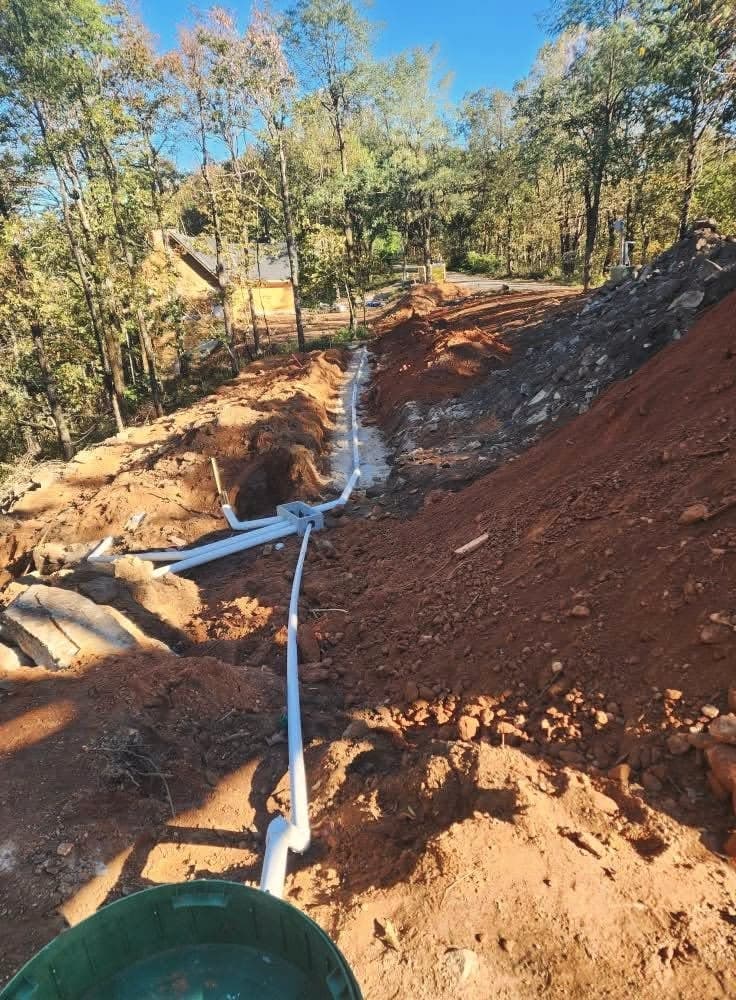
SEPTIC LINE REPAIR · METRO ATLANTA
Get a free estimate
or call (678) 863-5620The short answer
Septic line repair fixes the solid pipes of a septic system: the building sewer from the house to the tank, and the line from the tank to the distribution box and drain field. In Georgia those pipes must be at least 4-inch schedule 40 PVC or equivalent, with watertight, root-resistant joints, and every repair must be permitted and inspected.
Reviewed by Atlanta Water & Sewage Solutions · Last updated
Who does the work
One crew, the whole line
Key facts
Each row links to the agency, code or publisher it comes from. Tap a source to check it yourself.
| Topic | What it says | Source |
|---|---|---|
| Pipe the rules require | Schedule 40 PVC or equivalent, at least 4 inches across, for every solid pipe starting at the house (511-3-1-.04(2)) | Georgia DPH Rules Chapter 511-3-1, On-Site Sewage Management Systems (Jan 2016), 2016 |
| Joints | Sealed, watertight and root-resistant, on a firm foundation, not subject to settling, at a self-cleaning grade (511-3-1-.04(3)) | Same source as above |
| Under a driveway | Pipe must withstand the expected loads, or be installed so it is protected from crushing (511-3-1-.04(2)) | Same source as above |
| Permit | Repairs, replacement or additions to an existing system must be permitted and inspected (511-3-1-.03(2)(c)) | Same source as above |
| Where the tank usually is | Often 10 to 20 feet outside the home, directly in front of the building sewer | UGA Cooperative Extension Bulletin 1421 — A Beginner's Guide to Septic Systems, 2024 |
| Who marks the line | Calling 811 marks utility lines only, not lines owned by the home or business, so a septic line has to be traced on site | Same source as above |
| Public sewer nearby | If a failing system has a public sewer available within 200 feet of the property line, it must connect, unless the county grants the residential exemption (511-3-1-.03(1)(a)-(b)) | Georgia DPH Rules Chapter 511-3-1, On-Site Sewage Management Systems (Jan 2016), 2016 |
Plain definitions
Warning signs
Seeing any of these? Call (678) 863-5620
How the job runs
We trace the pipe from where it leaves the foundation toward the tank, which often sits 10 to 20 feet out in front of the building sewer. We call 811 for the public utilities first, because 811 does not mark a home's own lines.
UGA Cooperative Extension Bulletin 1421 — A Beginner's Guide to Septic Systems
Where there is a cleanout, a camera run shows whether the pipe is broken, separated, root-filled or sagging, and how far from the house the fault is. Our sewer camera inspection page explains what the footage shows.
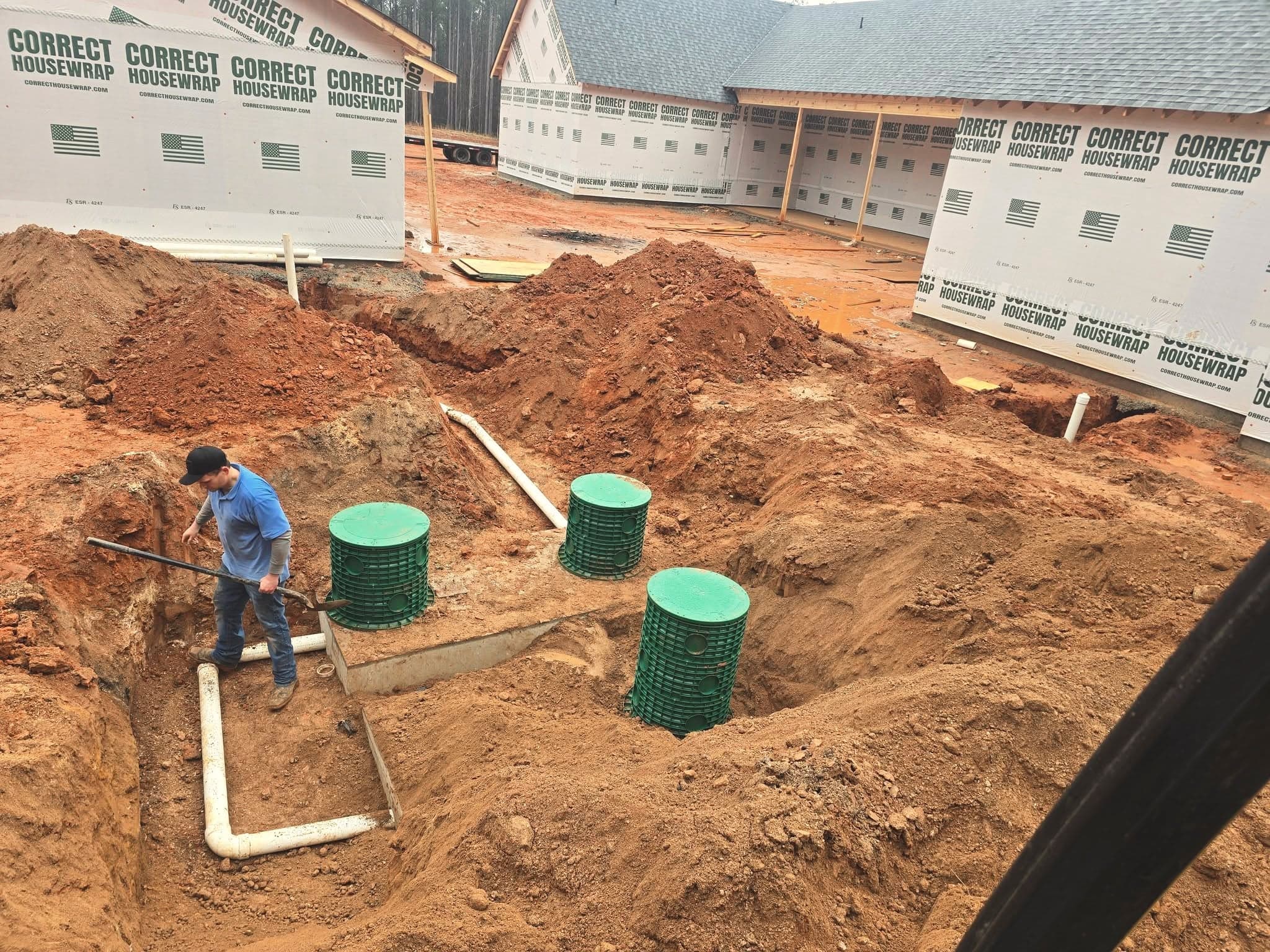
We open the tank and look at the inlet and outlet tees, because a clogged or broken tee can look exactly like a pipe failure from inside the house.
Georgia requires that repairs, replacement or additions to an existing system be permitted and inspected, so the county environmental health office is part of the job.
511-3-1-.03(2)(c)Georgia DPH Rules Chapter 511-3-1, On-Site Sewage Management Systems (Jan 2016)
We cut out the broken, crushed or root-packed section and replace it with schedule 40 PVC or equivalent, at least 4 inches, with sealed, watertight, root-resistant joints. The new pipe is bedded on firm ground at a grade that keeps solids moving, and pipe under a driveway is rated or protected for the load.
511-3-1-.04(2)-(3)Georgia DPH Rules Chapter 511-3-1, On-Site Sewage Management Systems (Jan 2016)
The repair is left open for the county inspection where the county requires it, then backfilled and the yard put back.
511-3-1-.03(2)(c)Georgia DPH Rules Chapter 511-3-1, On-Site Sewage Management Systems (Jan 2016)
Permits & the Georgia rules
Contact the county environmental health office for the repair permit before the line is replaced.↗
If a public sewer is within 200 feet of the property line, expect the county to ask whether the system must connect instead of being repaired; a residential system under 2,000 gallons per day may be exempted.↗
Where there is no local plumbing code or plumbing inspection for the building sewer, the County Board of Health may check that pipe itself (511-3-1-.04(3)).↗
Georgia rule 511-3-1-.03(2)(c)
“Repairs, replacement, or additions to existing systems must be permitted and inspected.”
Georgia rule 511-3-1-.04(2)
“All solid pipes and fittings ... beginning at the house, shall be NSF International schedule 40 PVC or equivalent”
Georgia rule 511-3-1-.04(3)
“Sewers ... shall be laid with sealed, watertight, root-resistant joints.”
Georgia rule 511-3-1-.03(1)(a)
“If an existing on-site sewage system fails, immediate connection shall be made to a public or community sewerage system if such a system is available.”
Your options
OPTION 01
When it fits: One break, one separated joint or one root-packed stretch, with the rest of the pipe sound on camera.
OPTION 02
When it fits: The camera shows several defects, the pipe is an old material, or it sags along its length.
OPTION 03
When it fits: The system is failing and a public or community sewer is available within 200 feet of the property line.
See our septic-to-sewer conversion guide.
The whole story
A blocked building sewer, a broken outlet line and a failing drain field can all show up the same way inside the house: slow drains and backups. Replacing a field that was never the problem is the most expensive mistake in septic work, so we start at the foundation and prove each piece before moving to the next. If it does turn out to be the field, the same crew handles drain field repair.
Atlanta Water & Sewage Solutions is on the Georgia DPH lists of certified septic installers and approved pumpers, so the tank can be opened, pumped and checked on the same visit as the pipe work. One long-time customer put it plainly in a Google review: “When my septic lines failed, they did an excellent job of repair & update.”
Where we do this
FAQ
Straight answers, with the rule or record behind them. Still unsure? Call and ask the crew that digs.
(678) 863-5620No. A septic line carries wastewater to your own tank and field, and the whole run is yours. A sewer line, or lateral, carries it to a public sewer main, and part of it can belong to the utility. If you are not sure which you have, our septic or sewer guide helps, and sewer line repair covers the public-sewer side.
Yes. Georgia's on-site sewage rules say repairs, replacement or additions to existing systems must be permitted and inspected (511-3-1-.03(2)(c)). The permit comes from your county environmental health office, which also inspects the work. We handle that conversation as part of the repair, so you are not coordinating it yourself.
Source: Georgia DPH Rules Chapter 511-3-1, On-Site Sewage Management Systems (Jan 2016)
Every solid pipe and fitting from the house onward must be NSF schedule 40 PVC or equivalent, at least 4 inches in diameter, with sealed, watertight, root-resistant joints on a firm, non-settling foundation (511-3-1-.04(2)-(3)). Pipe under a driveway must be able to take the load or be protected from crushing.
Source: Georgia DPH Rules Chapter 511-3-1, On-Site Sewage Management Systems (Jan 2016)
Yes. UGA Extension notes that tree and shrub roots can grow into drain lines and even into the tank, and the EPA advises planting trees far enough from the drain field that roots cannot reach the system. Roots usually get in at a crack or a loose joint, which is why the repair uses root-resistant joints.
Source: UGA Cooperative Extension Bulletin 1421 — A Beginner's Guide to Septic Systems
Avoid it. UGA Extension warns that driving or parking over the tank or drain field can damage or collapse the tank or drain lines and compact the soil, and the EPA says not to park or drive on a drain field. Where a line must cross a driveway, Georgia requires pipe that can take the load or protection from crushing.
No. Calling 811 marks public utility lines, but not lines owned by the home or business, according to UGA Extension. Your septic line has to be traced on site, starting where the pipe leaves the crawlspace or basement wall. The tank is often 10 to 20 feet out, straight in front of that pipe.
Source: UGA Cooperative Extension Bulletin 1421 — A Beginner's Guide to Septic Systems
The EPA's rule of thumb is to flush nothing but human waste and toilet paper. Its never-flush list includes cooking grease or oil, non-flushable wipes, paper towels, diapers, feminine hygiene products, coffee grounds and cat litter. Those are also what tend to snag at a joint or a sag in the line.
If your system is failing and a public or community sewer is available within 200 feet of the property line, Georgia's rule is that the house must connect. A residential system under 2,000 gallons per day may be exempted if the repair meets the state manual and the lot has enough usable soil, as decided by the County Board of Health.
Source: Georgia DPH Rules Chapter 511-3-1, On-Site Sewage Management Systems (Jan 2016)
Keep going
Sources
Rules, costs and local facts on this page link to the agency, code or publisher that states them. Cost figures are third-party market ranges, not our prices — estimates are free.
Reviewed by Atlanta Water & Sewage Solutions · Last updated
Ready when you are
Most septic trouble that starts in the house is a pipe problem before it is a tank problem. We find the break, the root mass or the crushed section, repair it to Georgia's pipe rules, and leave the rest of the system alone.
(678) 863-5620Free estimate
or call (678) 863-5620