24/7 Emergency? (678) 863-5620
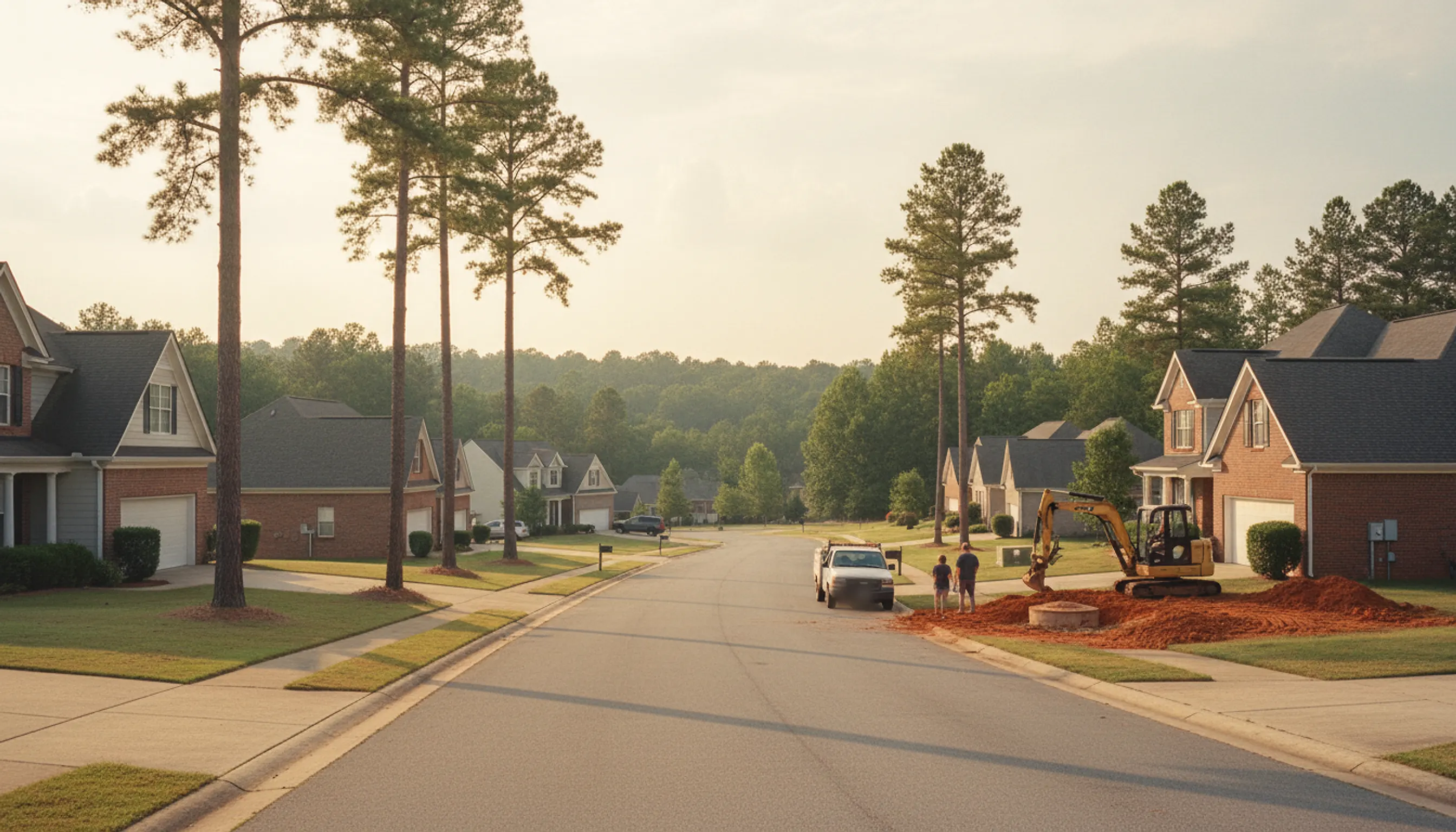
A 1990s cul-de-sac under tall pines, with one lawn dug open to red clay around a concrete septic tank lid.

Gwinnett County · Septic & sewer rules

Septic and sewer service in Gwinnett County, where roughly three in ten residents rely on a septic tank.

Lawrenceville is the county seat. Septic permits and records: Gwinnett Environmental Health Department (GNR Public Health), part of GNR Public Health (Gwinnett, Newton & Rockdale) — Environmental Health.
  • Georgia DPH-certified installer & pumper
  • Residential & commercial
  • Local shop in Oxford, GA

Get a free estimate

or call (678) 863-5620

Property type
What do you need?
Rather talk? (678) 863-5620
Where's the property?
Is sewage backing up inside? (optional)
Who should we call?

By submitting, you agree we may call or text you about this request. Msg & data rates may apply. Reply STOP to opt out. SMS terms.

The short answer

Who permits septic in Gwinnett County, and is it on sewer?

Both. Gwinnett's Department of Water Resources runs a 3,000-mile sewer network, yet about 30 percent of residents still use septic. Septic permits come from GNR Public Health's Gwinnett office in Lawrenceville and require a Level 3 soil report. Pumping a tank earns a 10 percent county stormwater credit. We repair, pump and connect across Gwinnett.

Reviewed by Atlanta Water & Sewage Solutions · Last updated

At a glance

County seat
Lawrenceville
Health district
GNR Public Health (Gwinnett, Newton & Rockdale) — Environmental Health
Septic permits
Gwinnett Environmental Health Department (GNR Public Health)
EH office phone
770.963.5132
Population
979,864 (ACS 2020-2024 5-year, table B01003)
Median home built
1996

The Gwinnett County story

A suburban county with a rural share of septic tanks

Gwinnett looks fully built out: close to a million residents and a median house from 1996. Underground the picture splits. Citing the Georgia Department of Public Health, the county's water department says Gwinnett has one of the greatest concentrations of septic systems in the United States.

So one Gwinnett street can hold two kinds of owner: one pays a sewer charge and owns a lateral to the right-of-way; the next owns a tank and drain field and answers to GNR Environmental Health when it fails. The first job on any Gwinnett call is working out which of the two you are.

On the record

  • According to DPH, as quoted by Gwinnett DWR, an estimated 30 percent of the county's population uses septic.

Local facts

Gwinnett septic and sewer, in one table

Each row links to the agency, code or publisher it comes from. Tap a source to check it yourself.

County-level facts with their sources, retrieved September 2026.
TopicWhat it saysSource
Septic shareAbout 30% of residents; "one of the greatest concentrations of septic systems in the United States" (DPH via DWR)Gwinnett County DWR — Septic Tanks
Sewer systemAbout 56 million gallons a day from 180,000+ customers, ~3,000 miles of pipe, ~200 pump stations, 3 treatment facilitiesGwinnett County DWR — Wastewater
Septic permitsGNR Public Health — Gwinnett Environmental Health, 455 Grayson Hwy, Suite 600, Lawrenceville; 770.963.5132GNR Public Health — Locations (Environmental Health Offices)
Soil reportLevel 3 required for every septic permit since February 7, 2022GNR Public Health — Septic Systems
Repair / new permit fee$275 residential; $400 after a complaint (effective January 1, 2026)GNR Environmental Health Fee Schedule — Gwinnett County (effective Jan 1, 2026)
Pumping credit10% off the county stormwater fee, yearly for five yearsGwinnett County DWR — Septic Tanks
Septic recordsEnvironmental Health files go back to systems installed in 1959Gwinnett County DWR — Septic Tanks
River basinsUpper Ocmulgee in the south and center, Upper Chattahoochee on the north edge, Upper Oconee in the east around DaculaWikipedia — Gwinnett County, Georgia

Sewer or septic?

Telling a Gwinnett sewer house from a septic house

DWR gives the simplest test itself. Pull a recent water bill; if the line reading "Sewer Amount Charged" shows $0.00, the property is very likely on septic.

For the details, Gwinnett Environmental Health holds records for systems installed since 1959, and the county GIS Data Browser can show a septic sketch and earlier repair permits where they exist. Those files are worth reading before anyone probes a yard.

How to tell which one you have

  • Check the "Sewer Amount Charged" line on the DWR bill.
  • Ask Gwinnett Environmental Health for the permit file on the address.
  • Look up the parcel in the county GIS Data Browser for a septic sketch.

More about Gwinnett County

The 10 percent credit: how Gwinnett pays you to pump

Gwinnett funds stormwater work through a utility fee billed with property taxes, and it rewards septic upkeep. Pump the tank, send DWR a dated receipt or paid invoice from a licensed septic hauler, and the county takes 10 percent off that fee each year for five years.

All stormwater credits on a parcel together top out at 40 percent, and credit questions go to 678.376.7193. One caution: some cities bill their own stormwater utility, so check that the county fee is actually on your tax bill before you apply.

  • Gwinnett's stormwater credits are capped at 40 percent per property and are applied to the stormwater fee on the property tax bill.
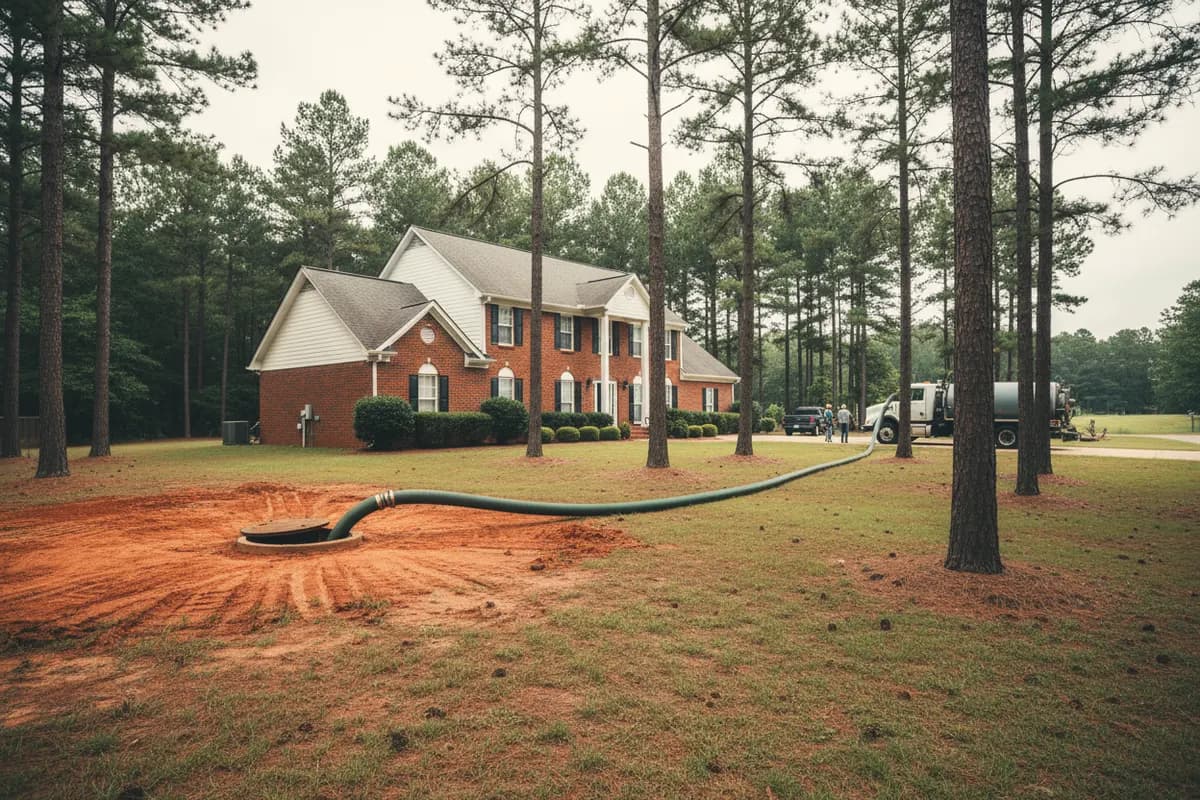
A suction hose runs across a suburban front lawn to an open septic tank riser ringed with red clay.

Permits · GNR Public Health — Gwinnett Environmental Health Department

Getting a septic permit from GNR's Gwinnett office

  1. 01

    Hire a Georgia-certified soil classifier to write a Level 3 soil report for the lot.

  2. 02

    File GNR's Residential Septic System Permit Application with fees paid to Gwinnett County; a contractor you choose may apply and collect the permit as your agent, and we do.

  3. 03

    On a difficult lot, supply three copies of an engineered site plan; alternative systems may also need a Level 4 soil report.

  4. 04

    Allow about 10 working days for plan review and a site visit.

  5. 05

    Build under the permit within 12 months of issue and have Environmental Health inspect before backfill.

Published fees

  • Site evaluation, permit and initial inspection — residentialEffective January 1, 2026$275
  • Same, following a complaint — residentialEffective January 1, 2026$400
  • Site evaluation, permit and initial inspection — commercialEffective January 1, 2026$600
  • Visual inspection of an existing systemEffective January 1, 2026$145
  • ReinspectionEffective January 1, 2026$175
  • Installing without a permitEffective January 1, 20262 × permit fees

Who owns what

Where DWR's pipe ends and yours begins

On sewered Gwinnett lots, the county's lines are drawn at the right-of-way for sewer and at the meter for water.
Cross-section: house, building drain, sewer lateral, cleanout, property line, tap and public sewer mainSTREETPROPERTY LINECLEANOUTTAPPUBLIC SEWER MAINSEWER LATERALBUILDING DRAINPROPERTY OWNERUTILITY
Green = sewer (APWA uniform color code)Typical handoff here: Right-of-way
Cross-section: water main, meter box, water service line and houseSTREETPROPERTY LINEMETER BOXWATER MAINWATER SERVICE LINEPROPERTY OWNERUTILITY
Blue = potable water (APWA uniform color code)Typical handoff here: Meter
  • Gwinnett DWRsewer lateral

    Owner — the whole lateral from the house to the county connection in the right-of-way, including that connection

    Where the line sits: right-of-way cleanout / sewer stub

  • Gwinnett DWRmain

    DWR — clears blockages in the main and in the lateral section inside the right-of-way; backups go to 678.376.7000

  • Gwinnett DWRwater service line

    Owner on the house side of the meter; DWR owns the main, the pipe to the meter and the meter

    Where the line sits: meter

Soil & terrain

Red clay with a county name: Gwinnett's soils and headwaters

Gwinnett sits in Georgia's upper Piedmont astride the Eastern Continental Divide, which is why three river systems begin here. The soil survey is dominated by Appling, Pacolet and Madison units, with Chewacla silt loam in the flood-prone bottoms along the streams.

One soil series, a red clay loam established here in 1969, even carries the county's name. Ridge-to-creek variation like this is why GNR wants a Level 3 report on the actual lot.

  1. Appling sandy loam, 6–10% slopes

    Largest single unit in the county survey, about 27,990 acres.

  2. Pacolet sandy loam / sandy clay loam

    Several units on 2–25% slopes, together over 45,000 acres.

  3. Madison sandy clay loam, 10–45% slopes

    About 24,440 acres; steep ground for a field.

  4. Chewacla silt loam, 0–2% slopes

    Frequently flooded floodplain soil, about 19,450 acres along the creeks.

  5. Gwinnett clay loam

    Well-drained red clay loam over gneiss and schist saprolite.

  6. Soil series · USDA NRCS

What it costs

Gwinnett's published fees for leaving septic behind

Public county fees only; contractor work is priced separately.

What moves the price

These are third-party typical market ranges, not our prices. Every job is quoted after we see it — estimates are free.

Free estimate: (678) 863-5620
  1. 01Distance and depth from the house to the county stub
  2. 02Pumping out the old tank and crushing it or filling it with concrete or gravel
  3. 03Two inspections: at the cleanout connection and after the tank is abandoned

Who to call at the county

Gwinnett's septic office and water utility

Septic permits & records

Gwinnett Environmental Health Department (GNR Public Health)

Address
455 Grayson Hwy, Suite 600, Lawrenceville, GA 30046
Hours
Applications not accepted Wednesdays or 1–2 p.m., and not after 4 p.m. Mon/Tue/Thu/Fri; inspector not available Wednesdays. After-hours EH emergencies: 678.409.0997.


FAQ

Gwinnett County septic and sewer FAQ

Straight answers, with the rule or record behind them. Still unsure? Call and ask the crew that digs.

(678) 863-5620

How can I tell whether my Gwinnett County home has a septic tank?

Start with your DWR water bill. Gwinnett says a "Sewer Amount Charged" of $0.00 means the property is very likely on septic. To confirm, ask Gwinnett Environmental Health, which keeps records for systems installed since 1959, or open the parcel in the county GIS Data Browser, which may show a septic sketch and past repair permits.

Source: Gwinnett County DWR — Septic Tanks

Does Gwinnett County give a credit for septic tank pumping?

Yes. Pumping earns a 10 percent credit on the county stormwater utility fee, and you can earn it each year for five years. Send DWR a dated receipt or paid invoice from a licensed septic hauler. Credits appear on the property tax bill and all credits combined are capped at 40 percent per property.

Source: Gwinnett County DWR — Stormwater Utility Fee and Credits

What does a septic repair permit cost in Gwinnett in 2026?

GNR's Gwinnett fee schedule, effective January 1, 2026, charges $275 for a residential site evaluation, permit and initial inspection, or $400 when the permit follows a complaint. Commercial permits are $600, a reinspection is $175, and installing without a permit costs double the permit fees. The Level 3 soil report is billed separately by the classifier.

Source: GNR Environmental Health Fee Schedule — Gwinnett County (effective Jan 1, 2026)

Why do Gwinnett septic permits require a Level 3 soil report?

Since February 7, 2022, GNR Public Health has required a Level 3 soil report from a certified soil classifier before it permits any septic system in its counties, including repairs and additions that change the system. Gwinnett's soils swing from Appling and Pacolet uplands to flood-prone Chewacla bottoms, so the report sizes the field to your lot.

Source: GNR Public Health — Septic Systems

How much does Gwinnett charge to switch a house from septic to sewer?

For a typical 3/4-inch residential account, DWR's septic-to-sewer procedure lists $4,172 in county fees: a $4,147 system development charge plus a $25 permit. You also need a Planning & Development Plumbing Only permit at 0.6 percent of the estimate, $30 minimum. The old tank must be emptied and crushed or filled with concrete or gravel.

Source: Residential Septic to Sewer Procedure for Unincorporated Gwinnett County

Who is responsible for a clogged sewer lateral in Gwinnett County?

The owner maintains the entire lateral, including where it joins the county line at the right-of-way. DWR clears blockages in its main and in the right-of-way portion; report a backup on its 24-hour line, 678.376.7000. If the only blockage is inside the right-of-way, a reimbursement claim is possible, but DWR must inspect the open excavation first.

Source: Gwinnett County Sewer Service Lateral Repair/Cleaning Policy

Ready when you are

Gwinnett tank or Gwinnett lateral — one call covers both.

Tell us what's backing up or what the inspector found. We give free on-site estimates anywhere in the county, handle the GNR permit as your agent, and leave the pumping receipt DWR's credit form asks for.

(678) 863-5620
  • Georgia DPH-certified installer & pumper
  • Residential & commercial
  • Oxford, GA

Property type
What do you need?
Rather talk? (678) 863-5620
Where's the property?
Is sewage backing up inside? (optional)
Who should we call?

By submitting, you agree we may call or text you about this request. Msg & data rates may apply. Reply STOP to opt out. SMS terms.

Call nowFree Estimate