24/7 Emergency? (678) 863-5620

GREASE TRAP SEWER LINES · RESTAURANTS · METRO ATLANTA

Grease trap sewer lines — restaurant laterals and interceptor connections, dug and fixed.

Grease that leaves the kitchen hot turns to paste in a cold lateral, and local ordinances decide how your interceptor is sized, pumped and inspected. We excavate, repair and replace the lines into and out of it — the building sewer, the tees, the connection to the street.
  • Georgia DPH-certified installer & pumper
  • Commercial properties
  • Emergency line answered 24/7

Get a free estimate

or call (678) 863-5620

Property type
What do you need?
Rather talk? (678) 863-5620
Where's the property?
Is sewage backing up inside? (optional)
Who should we call?

By submitting, you agree we may call or text you about this request. Msg & data rates may apply. Reply STOP to opt out. SMS terms.

The short answer

What is grease trap sewer line repair?

Grease trap sewer line repair fixes the pipes that carry kitchen wastewater into and out of a restaurant's grease interceptor, where fats, oils and grease cool, harden and choke the lateral. In metro Atlanta, local FOG ordinances set interceptor size and pumping. Atlanta Water & Sewage Solutions, based in Oxford, GA, excavates and replaces those lines.

Reviewed by Atlanta Water & Sewage Solutions · Last updated

Key facts

Grease rules that shape the line, county by county

Each row links to the agency, code or publisher it comes from. Tap a source to check it yourself.

Interceptor sizing, pumping and inspection requirements from metro Atlanta sewer utilities and Georgia DPH, each with its source.
TopicWhat it saysSource
Newton (NCWSA) interceptor size15 gallons per seat, minimum 750 and maximum 3,000 gallons, for all commercial food-preparation users (Sewer Use Rules § 3.5).NCWSA Rules and Regulations for Sewer Use and Industrial Pretreatment Program (adopted July 18, 2018; rev. April 10, 2019), § 3.5, 2019
Newton (NCWSA) pumpingQuarterly or when food and FOG exceed 25% of volume, whichever is sooner, by an NCWSA-registered grease hauler; manifests kept three years.NCWSA — F.O.G. commercial brochure
Rockdale interceptor size and pumping15 gallons per seat (750 minimum, 3,000 maximum); full pump-out at least every 90 days, and outdoor units whenever FOG plus solids reach 25% of liquid depth (Sec. 98-168).Rockdale County Code, Ch. 98, Art. III, Div. 5 — Sec. 98-168 Sand and oil/grease interceptors (Municode)
Monroe interceptor designMinimum 24-minute retention plus a 20% sludge allowance, two compartments, followed by a sampling manhole; inspected before backfill with 48 hours' notice.City of Monroe Code of Ordinances, Ch. 98, Art. V — Sanitary Sewer Grease Control (Secs. 98-200–98-208)
DeKalb separator triggerGrease, oil and sand separators are required when wastes carry more than 100 mg/l of fat, oil, grease or sand (Sec. 25-257).DeKalb County Code Ch. 25, Art. IV, Div. 5 — Sec. 25-257 Separators and interceptors (Municode)
Covington cleaning ruleTraps and interceptors must be cleaned by a licensed sewage handler, with the manifest sent to the city's FOG program.City of Covington — Fats, Oils and Grease Program (FOG)
On septic (Georgia DPH)Grease trap required when grease may exceed 50 mg/l; effluent goes to a septic tank, never straight to the drain field; 125-gallon minimum size.Georgia DPH Manual for On-Site Sewage Management Systems (March 2026), Section D(18) Grease Traps, 2026

Plain definitions

The parts of a restaurant's grease line

FOG
Fats, oils and grease from cooking and dishwashing, which can build up in sewer pipes until wastewater backs up or overflows.
Grease trap vs. grease interceptor
Covington's FOG program describes a grease trap as typically inside and a grease interceptor as typically outside; both hold kitchen wastewater long enough for grease to float and separate.
Building sewer
The private line from the building drain to the public sewer — on a restaurant lot, the pipe that runs into the interceptor and on out to the street.
Sampling manhole
An access point downstream of the interceptor where the utility can sample what leaves your property; Monroe requires one after every new interceptor.
Waste manifest
The hauler's record of each pump-out, which utilities such as NCWSA, Rockdale and Covington require you to keep or send in.
High-strength waste
Wastewater with BOD5 and TSS above 200 mg/L, which Georgia requires to be pretreated before a conventional or chamber septic system.

Warning signs

Signs the problem is the line, not just a full trap

A full interceptor and a failing line can look the same from the kitchen. These point past the trap, toward the pipe.

Seeing two or more? Call (678) 863-5620

  • 1. Backups right after a pump-outIf floor drains back up within days of your hauler emptying the interceptor, the restriction is likely in the inlet line or downstream of the outlet.
  • 2. The interceptor runs high on the outlet sideWater standing above the outlet tee usually means the building sewer between the interceptor and the street isn't carrying flow away.
  • 3. Grease at the right-of-way cleanoutGrease showing at the cleanout by the street means FOG is escaping the interceptor and coating the lateral.
  • 4. Lowest fixtures go firstMop sinks and floor drains at the lowest point overflow before anything else when the lateral is restricted.
  • 5. Sewer odor outside the kitchenSmell at the interceptor lids, the cleanout or a sunken spot in the pavement can mean a cracked pipe or a failed joint.
  • 6. Sinking asphalt over the lineA settling strip of pavement along the pipe route often means a broken pipe washing soil away underneath.

The whole story

How grease closes a lateral

Grease goes down the drain as a liquid. Covington's FOG program puts it plainly: FOG in a liquid form may turn viscous or solid as it cools in the underground sewer, ultimately causing a blockage. A three-compartment sink full of hot dishwater carries grease past the first few feet of pipe with ease. By the time that water reaches a buried lateral in a Georgia winter, it has cooled, and the grease starts to cling to the pipe wall — first as a film, then as a ring, then as a plug that catches food solids and paper.

The interceptor exists to stop that, and the DPH manual explains why placement matters: set close to the kitchen, where the wastewater is still hot, grease flows into the trap before it congeals, then separates as it cools inside. When the interceptor is too small for the flow, gets overdue for pumping or takes a surge, grease escapes through the outlet. The manual notes that surges can agitate the trap and push grease out, and that failing to clean it can lead to grease discharging into the system downstream.

Downstream is where we come in. Grease that gets past the interceptor settles wherever the line is weakest: a belly where the pipe has sagged, an offset joint, a root-cracked section of old clay pipe, a tee that was never set right. Madison's utility warns that grease hardens in sewer pipes and causes sanitary sewer overflows; that is exactly what a partly collapsed or sagging lateral makes worse. A plug can be cleared, but if the pipe itself holds grease because of its shape, the plug comes back.

On a restaurant lot, the fix is usually under asphalt: the building sewer out of the kitchen, the inlet and outlet runs at the interceptor, the sampling manhole and the lateral to the utility's connection. Having one crew find the bad section, dig it, replace the pipe and fittings, call the inspection and backfill under the paving means the kitchen isn't waiting on four different trades to line up.

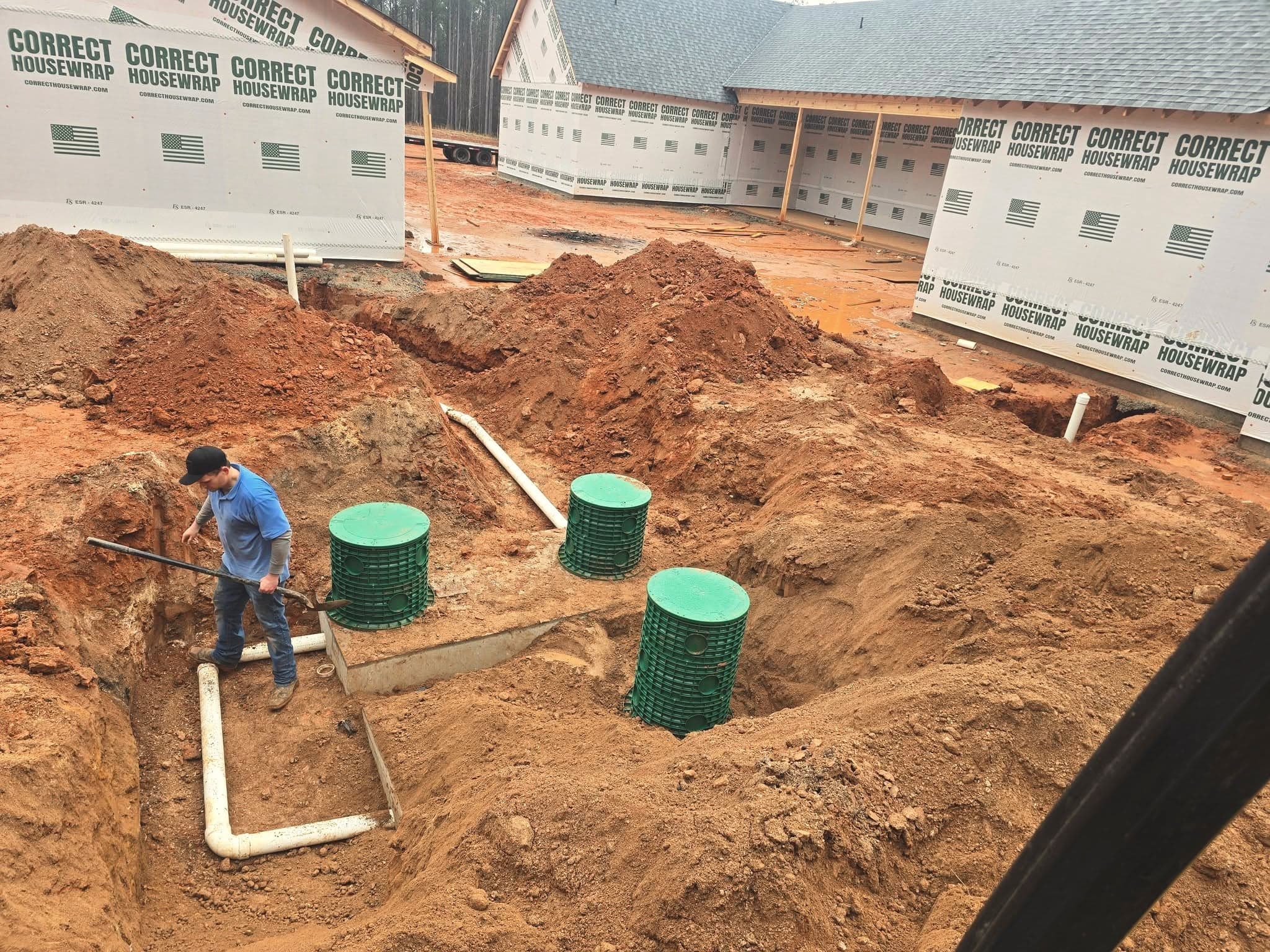
From our job files.

Your options

Clear it, spot-repair it or replace it

Which fix fits depends on whether the pipe is sound under the grease. A camera look down the line after it is cleared usually answers that.

OPTION 01

Clear the line

When it fits: The pipe is intact and correctly graded; the problem is grease buildup from an overdue or undersized interceptor.

  • No excavation
  • Fastest return to service
  • Comes back if the interceptor isn't fixed
  • Does nothing for a belly or break

Line cleaning (including jetting) is usually handled by a drain-cleaning or grease-service contractor; we'll tell you honestly when that is all you need.

OPTION 02

Spot repair

When it fits: One section is broken, offset or bellied — often right at the interceptor inlet or outlet, or where the lateral crosses a drive lane.

  • Smaller trench and paving patch
  • Fixes the place grease keeps catching
  • Rest of an old line may be near the end of its life

OPTION 03

Replace the building sewer

When it fits: Old clay or cast iron with several defects, or a line that was graded wrong from the start.

  • New pipe at correct grade end to end
  • Chance to add cleanouts where your hauler and plumber need them
  • Largest excavation and paving restoration
  • May trigger interceptor upgrades under local rules

Trenchless methods exist for some lines; if one fits your site we'll talk it through, but on these pages what we describe is dig-and-replace.

OPTION 04

Replace or relocate interceptor connections

When it fits: Cracked tees, missing baffles at the pipe connection, or an interceptor being upsized to meet the current ordinance.

  • Brings the tie-ins up to the utility's current standard
  • Needs the utility's approval and inspection before backfill

Permits & the Georgia rules

Local FOG ordinances and the Georgia rules on septic

On public sewer, grease is regulated by the utility that owns the sewer — not by Environmental Health. On septic, Georgia's Rule 511-3-1-.12 governs. Either way, the interceptor is the owner's to install, maintain and pay for.
  1. 01

    Find out which utility's ordinance applies — the city (Covington, Monroe) or the county authority (NCWSA, Rockdale, DeKalb, Gwinnett) that owns the sewer your lateral connects to.

  2. 02

    Size the interceptor to that ordinance: 15 gallons per seat (750–3,000) under NCWSA and Rockdale rules; 24-minute retention plus 20% sludge allowance, two compartments and a sampling manhole in Monroe.

  3. 03

    Get the unit approved before it goes in; Covington and DeKalb both require approved interceptors located for easy inspection.

  4. 04

    Schedule the utility's inspection before backfill — Monroe asks for 48 hours' notice and withholds the certificate of occupancy until the final inspection.

  5. 05

    Keep pumping records: NCWSA wants manifests kept three years; Rockdale wants them within 14 days of pumping plus a 12-month log on site.

  6. 06

    On septic, submit grease trap plans to the county board of health for approval and route the trap's effluent to the septic tank.

Georgia rule 511-3-1-.12(1)

Grease traps shall be required for commercial or industrial establishments with on-site sewage management systems
Read the rule

Georgia rule 511-3-1-.12(2)

Effluent from grease traps shall be disposed of in a septic tank and not directly discharged to the absorption field.
Read the rule

Georgia rule Covington FOG Program

FOG in a liquid form may turn viscous or solid as it cools in the underground sewer, ultimately causing a blockage.
Read the rule

Georgia rule Gwinnett DWR FOG

The FOG ordinance outlines steps restaurants and food service establishments must take to keep FOG out of the County's system.
Read the rule

How it varies by county

  • Newton County — NCWSA

    Sewer Use Rules § 3.5 set interceptor maintenance monthly, quarterly or semiannually depending on customers served, or before solids plus grease exceed 20% of volume; NCWSA's FOG brochure says quarterly or at 25%, whichever is sooner. Drain screens, waste-grease bins and sink signage are also required.

  • Covington

    Code § 13.24.030(B)(4) requires interceptors where the superintendent deems them necessary for excessive grease, oil or sand; the user inspects, cleans and repairs them at their own expense.

  • Monroe (Walton County)

    Monroe's grease control article requires every permitted food service establishment on city sewer to have an approved interceptor, allows only full pump-outs (no skimming), and brings existing sites into compliance when plumbing work reaches $20,000 or more.

  • Rockdale County

    Sec. 98-168 says enzyme or bacteria additives cannot substitute for pumping. In October 2025 Rockdale Water Resources launched a FOG compliance application for haulers to report pump-outs.

  • DeKalb County

    Food service establishments on DeKalb sewer must take part in the county's FOG program, and compliance inspectors routinely inspect grease interceptors and related equipment.

  • Gwinnett County

    Gwinnett's FOG ordinance reaches beyond restaurants to daycares, assisted living facilities, schools, hotels and hospitals with commercial kitchens, and county inspectors check compliance.

Worth knowing

Grease on a septic system

Rural restaurants, church kitchens and school cafeterias on septic answer to the county board of health, not a sewer utility. Rule 511-3-1-.12 requires a grease trap when the county expects grease above 50 mg/l, and the DPH manual says that mostly means kitchen wastewater from cafeterias, restaurants, hospitals, schools and other institutions. The trap is an outside tank, built much like a septic tank, that sits between the kitchen and the septic tank.

The manual gives the sizing formula: seats × 25 gallons per seat × (hours open ÷ 12) × a loading factor based on location. Its own example — a 75-seat restaurant open 12 hours on a main highway — comes to 1,875 gallons. For hospitals, nursing homes and other kitchens with varied seating it uses meals per day × 5 gallons per meal × a dishwashing factor. The minimum is 125 gallons.

Two plumbing details matter for the lines we dig. Restroom waste should not go through the grease trap, and garbage-grinder waste should not either, because the extra solids upset it. So a septic-served kitchen usually has two building sewers: kitchen to grease trap to septic tank, and restrooms straight to the septic tank. The manual also says inlet and outlet fittings are tees reaching 12 inches from the tank floor and well above the water line, with access brought to grade.

Grease that escapes to the tank does not stop there. The manual warns that commercial effluent such as a restaurant's can clog the drain field faster than household effluent, and Rule .03(1)(c) requires pretreatment when BOD5 and TSS exceed 200 mg/L. As a DPH-certified septic installer, we can take the line, the tank connection and the drain field as one job; the pumping itself stays with your hauler.

Rural restaurants, church kitchens and school cafeterias on septic answer to the county board of health, not a sewer utility.

How the job runs

How we handle a grease line repair or interceptor tie-in

Most of this happens under pavement next to a working kitchen, so planning comes first.
  1. 1

    Free on-site estimate

    We locate the interceptor, cleanouts, sampling manhole and the route to the street, and ask for your last few pump-out manifests. The dates tell us whether the grease is a maintenance problem or a pipe problem.

  2. 2

    Coordinate with your grease hauler

    Before anyone cuts into a line tied to the interceptor, your grease hauler or pumping contractor empties it. We'll schedule the dig for right after the pump-out.

  3. 3

    Look before digging

    Once the line is cleared, a camera inspection shows breaks, bellies and offset joints and where they are, so the trench goes in the right place.

  4. 4

    Approvals

    New or replaced interceptors and connections need the utility's approval under the local ordinance; on septic, grease trap plans go to the county board of health. We handle the permit paperwork.

    City of Monroe Code of Ordinances, Ch. 98, Art. IV — Sewer Use

  5. 5

    Excavate and repair

    Saw-cut the paving, dig to the pipe, and replace the damaged section, the inlet or outlet tees, or the full building sewer at proper grade — including excavation for a new or upsized interceptor.

  6. 6

    Inspection before backfill

    The utility or county inspects the open work. Monroe, for one, requires 48 hours' notice; on septic, Rule .03(4) bars backfill until the county's final inspection.

    511-3-1-.03(4)Georgia DPH Rules Chapter 511-3-1, On-Site Sewage Management Systems (Jan 2016)

  7. 7

    Backfill and restore

    Compacted backfill under the drive lane, paving restored, and cleanouts left where your hauler and plumber can reach them.

Who owns what

Who owns the grease line

The interceptor and the building sewer are the property owner's in every utility below. Where the owner's pipe ends varies.
Cross-section: house, building drain, sewer lateral, cleanout, property line, tap and public sewer mainSTREETPROPERTY LINECLEANOUTTAPPUBLIC SEWER MAINSEWER LATERALBUILDING DRAINPROPERTY OWNERUTILITY
Green = sewer (APWA uniform color code)Typical handoff here: The main
  • NCWSA (unincorporated Newton)

    Since March 1, 2021, customers pay to clear blockages in the building sewer from the building through the tap at the main.

    Where the line sits: Tap at the main sewer

  • City of Covington

    Customers maintain and keep clean the sewer pipes from their plumbing to the city street line or the city sewer main, whichever is nearer.

    Where the line sits: Street line or main, whichever is nearer

  • Rockdale County

    The customer owns the line from the right-of-way to the building, plus the cleanout at the right-of-way limit.

    Where the line sits: Street right-of-way

  • Gwinnett County DWR

    The owner owns the entire private lateral to the connection with the county system in the right-of-way, including that connection.

    Where the line sits: Right-of-way connection

Homes & businesses

Kitchen grease at home vs in a restaurant

Residential

Homes

Grease ordinances exempt private homes — DeKalb's separator rule excludes private living quarters, and Covington's interceptor rule does not apply to residential users. Household grease still clogs laterals, which is why utilities tell you to can it and trash it.

  • No interceptor required
  • Owner still maintains the lateral

Commercial

Food service

Food service establishments must install, size, pump and document an interceptor to the local ordinance, and the utility inspects it. The lines on either side of it are the owner's to keep working.

  • Interceptor sized per ordinance
  • Registered hauler and manifests
  • Utility inspections
All commercial sewer and septic services

What it costs

Published cost ranges for grease line and interceptor work

Grease line jobs combine sewer repair and, sometimes, interceptor installation. These are the closest published third-party figures.

What moves the price

These are published third-party market ranges, not our prices. We give free on-site estimates.

Free estimate: (678) 863-5620
  1. 01Paving and trafficDrive-through lanes and parking over the line mean saw-cutting, patching and staging around customers.
  2. 02Ordinance upgradesReplacing an interceptor can mean upsizing it to the current per-seat or retention rule and adding a sampling manhole.
  3. 03Depth and gradeDeeper laterals and lines that must be re-graded to stop grease settling take more excavation.
  4. 04Inspection timingUtility inspection before backfill (48 hours' notice in Monroe) can add a day to the schedule.

FAQ

Grease trap sewer line questions

Straight answers, with the rule or record behind them. Still unsure? Call and ask the crew that digs.

(678) 863-5620

Why does my restaurant's sewer line keep clogging even though the grease trap is pumped?

If backups return soon after a pump-out, the problem is usually the pipe, not the trap: a belly, offset joint or broken section downstream of the interceptor that catches the grease that gets past it. Clearing the line and running a camera through it shows where. A pipe that holds grease because of its shape needs repair, not more pumping.

How big does a grease interceptor need to be in Newton or Rockdale County?

NCWSA and Rockdale County both size interceptors for commercial food-preparation users at 15 gallons per seat, with a 750-gallon minimum and a 3,000-gallon maximum. A 60-seat dining room works out to 900 gallons. Under-the-counter units are allowed only in limited cases under NCWSA's rules.

Source: NCWSA Rules and Regulations for Sewer Use and Industrial Pretreatment Program (adopted July 18, 2018; rev. April 10, 2019), § 3.5

How often does a grease interceptor have to be pumped in metro Atlanta?

It depends on the utility. NCWSA's FOG brochure says quarterly or when food and FOG exceed 25% of volume, whichever is sooner. Rockdale requires a full pump-out at least every 90 days. Monroe allows only full pump-outs, not skimming. Your registered grease hauler handles the pumping and the manifest.

Source: NCWSA — F.O.G. commercial brochure

Do you pump grease traps?

No — this page covers the lines, not the pumping. Your grease hauler or pumping contractor empties the interceptor and files the manifest. We excavate, repair and replace the building sewer, the interceptor's inlet and outlet connections and the lateral to the street, and we coordinate the dig with your hauler's pump-out.

Can bacteria or enzyme additives replace grease trap pumping?

Not in Rockdale County: Sec. 98-168 says enzyme or bacteria additives cannot substitute for pumping. On septic, Georgia DPH's separate advisory on septic additives discourages relying on them too. Pumping on the ordinance's schedule is what keeps grease out of the lateral.

Source: Rockdale County Code, Ch. 98, Art. III, Div. 5 — Sec. 98-168 Sand and oil/grease interceptors (Municode)

Does a restaurant on septic in Georgia need a grease trap?

Yes, when the county board of health determines grease may exceed 50 mg/l, which Rule 511-3-1-.12 ties to commercial and industrial establishments. The trap's effluent must go to the septic tank, not the drain field. The DPH manual sets a 125-gallon minimum and sizes restaurants at 25 gallons per seat.

Source: Georgia DPH Rules Chapter 511-3-1, On-Site Sewage Management Systems (Jan 2016)

Will renovating my kitchen trigger a new grease interceptor?

In Monroe it can: the grease control article brings existing food service sites into compliance when plumbing work reaches $20,000 or more. Other utilities apply their own triggers when a building changes use or adds seats, so check with the sewer utility before you finalize the kitchen plans.

Source: City of Monroe Code of Ordinances, Ch. 98, Art. V — Sanitary Sewer Grease Control (Secs. 98-200–98-208)

Who pays to fix a grease-clogged lateral under the parking lot?

The property owner, in every metro utility we cover here. NCWSA puts the owner's responsibility all the way to the tap at the main, Covington to the street line or main, and Rockdale and Gwinnett to the right-of-way. Between a landlord and a restaurant tenant, the lease decides.

Source: NCWSA — Notice of Policy Change: Maintenance of Sewer Service Laterals (July 14, 2021)

Sources

Where these facts come from

Rules, costs and local facts on this page link to the agency, code or publisher that states them. Cost figures are third-party market ranges, not our prices — estimates are free.

Reviewed by Atlanta Water & Sewage Solutions · Last updated

  1. 1Georgia DPH Rules Chapter 511-3-1, On-Site Sewage Management Systems (Jan 2016) (2016)
  2. 2Georgia DPH Manual for On-Site Sewage Management Systems (March 2026), Section D(18) Grease Traps (2026)
  3. 3Georgia DPH Certified Septic Tank Installers list (9/18/2026) (2026)
  4. 4NCWSA Rules and Regulations for Sewer Use and Industrial Pretreatment Program (adopted July 18, 2018; rev. April 10, 2019), § 3.5 (2019)
  5. 5NCWSA — F.O.G. commercial brochure
  6. 6NCWSA — Customer vs. NCWSA Responsibilities
  7. 7NCWSA — Notice of Policy Change: Maintenance of Sewer Service Laterals (July 14, 2021) (2021)
  8. 8City of Covington — Fats, Oils and Grease Program (FOG)
  9. 9Covington, GA Code of Ordinances § 13.24.030 (Municode)
  10. 10Covington, GA Code of Ordinances § 13.16.070 (Municode)
  11. 11City of Monroe Code of Ordinances, Ch. 98, Art. V — Sanitary Sewer Grease Control (Secs. 98-200–98-208)
  12. 12City of Monroe Code of Ordinances, Ch. 98, Art. IV — Sewer Use
  13. 13DeKalb County Watershed Management — Commercial Fats, Oils and Grease (FOG) Program
  14. 14DeKalb County Code Ch. 25, Art. IV, Div. 5 — Sec. 25-257 Separators and interceptors (Municode)
  15. 15DeKalb County Code Ch. 25, Art. IV, Div. 1 — Sewers and Sewage Disposal, Generally (Municode)
  16. 16Gwinnett County DWR — Fats, Oil, and Grease (FOG)
  17. 17Gwinnett County DWR — Sewer Lateral
  18. 18Rockdale County Code, Ch. 98, Art. III, Div. 5 — Sec. 98-168 Sand and oil/grease interceptors (Municode)
  19. 19Rockdale Water Resources — RWR Water Compliance Launches New FOG Compliance Application (2025)
  20. 20Rockdale County Code of Ordinances, Ch. 98, Art. I, Div. 1 — Sec. 98-10 (Municode)
  21. 21City of Madison, GA — F.O.G. (Fats, Oils, Grease)
  22. 22Georgia DPH — Septic Tank Additives Advisory
  23. 23Grease Trap Locator — Grease Trap Installation Cost (updated August 8, 2026) (2026)
  24. 24HomeGuide — How Much Does Sewer Line Replacement Cost? (2026) (2026)
  25. 25Angi — How Much Does Sewer Line Replacement Cost in Atlanta, GA? (2026)

Ready when you are

Need grease trap sewer lines? Call the crew that digs.

Grease that leaves the kitchen hot turns to paste in a cold lateral, and local ordinances decide how your interceptor is sized, pumped and inspected. We excavate, repair and replace the lines into and out of it — the building sewer, the tees, the connection to the street.

(678) 863-5620
  • Georgia DPH-certified installer & pumper
  • Residential & commercial
  • Oxford, GA

Property type
What do you need?
Rather talk? (678) 863-5620
Where's the property?
Is sewage backing up inside? (optional)
Who should we call?

By submitting, you agree we may call or text you about this request. Msg & data rates may apply. Reply STOP to opt out. SMS terms.

Call nowFree Estimate