24/7 Emergency? (678) 863-5620

WATER LINE REPAIR · METRO ATLANTA

Water line repair, meter to house, in metro Atlanta

The pipe from your water meter to your house is yours, not the utility's, in every county we checked. We find the leak, dig it out, and repair or replace the line from Oxford, GA across the east metro.
  • Georgia DPH-certified installer & pumper
  • Residential & commercial
  • Emergency line answered 24/7

Get a free estimate

or call (678) 863-5620

Property type
What do you need?
Rather talk? (678) 863-5620
Where's the property?
Is sewage backing up inside? (optional)
Who should we call?

By submitting, you agree we may call or text you about this request. Msg & data rates may apply. Reply STOP to opt out. SMS terms.

The short answer

What is water line repair, and who pays for it in Georgia?

Water line repair fixes the buried service pipe that runs from your water meter to your house. In metro Atlanta utilities such as Gwinnett, Rockdale, DeKalb and Newton County's NCWSA own the meter and everything on the street side; the homeowner owns the rest. Atlanta Water & Sewage Solutions, based in Oxford, GA, digs, repairs and replaces that line.

Reviewed by Atlanta Water & Sewage Solutions · Last updated

Key facts

Water service line: the facts that decide your bill

Each row links to the agency, code or publisher it comes from. Tap a source to check it yourself.

Ownership, cost and code facts for the water line between the meter and the house, each with its source.
TopicWhat it saysSource
Where your pipe startsAt the meter. Gwinnett DWR, Rockdale Water Resources, DeKalb Watershed, NCWSA and the Walton County Water Department all put the customer's side on the house side of the meter.Gwinnett County DWR — Resident Responsibility
Typical replacement cost$2,000–$5,000 for a main water line, per HomeGuide (Dec. 2025); trenched work runs $50–$200 per linear footHomeGuide — How Much Does Water Line Replacement Cost? (Dec. 22, 2025), 2025
Typical repair cost$400–$1,500 when only a short section is damaged, per HomeGuide (Dec. 2025)HomeGuide — How Much Does Water Line Replacement Cost? (Dec. 22, 2025), 2025
Leak test you can do todayRead the meter, use no water for two hours, read it again. EPA WaterSense: if it changed at all, you probably have a leak.EPA WaterSense — Fix a Leak Week
Minimum pipe sizeWater service pipe of at least 3/4 inch under Georgia's plumbing code (IPC 2018, Sec. 603.1)Georgia State Minimum Standard Plumbing Code 2018 (IPC 2018), Ch. 6 — Sec. 603 Water Service (UpCodes), 2018
Separation from the sewer5 feet of undisturbed or compacted earth between water service and building sewer, with listed exceptions (IPC 2018, Sec. 603.2)Georgia State Minimum Standard Plumbing Code 2018 (IPC 2018), Ch. 6 — Sec. 603 Water Service (UpCodes), 2018
Separation from a septic systemTank at least 10 ft from pressure water lines; drain field at least 10 ft from water supply lines (Rules 511-3-1-.05(2), .07(3))Georgia DPH Rules Chapter 511-3-1 On-Site Sewage Management Systems (Jan 2016), 2016
Who does the workAtlanta Water & Sewage Solutions, a Georgia DPH-certified septic installer based in Oxford, GA, digging and replacing water service linesGeorgia DPH Certified Septic Tank Installers list (9/18/2026), 2026

Plain definitions

The parts of a water service, in plain words

Water service line
The buried pipe that carries drinking water from the utility's meter into your house; most are 3/4 to 1 inch in diameter.
Meter and meter box
The utility-owned device, usually in a plastic or concrete box near the street, that measures your use and marks where your ownership begins.
Customer-side shutoff
The valve on your side of the meter or where the line enters the house that lets you stop water to the home without touching the utility's equipment.
Pressure-reducing valve (PRV)
A valve that lowers street pressure to a safe household level; Walton County lists it among the parts the customer owns.
Backflow preventer
A device that stops water in your pipes from flowing back into the public main; Rockdale requires it on the customer's side of the meter, owned by the customer.
Tap
The connection the utility makes to its main to feed a new service; tap and meter fees are set by each water provider.

Who owns what

Who owns which part of the water line, utility by utility

Every provider we checked draws the line at the meter. The utility repairs the main, the short pipe to the meter and the meter itself. From the meter's outlet to your house, repairs are on you. That includes a leak you can't see. Here is what each provider actually publishes.
Cross-section: water main, meter box, water service line and houseSTREETPROPERTY LINEMETER BOXWATER MAINWATER SERVICE LINEPROPERTY OWNERUTILITY
Blue = potable water (APWA uniform color code)Typical handoff here: Meter
  • Newton County Water & Sewerage Authority (NCWSA)

    The owner maintains and repairs the water service line from the meter to the building, including the connection at the meter; NCWSA owns the meter and everything on the street side.

    Where the line sits: Water meter, usually in the right-of-way

  • Walton County Water Department

    The department is responsible up through the meter; the customer's responsibility starts at the meter and includes the water line, pressure-reducing valves and backflow valves.

    Where the line sits: Meter

  • City of Monroe

    Utility consumers must maintain and keep in good repair all connections, appliances and apparatus used with city utility service; connections are made under city supervision.

  • Rockdale Water Resources

    The county owns the service line from the main through the meter; the line from the meter to the building is the customer's, and customer-side changes at the meter are done under county supervision.

    Where the line sits: Meter

  • Gwinnett County Department of Water Resources

    DWR maintains the main, the pipe from the main to the meter, and the meter; leaks between the meter and the home, backflow devices and irrigation are the owner's to repair or replace.

    Where the line sits: Meter

  • DeKalb County Department of Watershed Management

    The water system up to and including the meter is county property; no contractor or plumber may tap a county main without written permission, and a replaced service line is charged as a new connection.

    Where the line sits: Meter

Warning signs

Signs the leak is in the yard, not the house

Most homeowners find a service-line leak through the water bill. HomeGuide notes water lines in warm regions may sit less than 3 feet deep; in Georgia clay the escaping water often goes down or sideways and never shows. Check these before you call anyone.

Meter moving with the house shut off? Call (678) 863-5620

  • 1. A bill that jumped with no change in how you use waterCompare the same month last year. A steady leak on the service line runs day and night, so the extra gallons show up on every bill until it's fixed. Your utility's customer line can tell you if the reading was estimated.
  • 2. The meter moves with every tap closedClose every fixture, then watch the meter's leak indicator (a small triangle or dial on most residential meters). EPA WaterSense suggests reading the meter before and after two hours of no use. Movement with the house shut off points to a leak.
  • 3. Movement stops when you close the house shutoffIf the meter keeps spinning after you close the main valve where the line enters the house, the leak is between that valve and the meter. That's the buried service line, and it's on your side.
  • 4. A soft, wet strip between the meter and the houseA line of green grass in a dry August, a puddle that never dries, or a sunken spot along the path from the meter box toward the foundation. In red clay the water can travel along the trench before it surfaces.
  • 5. Pressure dropped across the whole houseWeak showers upstairs and down at the same time suggests a restriction or leak before the water reaches your fixtures: a failing PRV, a crushed line, or corroded old pipe.
  • 6. Rusty or cloudy water at every tapDiscolored water throughout the house can come from corroded galvanized steel. InterNACHI notes internal corrosion in piping is hard to detect from outside.

The whole story

What's buried in your yard: pipe materials in metro Atlanta

You can usually tell what you have by looking inside the meter box or where the line comes up through the crawl space or slab. The material decides whether we patch or replace.

**Polybutylene (PB).** A gray, sometimes blue, plastic pipe, usually stamped "PB2110". InterNACHI says it was made between 1978 and mid-1995 and installed in up to 10 million US homes, and that certain water disinfectants react with it and cause it to flake apart from the inside. Blue PB was mainly used for outdoor cold water, which means service lines. It fails where there are no fittings, so a spot repair on one leak rarely ends the problem. When we find PB in a service line, we talk about replacing the whole run.

**Galvanized steel.** Threaded gray steel pipe, common in older houses. InterNACHI gives it a useful life of about 20 to 30 years and warns that internal corrosion isn't visible from outside. Rust narrows the bore, which is why low pressure and brown water often come with it.

**Copper.** Durable, and still in plenty of east-metro yards. HomeGuide lists copper as lasting up to 100 years but notes it may corrode and leak over time and isn't recommended for hard water. A pinhole in copper can often be cut out and repaired.

**PEX and polyethylene.** Flexible plastic that comes in long coils, so a full run from meter to house can go in with few or no joints underground. HomeGuide lists it as lasting up to 50 years and less likely to crack in freezing temperatures.

**PVC.** Rigid plastic, cheap and easy to join. HomeGuide notes a long lifespan in most cases but says it can be damaged by tree roots or chemicals. The joints are the weak point if the trench settles.

**Lead.** Lead service lines are mostly an older-city issue, but EPA's Lead and Copper Rule Improvements require drinking water systems to identify and replace lead pipes within 10 years. If your utility's service-line inventory flags your address, call them first. Part of the job may be theirs.
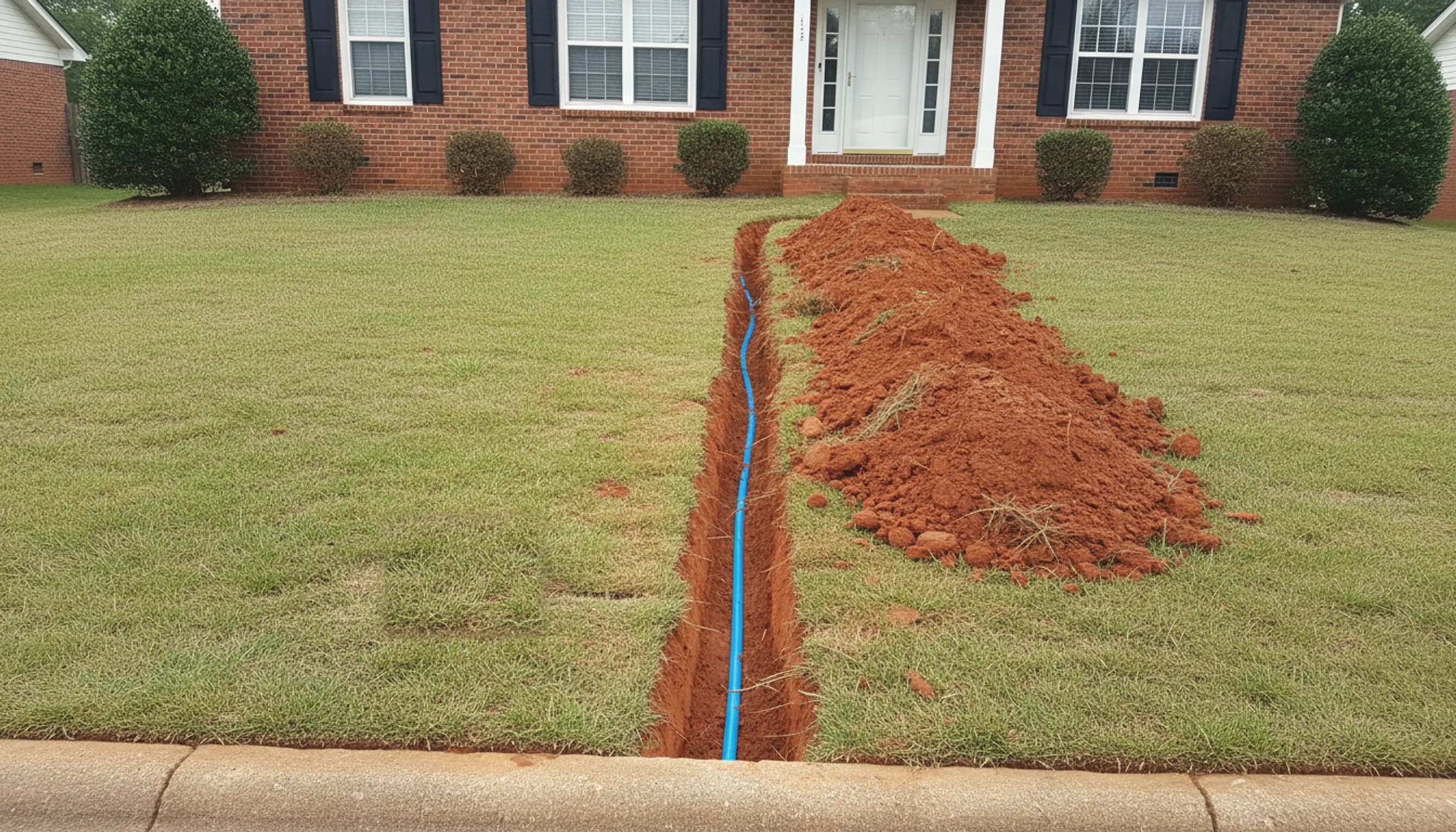
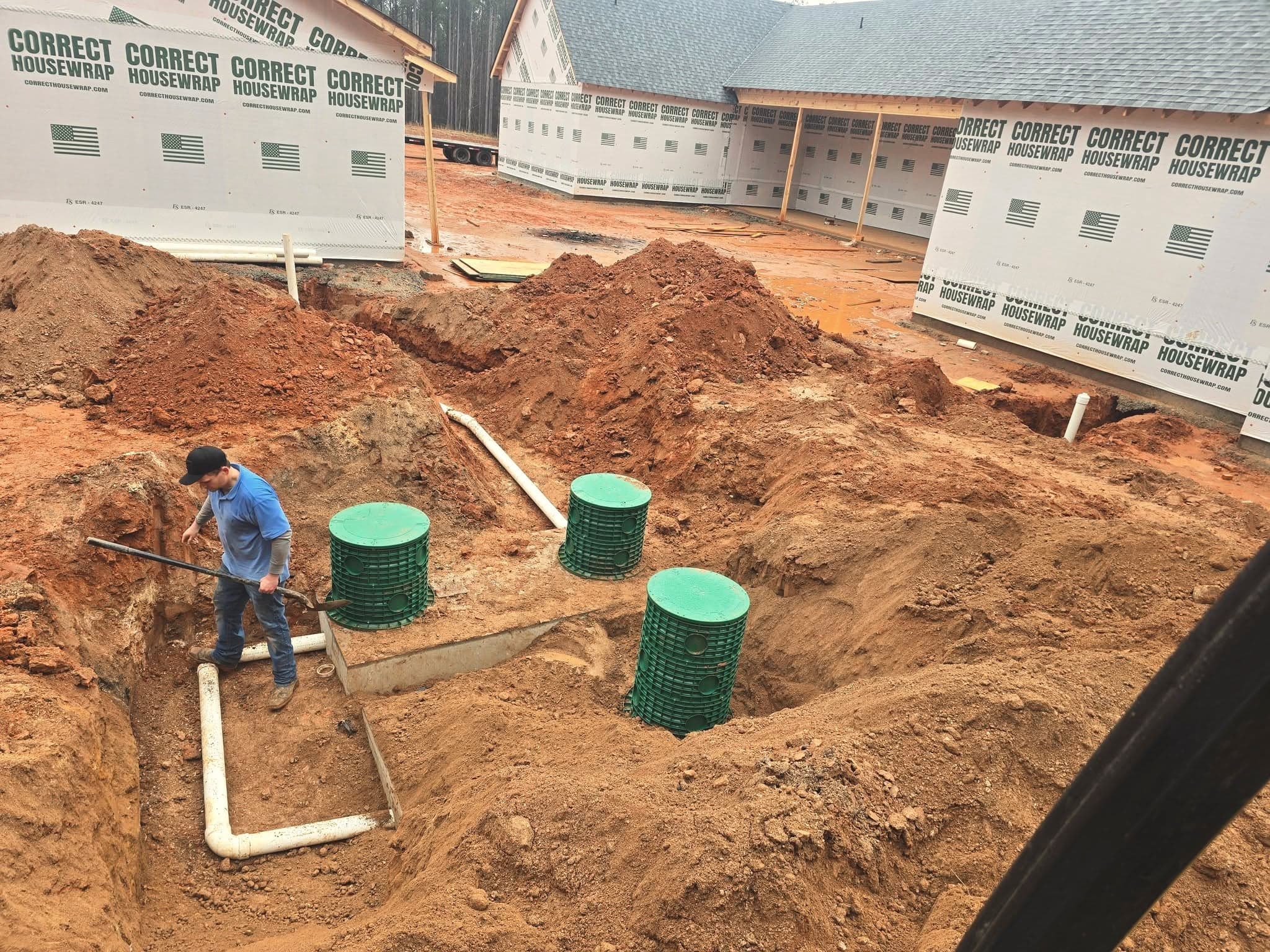
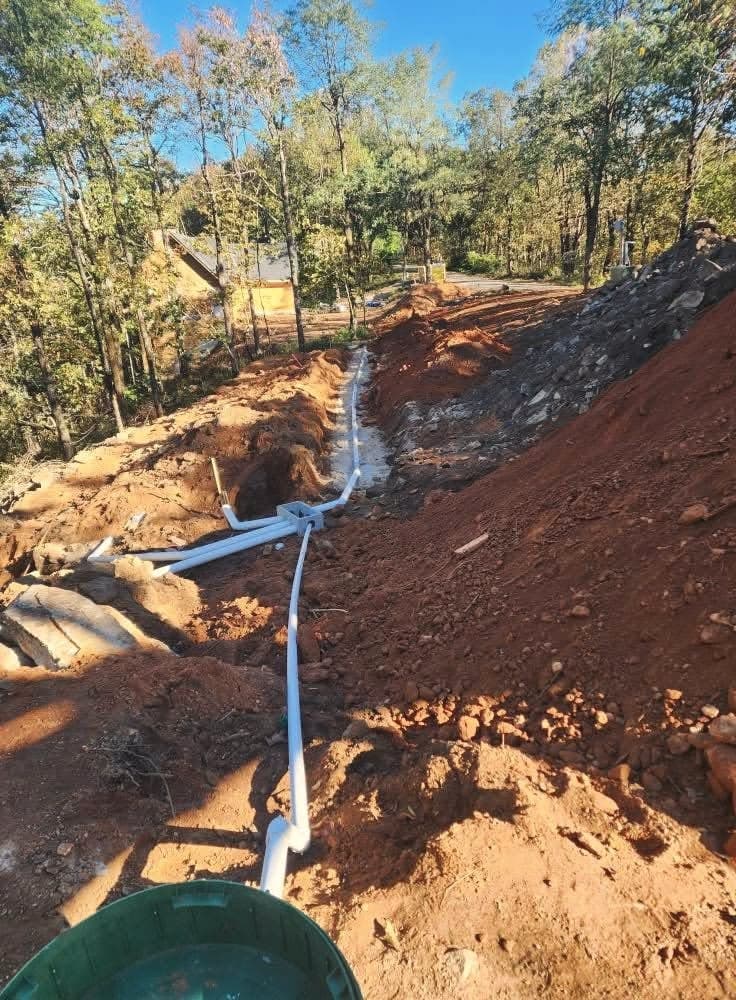
From our job files.

Your options

Repair the leak or replace the line?

The honest answer depends on the pipe, its age and how many times it has leaked. Here is how we weigh it with you on site.

OPTION 01

Spot repair

When it fits: One leak, a pipe material that's otherwise sound (copper, newer PEX or PVC), and a known cause such as a dig strike, a root, or a fitting that let go.

  • Smallest hole in the yard
  • Lowest cost; HomeGuide's range is $400–$1,500
  • Water back on the same visit in many cases
  • Doesn't help if the rest of the pipe is failing
  • A second leak means paying to dig twice

OPTION 02

Full replacement, meter to house

When it fits: Polybutylene, galvanized steel, repeat leaks, whole-house low pressure, or a line that has to move for an addition, driveway, pool or septic work.

  • New pipe end to end, sized to code (3/4 inch minimum)
  • Chance to add a customer-side shutoff and fix the PRV
  • Ends the cycle of patching
  • Longer trench and more yard restoration
  • HomeGuide puts it at $2,000–$5,000 on average

OPTION 03

Trenchless replacement

When it fits: The line runs under a driveway, mature trees or hardscape you don't want disturbed.

  • Far less digging at the surface
  • Needs entry and exit pits anyway
  • Not suited to every soil or route

Trenchless is an option we'll discuss with you. What we do day to day is excavate and replace. If a trenchless method fits your line, we'll talk it through honestly.

Homes & businesses

Houses and businesses: same pipe, different stakes

Residential

Homes

Most house services are a single line, typically 3/4 inch to 1 inch per HomeGuide, running from a meter near the road. The work is usually a trench by mini excavator, a new pipe bedded in clean fill, pressure testing, and backfill and seed.

If you're on septic, the new line's route matters. Georgia's rules keep the tank 10 feet from pressure water lines and the drain field 10 feet from water supply lines, so we route around the system rather than through it.

  • Leak located before we dig
  • Water off for as short a window as the job allows
  • Yard backfilled and graded when we leave

Commercial

Businesses

Commercial services are larger (Covington's tap sheet runs from 3/4-inch up to 4-inch meters), may have a separate fire line, and usually carry a backflow assembly your utility inspects. Tap fees scale with the meter: Covington lists $2,225 for a 3/4-inch water tap and $47,750 for a 4-inch.

Downtime is the real cost for a restaurant, church or shop. We plan the tie-in with you so the shutoff happens when you're closed.

  • Coordinated shutoff window
  • Fire line and backflow kept separate
  • Utility coordination at the meter
Commercial water line repair and replacement

How the job runs

How a water line job runs, from first call to backfill

The meter-to-house run is one continuous pipe, and we treat it that way: the same crew that finds the leak digs it, repairs or replaces the line, and closes the trench. You don't hire a locator, a plumber and an excavator separately.
  1. 1

    Free on-site estimate

    We look at the meter, the shutoff and the path to the house, ask about the bill and the pressure, and tell you whether it looks like a repair or a replacement.

  2. 2

    Call Georgia 811 before any machine digs

    Georgia 811 asks for a ticket at least 3 business days before digging. Utilities mark gas, power, phone and public water and sewer. The law's definition of a utility facility stops at the connection to the customer's facilities, so your own service line usually isn't marked by the utility.

    O.C.G.A. 25-9Georgia 811 — The 811 Process

  3. 3

    Find the leak

    We trace the line from the meter and narrow the leak down by sound, wet soil and pressure checks before we open the ground, so the hole goes where the problem is.

  4. 4

    Shut off and protect the meter

    We close the customer-side valve. Where a utility requires its own crew or supervision at the meter (Rockdale's code, for one), we coordinate that before cutting in.

    Rockdale County Code of Ordinances, Ch. 98, Art. I, Div. 1 — Sec. 98-10 (Municode)

  5. 5

    Excavate, repair or replace

    Spot repairs get a clean cut-out and approved couplings. Replacements get new pipe from the meter outlet to the house connection, kept at least 5 feet from the building sewer or installed under one of the code's listed exceptions.

    IPC 2018 Sec. 603.2Georgia State Minimum Standard Plumbing Code 2018 (IPC 2018), Ch. 6 — Sec. 603 Water Service (UpCodes)

  6. 6

    Permit and inspection where your jurisdiction requires it

    Whether a water service needs a plumbing permit depends on your city or county. We handle the permit when one is needed and schedule any inspection before the trench is closed.

  7. 7

    Pressure test, flush and backfill

    We bring the line up to pressure, check every joint, flush it, then backfill in lifts, compact the trench and leave the surface graded.

Permits & the Georgia rules

Georgia rules that shape a water line route

A water service rarely needs a health-department permit on its own. What catches people is the separation rules: from the sewer under the plumbing code, and from the septic tank and drain field under DPH's Chapter 511-3-1. Georgia's plumbing code is the 2018 IPC with state amendments, and DCA's 2022 amendment list doesn't change Section 603.
  1. 01

    Submit a Georgia 811 locate ticket at least 3 business days before mechanized digging; utilities have at least two full business days to mark or clear.

  2. 02

    Dig within 30 calendar days of the ticket's effective date, or file a new locate request.

  3. 03

    Keep the new service 5 feet from the building sewer, or meet an exception: the water pipe at least 12 inches above the sewer, both in approved materials, or sleeved at a crossing.

  4. 04

    Where the line must cross or run within 10 feet of a drain field, install it at least 12 inches above the absorption line's aggregate and encase it in a single length of larger-diameter water pipe.

  5. 05

    Pull the local plumbing permit if the city or county requires one (HomeGuide puts water line permits at $30–$500 on average), and have the work inspected before backfill.

Georgia rule IPC 2018 Sec. 603.2 (Georgia State Minimum Standard Plumbing Code)

Water service pipe and the building sewer shall be separated by 5 feet (1524 mm) of undisturbed or compacted earth.
Read the rule

Georgia rule Rule 511-3-1-.05(2)

No septic tank shall be installed … less than ten feet (10') from pressure water supply lines
Read the rule

Georgia rule Rule 511-3-1-.07(3)

If the water supply line crosses or comes within ten feet (10') of the absorption field, the water supply line shall be installed at least twelve inches (12") above
Read the rule

Georgia rule O.C.G.A. 25-9-3 (tolerance zone)

the width of the underground facility or sewer lateral plus 18 inches on either side of the outside edge
Read the rule

How it varies by county

  • DeKalb County

    Only the county taps its mains. Where an existing service line needs replacing, DeKalb charges the application as a new service connection (Code Secs. 25-83, 25-84).

  • Rockdale County

    A backflow preventer is required on the customer's side of the meter and is owned by the customer; customer-side changes at the meter happen under county supervision (Sec. 98-10).

  • Gwinnett County

    New meters are installed by DWR; a new residential 3/4-inch meter lists at $1,397 plus a $1,128 water system development charge (January 2026 schedule).

  • Newton County

    NCWSA's water meter fee starts at $2,951 for its smallest listed residential size; inside Covington, the city's own tap sheet applies ($2,225 for a 3/4-inch meter and service).

  • Walton County

    Walton County Water Department customers own the line, PRV and backflow valves from the meter in. Inside Monroe, the city lists a $1,235 water connection fee for a 5/8-inch meter and a $1,839–$2,804 service tap fee.

What it costs

What water line repair costs: published market ranges

No national guide knows your yard. These are published third-party ranges, labeled with their source and year, and the local fees water providers publish. Your number depends on length, depth, what's in the way, and the pipe that comes out.

What moves the price

These are published third-party market ranges and utility fee schedules, not our prices. We give free on-site estimates for your line.

Free estimate: (678) 863-5620
  1. 01Length from meter to housePer-foot pricing means a 40-foot run and a 140-foot run are different jobs. Houses set far back on east-metro lots cost more to re-pipe.
  2. 02Depth and red clayHomeGuide notes water lines in warm regions may sit less than 3 feet deep. Shallow helps, but dense Piedmont clay is slow to dig and must be compacted properly on the way back in.
  3. 03Driveways, walks and trees in the pathHomeGuide lists driveway repair at $100–$400 for small repairs and $600–$3,000 for major damage. Routing around hardscape is often cheaper than cutting through it.
  4. 04Meter and tap workIf the utility has to replace the tap or set a new meter, its fee is separate. DeKalb lists a $1,100 tap fee for a 3/4-inch meter; Covington lists $2,225 for a 3/4-inch meter and service.
  5. 05Septic system on the lotThe 10-foot setbacks from the tank and drain field can lengthen the route. Sleeving a crossing adds material and labor.

Worth knowing

Why a septic contractor is the right call for a water line

On a septic lot, the water service, the sewer line to the tank and the drain field all share one yard. The rules above keep them apart: 10 feet between the tank and a pressure water line, 10 feet between a drain field and a water line, and a sleeved, raised crossing when there's no other way. A crew that doesn't know where your field lines are can put a new water line straight through them.

We're on the Georgia DPH list of certified septic tank installers, so we read a septic permit drawing the same way the county inspector does. When we re-route a water service on a septic property, we plan it around the tank, the distribution box and the repair area. If a leak has saturated the ground over the field, we look at that too before we leave.

On sewered lots in Covington, Conyers, Monroe or Snellville, the concern is the building sewer. The plumbing code wants 5 feet of earth between them, or one of the listed exceptions. Replace one pipe and the other is often right there in the trench wall. That's the point to look at both, not after the yard is seeded.

On a septic lot, the water service, the sewer line to the tank and the drain field all share one yard.

Where we do this

WATER LINE REPAIR across the east metro

Every county runs its own permits and utilities. Start with your county's rules, or jump to your town.

FAQ

Water line repair questions

Straight answers, with the rule or record behind them. Still unsure? Call and ask the crew that digs.

(678) 863-5620

Is the leak between my meter and my house my responsibility?

In every metro Atlanta utility we checked, yes. Gwinnett DWR says leaks between the meter and the home belong to the property owner. Rockdale, DeKalb, NCWSA and the Walton County Water Department draw the same line at the meter. The utility fixes its main, the pipe to the meter and the meter itself.

Source: Gwinnett County DWR — Resident Responsibility

How do I tell if my water line is leaking underground?

Turn off every fixture and read the meter. EPA WaterSense suggests reading it before and after a two-hour period with no water use; if it moved at all, you probably have a leak. Then close the main valve at the house. If the meter still moves, the leak is on the buried service line.

Source: EPA WaterSense — Fix a Leak Week

How much does it cost to replace a water line from the meter to the house?

HomeGuide's December 2025 guide puts main water line replacement at $2,000–$5,000 on average and trenched work at $50–$200 per linear foot. HomeAdvisor's 2026 guide lists repairs at $350–$1,700. These are market ranges, not our prices; we give free on-site estimates.

Source: HomeGuide — How Much Does Water Line Replacement Cost? (Dec. 22, 2025)

Should I replace polybutylene water service pipe even if it's only leaked once?

Usually, yes. InterNACHI explains that disinfectants in the water react with polybutylene and make it flake apart from the inside, anywhere along the pipe, not just at fittings. One leak on a PB service line tends to be followed by another. Replacing the whole run avoids paying to dig twice.

Source: InterNACHI — Polybutylene for Inspectors

Can a new water line go near my septic tank or drain field?

Only at a distance. Georgia Rule 511-3-1-.05(2) keeps septic tanks at least 10 feet from pressure water lines, and .07(3) keeps drain fields 10 feet from water supply lines. A crossing within 10 feet of a field must run at least 12 inches above the aggregate, encased in larger pipe.

Source: Georgia DPH Rules Chapter 511-3-1 On-Site Sewage Management Systems (Jan 2016)

Can the water line and sewer line share a trench?

Georgia's plumbing code (IPC 2018, Sec. 603.2) normally requires 5 feet of undisturbed or compacted earth between the water service and the building sewer. It allows exceptions, including a shared trench when the sewer uses listed materials and crossings where the water pipe is sleeved. We'll tell you which applies on your lot.

Source: Georgia State Minimum Standard Plumbing Code 2018 (IPC 2018), Ch. 6 — Sec. 603 Water Service (UpCodes)

Will Georgia 811 mark my private water line?

Usually not. Georgia's Underground Facility Protection Act defines a utility's facility as extending up to the connection to the customer's facilities. Utilities mark their lines when you file a ticket, but the pipe from your meter to the house is generally yours to locate. We trace it before we dig.

Source: Georgia 811 — Laws & Policies (Georgia Underground Facility Protection Act, O.C.G.A. 25-9)

What are water tap fees for a new line in Newton or Gwinnett County?

NCWSA's fee sheet effective July 1, 2025 lists $2,951 for its smallest residential meter and $3,082 for a 1-inch meter. Gwinnett DWR's January 2026 schedule lists $1,397 for a residential 3/4-inch meter plus a $1,128 water system development charge. Covington publishes its own tap sheet.

Source: NCWSA Water and Sewer Fees (revised May 21, 2025; effective July 1, 2025)

Sources

Where these facts come from

Rules, costs and local facts on this page link to the agency, code or publisher that states them. Cost figures are third-party market ranges, not our prices — estimates are free.

Reviewed by Atlanta Water & Sewage Solutions · Last updated

  1. 1Georgia DPH Certified Septic Tank Installers list (9/18/2026) (2026)
  2. 2NCWSA — Customer vs. NCWSA Responsibilities
  3. 3NCWSA Water and Sewer Fees (revised May 21, 2025; effective July 1, 2025) (2025)
  4. 4City of Covington — Tap Fees
  5. 5Walton County Water Department — Accounts Policies & Procedures (New Service Application) (2023)
  6. 6City of Monroe Code of Ordinances, Ch. 98, Secs. 98-19 and 98-23
  7. 7City of Monroe Water Rates 2026 (2026)
  8. 8Rockdale County Code of Ordinances, Ch. 98, Art. I, Div. 1 — Sec. 98-10 (Municode)
  9. 9Gwinnett County DWR — Resident Responsibility
  10. 10Gwinnett DWR Rates and Fee Schedule — January 2026 (2026)
  11. 11DeKalb County Code Ch. 25, Art. II, Div. 1 — Sec. 25-43 Location, ownership of facilities (Municode)
  12. 12DeKalb County Code Ch. 25, Art. II, Div. 3 — Secs. 25-83, 25-84 Service connections (Municode)
  13. 13DeKalb County Watershed 2022 Rate Sheet — Water and Sewer Rates and Service Charges (2022)
  14. 14HomeGuide — How Much Does Water Line Replacement Cost? (Dec. 22, 2025) (2025)
  15. 15HomeAdvisor — Main Water Line Replacement Cost (2026) (2026)
  16. 16EPA WaterSense — Fix a Leak Week
  17. 17InterNACHI — Polybutylene for Inspectors
  18. 18InterNACHI — Plumbing in Older Homes
  19. 19US EPA — Lead and Copper Rule Improvements (2024)
  20. 20Georgia DPH Rules Chapter 511-3-1 On-Site Sewage Management Systems (Jan 2016) (2016)
  21. 21Georgia State Minimum Standard Plumbing Code 2018 (IPC 2018), Ch. 6 — Sec. 603 Water Service (UpCodes) (2018)
  22. 22Georgia DCA — Georgia State Amendments to the International Plumbing Code (2018 Edition), revised Jan. 1, 2022 (2022)
  23. 23Georgia 811 — Laws & Policies (Georgia Underground Facility Protection Act, O.C.G.A. 25-9) (2022)
  24. 24Georgia 811 — The 811 Process

Ready when you are

Need water line repair? Call the crew that digs.

The pipe from your water meter to your house is yours, not the utility's, in every county we checked. We find the leak, dig it out, and repair or replace the line from Oxford, GA across the east metro.

(678) 863-5620
  • Georgia DPH-certified installer & pumper
  • Residential & commercial
  • Oxford, GA

Property type
What do you need?
Rather talk? (678) 863-5620
Where's the property?
Is sewage backing up inside? (optional)
Who should we call?

By submitting, you agree we may call or text you about this request. Msg & data rates may apply. Reply STOP to opt out. SMS terms.

Call nowFree Estimate