24/7 Emergency? (678) 863-5620

HOMEOWNER GUIDE · SEPTIC VS SEWER · GEORGIA

Septic or sewer in Georgia: how to tell, and when you must connect

Your water bill, the county health office and a walk around the yard will usually settle the first question in an afternoon. The second depends on a state rule about distance and on your local utility's deadlines.
  • Georgia DPH-certified installer & pumper
  • Homes across metro Atlanta
  • Emergency line answered 24/7

Get a free estimate

or call (678) 863-5620

Property type
What do you need?
Rather talk? (678) 863-5620
Where's the property?
Is sewage backing up inside? (optional)
Who should we call?

By submitting, you agree we may call or text you about this request. Msg & data rates may apply. Reply STOP to opt out. SMS terms.

The short answer

Septic or sewer, and when must a Georgia home connect?

Check the water bill first: Gwinnett says a $0.00 sewer charge very likely means septic, and DeKalb bills septic homes no sewer charge. County health records and tank lids in the yard confirm it. Under Georgia rule 511-3-1-.03, new buildings connect when sewer is within 200 feet, and failing systems connect when sewer is available.

Reviewed by Atlanta Water & Sewage Solutions · Last updated

Key facts

Septic vs sewer in Georgia: the quick reference

Each row links to the agency, code or publisher it comes from. Tap a source to check it yourself.

Ways to confirm septic or sewer service and the state and local connection rules for Georgia homeowners, each tied to its published source.
TopicWhat it saysSource
Gwinnett bill testA $0.00 "Sewer Amount Charged" line very likely means septicGwinnett County DWR — Septic Tanks
DeKalb bill testSeptic customers pay no sewer charges, only the water portionDeKalb County Watershed Management — Services & Billing
Gwinnett septic recordsKept for systems installed since 1959; GIS Data Browser may show a sketch and repair permitsGwinnett County DWR — Septic Tanks
Share of Gwinnett residents on septicAbout 30 percent, per Georgia DPH as cited by Gwinnett DWRGwinnett County DWR — Septic Tanks
State connection triggerPublic sewer within 200 ft of the property line or in an abutting right-of-way (511-3-1-.03(1)(a))Georgia DPH Rules Chapter 511-3-1 On-Site Sewage Management Systems (Jan 2016), 2016
When a septic system failsImmediate connection if sewer is available; a residential system under 2,000 gpd may be exempted if a compliant repair fitsGeorgia DPH Rules Chapter 511-3-1 On-Site Sewage Management Systems (Jan 2016), 2016
Abandoning the tankPumped by a certified pumper, then filled with sand, soil or rock, or removed (511-3-1-.17(5))Georgia DPH Rules Chapter 511-3-1 On-Site Sewage Management Systems (Jan 2016), 2016

Plain definitions

Terms that come up

Septic system
An on-site system in which a buried tank separates solids and a drain field returns treated liquid to the soil on your own lot.
Public sewer
A utility-owned collection network of mains and pump stations that carries household wastewater to a treatment plant.
Sewer availability
Georgia's test of whether a public system is within 200 feet of the property line or in a right-of-way abutting the lot.
Septic-to-sewer conversion
Redirecting the house drain into a new lateral to the public sewer and properly abandoning the old tank.

How the job runs

Five ways to find out which one you have

Work through these in order. Most homeowners have the answer by step two.
  1. 1

    Read your water and sewer bill

    In Gwinnett, a zero on the "Sewer Amount Charged" line very likely means septic. DeKalb bills septic customers no sewer charge at all. A well-water home with no utility bill is almost certainly on septic too.

    Gwinnett County DWR — Septic Tanks

  2. 2

    Search county health records

    Environmental Health keeps septic permits and drawings. Gwinnett's records reach back to 1959 and can appear in the county GIS Data Browser; the county put them online in 2011.

    Gwinnett County — Septic Tank Records Now Available Online (news release, June 14, 2011)

  3. 3

    Walk the yard for lids and risers

    Look for round or square lids or risers out from the side of the house where the main plumbing exits, and for a long, level grassy area that could be a drain field.

    UGA Cooperative Extension Bulletin 1421 — A Beginner's Guide to Septic Systems

  4. 4

    Find the cleanout near the street

    Georgia's plumbing code has required a cleanout within 10 ft of the public right-of-way on building sewers since January 1, 2020, so a newer sewer line often shows a capped pipe near the front property line.

    Georgia State Minimum Standard Plumbing Code 2018 (IPC with Georgia amendments), Chapter 7 Sanitary Drainage — via UpCodes

  5. 5

    Ask the utility directly

    Your water and sewer provider can confirm whether an account includes sewer service and whether a main runs along your street.

Permits & the Georgia rules

The 200-foot rule and its exceptions

Georgia sets the floor statewide in DPH rule 511-3-1-.03. Local utilities then add notice periods and procedures, summarized below.
  1. 01

    A new building must connect when public sewer is within 200 ft of the property line or in an abutting right-of-way.

  2. 02

    A working septic system is not forced to connect by the state rule alone; local codes decide whether and when notice is given.

  3. 03

    A failed system must connect immediately if sewer is available. The exception: a residential system under 2,000 gallons per day may be repaired instead if a code-compliant repair fits the lot.

  4. 04

    After connecting, the old tank is pumped by a certified pumper and filled or removed.

Georgia rule 511-3-1-.03(1)(a)

…available within two hundred feet (200') of the property line…
Read the rule

Georgia rule 511-3-1-.03(1)(a)

If an existing on-site sewage system fails, immediate connection shall be made…
Read the rule

Georgia rule 511-3-1-.17(5)

…fill the empty tank with sand, soil, or rock…
Read the rule

How it varies by county

  • Newton County — NCWSA

    NCWSA's sewer-use rules let it require a septic property to connect within 30 days of notice once sewer is within 200 ft.

  • City of Covington

    Covington's code allows 90 days after official notice to connect.

  • DeKalb County

    The general rule gives owners 24 months after notice when sewer is within 100 ft.

  • DeKalb conversion districts

    Inside a septic-to-sewer conversion tax district, owners are encouraged rather than required to connect right away unless health or water-quality conditions call for it; each lot's extension share is capped at $7,500.

  • Rockdale County

    Where sewer is available, Rockdale gives the owner of a failed private system 30 days after written notice to hook up.

  • City of Monroe

    Owners abutting a city sewer within 200 ft connect at their own expense within 30 days of official notice.

Your options

Keep the septic system or connect?

When you have a choice, these are the trade-offs. When the rule gives you no choice, the second column is what the job involves.

OPTION 01

Stay on septic

When it fits: Sewer is not available, or it is available but your working system is not under a connection notice.

  • No sewer charge on the bill
  • No connection or tap fee
  • Pumping, inspection and eventual field repairs are yours
  • A failure with sewer available can trigger mandatory connection

OPTION 02

Connect to public sewer

When it fits: Sewer is within reach and you are building new, under notice, or your system has failed.

  • No tank to pump or field to maintain
  • Upfront connection fees plus the lateral, and a monthly sewer charge
  • The old tank must be properly abandoned

HomeGuide's 2025 national range for converting septic to sewer is $3,000 to $15,000; utility fees are separate, such as NCWSA's $3,650 residential sewer fee plus $75 tap inspection.

The whole story

Why so many metro Atlanta homes are still on septic

Sewer mains followed dense development, and a great deal of suburban east-metro housing went up on lots large enough for a tank and field. Gwinnett DWR cites Georgia DPH in saying the county has one of the heaviest concentrations of septic systems in the nation, with roughly 30 percent of residents using one (Gwinnett DWR).

That makes the question more common than people expect, especially at purchase time. Two houses on the same street can differ: one built after a main was extended, one built before and never tied in. DeKalb adopted a septic-to-sewer ordinance in 2017 because parts of the county still rely on older tanks that may eventually fail (DeKalb Code Div. 2.5).

If you are buying, ask for the bill history and the county septic file before closing. If you already own the house and nothing is written down, the county health department's records plus a probe for the tank lid will usually resolve it in one visit.

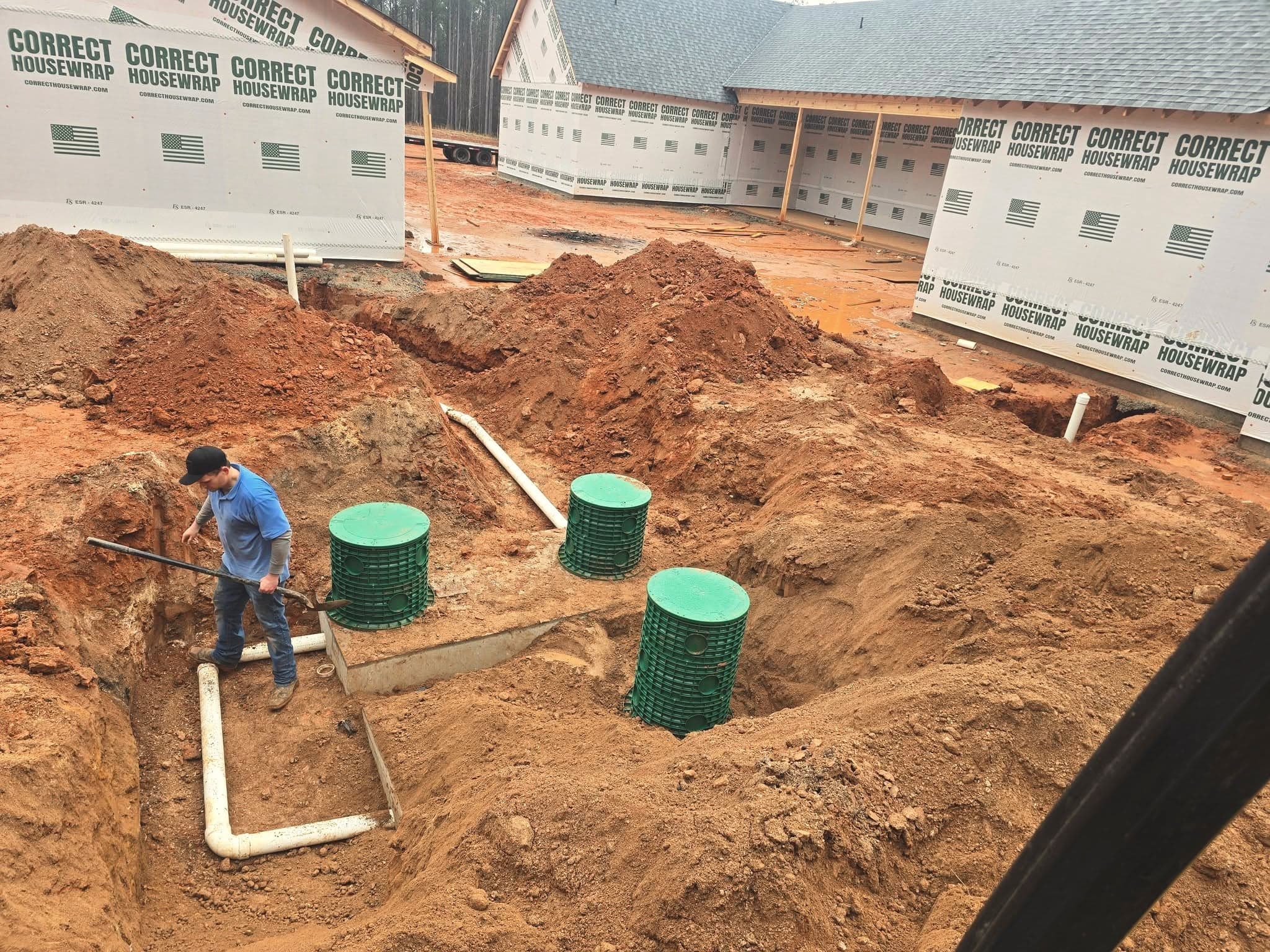
From our job files.

FAQ

Septic or sewer: common questions

Straight answers, with the rule or record behind them. Still unsure? Call and ask the crew that digs.

(678) 863-5620

How can I tell from my water bill if I'm on septic?

Look for a sewer line item. Gwinnett County DWR says a bill showing $0.00 for "Sewer Amount Charged" means the property is very likely on septic. DeKalb Watershed Management charges septic customers only for water. If your bill lists a sewer charge with a real amount, you are almost certainly connected to public sewer.

Source: Gwinnett County DWR — Septic Tanks

Where can I find septic records for my Georgia house?

Start with the county Environmental Health office, which issues septic permits. In Gwinnett, records go back to systems installed in 1959, and the county GIS Data Browser may show a septic sketch and past repair permits. DeKalb Public Health, GNR Public Health and Northeast Health District handle records for their own counties.

Source: Gwinnett County DWR — Septic Tanks

Do I have to connect to sewer if it's within 200 feet?

Georgia's rule requires a new building to connect when public sewer is within 200 feet of the property line or in an abutting right-of-way. For an existing working septic system, local utilities decide whether to issue a connection notice. NCWSA and Monroe can require connection within 30 days of notice, and Covington allows 90 days.

Source: Georgia DPH Rules Chapter 511-3-1 On-Site Sewage Management Systems (Jan 2016)

What happens if my septic system fails and sewer is nearby?

Under Georgia rule 511-3-1-.03(1), a failing system must connect immediately if public sewer is available. The rule allows an exception for a residential system under 2,000 gallons per day when a repair meeting code can be made on the lot. Rockdale County requires a failed system to connect within 30 days of written notice.

Source: Georgia DPH Rules Chapter 511-3-1 On-Site Sewage Management Systems (Jan 2016)

What do I do with the old septic tank after connecting to sewer?

Georgia rule 511-3-1-.17(5) requires the abandoned tank to be pumped by a certified pumper and then filled with sand, soil or rock, or removed, so no one can fall into it. Gwinnett's conversion procedure adds an inspection after the tank is cleaned out and crushed or filled with concrete or gravel.

Source: Residential Septic to Sewer Procedure for Unincorporated Gwinnett County

How much does it cost to switch from septic to sewer in Georgia?

HomeGuide's 2025 national range for a septic-to-sewer conversion is $3,000 to $15,000 for the work itself. Utility fees come on top: NCWSA's residential sewer fee is $3,650 plus a $75 tap inspection, and Gwinnett lists a $4,172 system development charge for a residential conversion on a 3/4-inch meter.

Source: HomeGuide — Sewer Line Installation Cost (updated December 2025)

Can I find my septic tank without records?

Often. Follow the main plumbing exit from the house and probe the lawn a short distance out for a lid or riser, since the building sewer runs from there to the tank. A camera pushed from an indoor cleanout with a locator can also trace the line to the tank.

Source: UGA Cooperative Extension Bulletin 1421 — A Beginner's Guide to Septic Systems

Does DeKalb County make septic homes connect to sewer?

DeKalb's general code gives owners 24 months after notice to connect when sewer is within 100 feet. Inside a special septic-to-sewer conversion tax district, owners are encouraged but not required to connect right away unless health or water-quality conditions call for it, and each lot's share of the line extension is capped at $7,500.

Source: DeKalb County Code Ch. 25, Art. IV, Div. 2.5 — Special Septic Tank to Sewer Conversion Tax District

Sources

Where these facts come from

Rules, costs and local facts on this page link to the agency, code or publisher that states them. Cost figures are third-party market ranges, not our prices — estimates are free.

Reviewed by Atlanta Water & Sewage Solutions · Last updated

  1. 1Georgia DPH Rules Chapter 511-3-1 On-Site Sewage Management Systems (Jan 2016) (2016)
  2. 2Gwinnett County DWR — Septic Tanks
  3. 3Gwinnett County — Septic Tank Records Now Available Online (news release, June 14, 2011) (2011)
  4. 4DeKalb County Watershed Management — Services & Billing
  5. 5DeKalb Public Health — Septic Systems
  6. 6GNR Public Health — Septic Systems (Gwinnett, Newton & Rockdale) (2026)
  7. 7Georgia State Minimum Standard Plumbing Code 2018 (IPC with Georgia amendments), Chapter 7 Sanitary Drainage — via UpCodes (2018)
  8. 8UGA Cooperative Extension Bulletin 1421 — A Beginner's Guide to Septic Systems (2024)
  9. 9NCWSA Rules and Regulations for Sewer Use and Industrial Pretreatment (rev. April 10, 2019) (2019)
  10. 10Covington, GA Code of Ordinances § 13.16.040 (Municode)
  11. 11DeKalb County Code Ch. 25, Art. IV, Div. 1 — Sewers and Sewage Disposal, Generally (Sec. 25-154)
  12. 12DeKalb County Code Ch. 25, Art. IV, Div. 2.5 — Special Septic Tank to Sewer Conversion Tax District
  13. 13Rockdale County Code, Ch. 98, Art. III, Div. 2 — Wastewater Application and Connection Process; Fees (Municode)
  14. 14City of Monroe Code of Ordinances, Ch. 98, Art. IV (Secs. 98-142, 98-144)
  15. 15Residential Septic to Sewer Procedure for Unincorporated Gwinnett County
  16. 16NCWSA Water and Sewer Fees (sheet header: effective July 1, 2025) (2025)
  17. 17HomeGuide — Sewer Line Installation Cost (updated December 2025) (2025)

Ready when you are

Rather have a pro look at it? Call the crew that digs.

Your water bill, the county health office and a walk around the yard will usually settle the first question in an afternoon. The second depends on a state rule about distance and on your local utility's deadlines.

(678) 863-5620
  • Georgia DPH-certified installer & pumper
  • Residential & commercial
  • Oxford, GA

Property type
What do you need?
Rather talk? (678) 863-5620
Where's the property?
Is sewage backing up inside? (optional)
Who should we call?

By submitting, you agree we may call or text you about this request. Msg & data rates may apply. Reply STOP to opt out. SMS terms.

Call nowFree Estimate