24/7 Emergency? (678) 863-5620
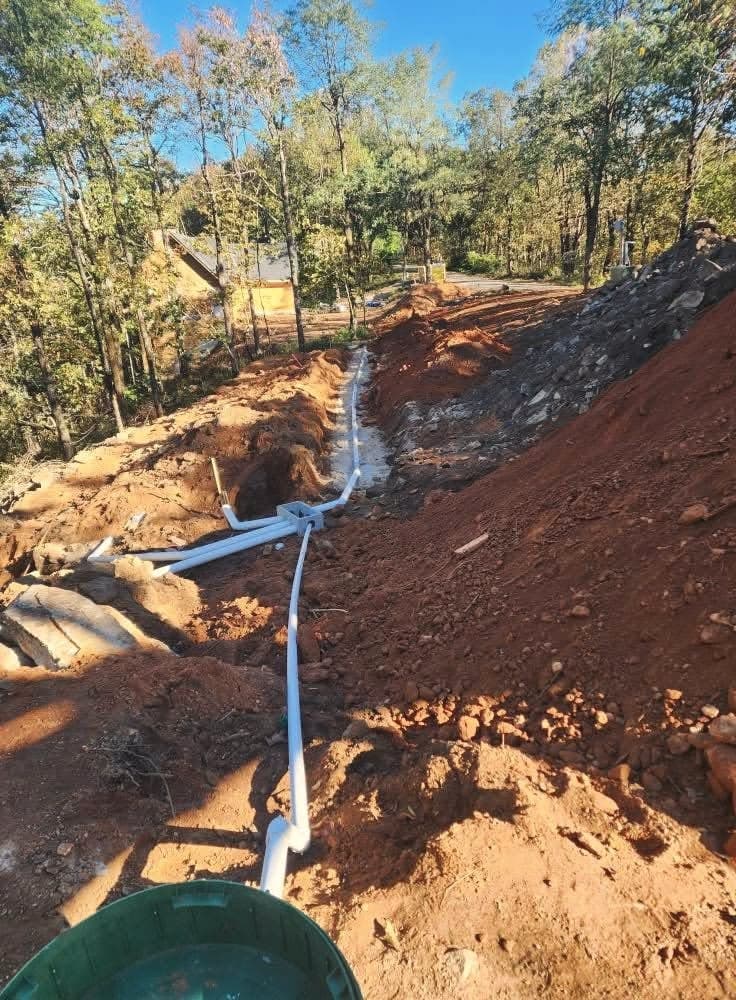
From our job files: parallel drain field trenches with PVC laterals feeding a concrete distribution box, a laser level on a tripod

DRAIN FIELD REPAIR · METRO ATLANTA

Drain field repair and replacement in metro Atlanta

Georgia's Piedmont red clay takes effluent slowly, so a drain field here has less room for error than one in sand. We find out why yours stopped absorbing, then restore the lines, add to them, or rebuild the field under a county repair permit.
  • Georgia DPH-certified installer & pumper
  • Residential & commercial
  • Emergency line answered 24/7

Get a free estimate

or call (678) 863-5620

Property type
What do you need?
Rather talk? (678) 863-5620
Where's the property?
Is sewage backing up inside? (optional)
Who should we call?

By submitting, you agree we may call or text you about this request. Msg & data rates may apply. Reply STOP to opt out. SMS terms.

The short answer

What is drain field repair?

Drain field repair restores a septic absorption field that has stopped taking effluent, by clearing or replacing failed lines, adding trench length, or building a new field. In Georgia's red clay it needs a county repair permit and, in GNR counties, a Level 3 soil report. Atlanta Water & Sewage Solutions, a DPH-certified installer in Oxford, GA, does this work.

Reviewed by Atlanta Water & Sewage Solutions · Last updated

Key facts

Drain field repair in Georgia: the key facts

Each row links to the agency, code or publisher it comes from. Tap a source to check it yourself.

Rules, soils and typical market ranges for drain field repair and replacement in metro Atlanta, each with its source.
TopicWhat it saysSource
PermitRequired. Field repairs, replacements and added lines must be permitted and inspected (511-3-1-.03(2)(c)).Georgia DPH Rules Chapter 511-3-1, On-Site Sewage Management Systems (Jan 2016), 2016
Soil reportLevel 3 soil report required for repair permits in Gwinnett, Newton and Rockdale (GNR, since February 7, 2022).GNR Public Health — Septic Systems (Gwinnett, Newton & Rockdale), 2026
Field sizingAbsorption area is based on the sewage volume and the soil where the field sits (511-3-1-.07(1)).Georgia DPH Rules Chapter 511-3-1, On-Site Sewage Management Systems (Jan 2016), 2016
Why clay means a bigger fieldClayey, slowly permeable soils need a larger drain field than sandy, permeable soils (NC State Extension).NC State Extension — Septic Systems and Their Maintenance, 2026
Where the biomat formsIn the upper 1 to 6 inches of soil just below the trench bottom (NC State Extension).NC State Extension — Septic Systems and Their Maintenance, 2026
Setback from wellsNo absorption field within 100 ft of wells, springs or sinkholes (511-3-1-.07(3)).Georgia DPH Rules Chapter 511-3-1, On-Site Sewage Management Systems (Jan 2016), 2016
Typical repair range$1,000 to $5,000 for drain field repair or rejuvenation; $3,000 to $15,000 for replacement (typical market ranges per HomeGuide, 2026).HomeGuide — How Much Does a Leach or Drain Field Replacement Cost? (2026), 2026
Our certificationListed on the Georgia DPH certified septic tank installer list dated 9/18/2026.Georgia DPH Certified Septic Tank Installers list (dated 9/18/2026), 2026

Plain definitions

Drain field terms, defined

Drain field (absorption field)
Georgia's rules define it as "a configuration of absorption trenches installed in a portion of land and used for the absorption and final treatment of sewage" (511-3-1-.02).
Absorption line and trench
The trench is the excavation; the line is the perforated pipe (or chamber) laid in it to carry effluent (511-3-1-.02).
Biomat
A layer of microbial growth that forms at the soil face under each trench and slows absorption; excess solids from the tank can thicken it until the trench floods.
Hydraulic overload
More liquid than the field can absorb, whether from heavy water use or rain-soaked soil; the EPA says an overloaded field can flood and push sewage to the surface or back into the house.
Chamber system
A field built with open-bottom plastic chambers instead of pipe and gravel; Georgia measures such products against a conventional 36-inch-wide gravel trench (511-3-1-.18).
Level 3 soil report
A stamped soil report from a Georgia-recognized certified soil classifier that GNR requires before it reviews a repair application.

Soil & terrain

Why fields fail sooner in Piedmont red clay

East-metro Atlanta sits on the Piedmont, and the ground under most lawns is a thin sandy topsoil over dense red clay subsoil. The USDA's official description of the Cecil series, the signature Piedmont soil, puts red clay from about 8 inches down to 42 inches, "firm; sticky, plastic" (NRCS Cecil OSD). Pacolet, its steeper cousin, has red clay starting as shallow as 3 inches in the typical profile and commonly sits on 15% to 25% slopes (NRCS Pacolet OSD).

These soils are rated well drained, so water doesn't pond in them year-round. But clay takes effluent in slowly, and Georgia sizes every field to the soil it sits in (511-3-1-.07(1)). That is why fields here are long. It is also why a field that was sized right in the 1980s can lose its margin once the house adds a bathroom, the family grows, or the lot is regraded over the trenches.

The same soils decide what a repair looks like. A perc test shows how fast water soaks in. Georgia's permit application asks for more than that: soil types and capabilities, seasonal high groundwater, and rock or other impervious layers (511-3-1-.03(2)(a)). In GNR counties the Level 3 soil report is how that gets documented. The classifier's report tells Environmental Health whether new trenches can go in the same ground, need more length, or have to move to better soil elsewhere on the lot.

You can look at your own lot first. The USDA Web Soil Survey is free: draw a box around your property and it lists the mapped soil units and how each rates for septic tank absorption fields. It is a starting point, not a substitute for the soil report, because map units are drawn at a scale far larger than one backyard.

  1. Cecil

    Very deep, well drained, Piedmont uplands; red clay Bt horizon roughly 8 to 42 inches in the typical pedon. About 26% of Newton County's major soil area and about 41% of Walton County's.

  2. Pacolet

    Very deep, well drained, moderately permeable; slopes commonly 15% to 25%. The largest series by area in the Newton–Rockdale soil survey (GA649), about 65,000 acres.

  3. Appling

    Very deep, well drained Piedmont soil with a strong-brown clay subsoil from about 12 to 48 inches; about 28,800 acres as a major component in Walton County.

  4. Cecil and Pacolet (county shares)

    Newton overlap of GA649: Cecil ~45,900 of 178,600 acres, Pacolet ~39,000 acres. Walton (GA297): Cecil ~87,300 of 211,400 acres.

  5. Soil series · USDA NRCS

Warning signs

Signs the field itself is failing

These point past the tank to the trenches. If your problem is an alarm, a backup at every drain, or a smell at the lids, start with septic repair instead. For a longer checklist, read signs your drain field is failing.

Seeing soggy stripes or rain-day backups? Call (678) 863-5620

  • 1. Soggy ground in stripesWet or spongy soil that runs in straight parallel bands follows the trench pattern. UGA lists wet, mushy soil and standing greyish water as failure signs.
  • 2. Grass greener over the linesBright green strips in a dry July lawn mean effluent is reaching the root zone instead of soaking down.
  • 3. Trouble after rain, fine in dry weatherSlow drains that come and go with the weather are classic hydraulic overload. UGA notes a saturated field may not handle several loads of laundry on a rainy day.
  • 4. Tank full to the outlet right after serviceIf the tank refills to the outlet and effluent runs back when it's pumped, the water is backing up from the field.
  • 5. Wet spot at the low end onlyOn a slope, effluent runs to the lowest trench end and surfaces there first. It can also mean the first line has sealed and flow is being forced downhill.
  • 6. Odor across the yard, not at the lidsSewage smell spread over the field area rather than at the tank means effluent is near the surface.

The whole story

What actually kills a drain field in the east metro

Biomat is the slow one. Every working field grows a thin biological layer where effluent meets the soil, and a little of it helps treat the water. NC State Extension explains that when a tank is never pumped, solids flow into the trenches and build "an intensive biomat that becomes too thick" (NC State). Clay has fewer and smaller pores to begin with, so it seals faster. Georgia DPH warns that additives sold to "help" can make it worse by pushing fine solids out to the field.

Water is the fast one. The Piedmont gets 37 to 60 inches of rain a year, according to the NRCS description of the Pacolet series, and much of it lands in heavy storms on soil that is already slow to drain. When the ground around the trenches is saturated, the field has nowhere to send effluent, and the EPA notes an overloaded field can flood and push sewage to the surface or back up into toilets and sinks. A field that only fails after storms may be undersized, sitting in the path of roof or yard runoff, or both. Sometimes the right repair starts with a swale or a French drain above the field, which is grading and drainage work.

Weight crushes the rest. UGA Extension says not to drive or park over the tank or drain field because it can collapse drain lines or compact the soil (UGA B1421). A concrete truck for a patio, a pool dig or a new driveway laid across old lines can do in an afternoon what biomat takes decades to do. Our guide on whether you can build or drive over a drain field covers what's safe.

Roots are the sneaky one. UMD Extension notes tree roots can enter the system and clog the pipes. Trees planted along a field edge follow the moisture into the trenches and fill the pipe perforations. And some fields were simply too small from day one: sized for a two-bedroom house that is now four, or laid out before today's Level 3 soil reports showed what the clay could really take.

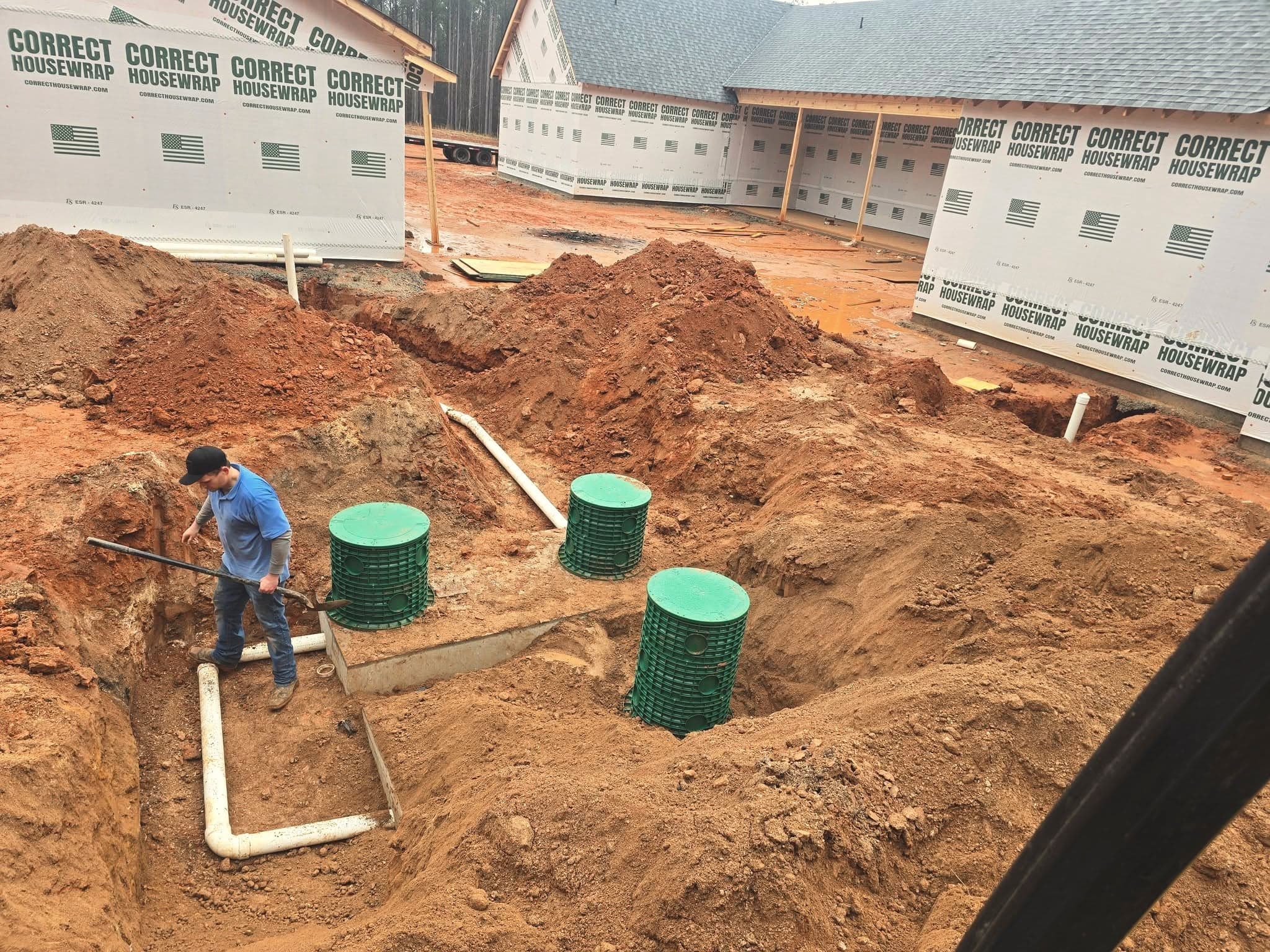
From our job files.

Your options

Restore, add, replace or relocate: choosing the repair

The choice depends on why the field failed and what soil and space are left. The soil report and the county make the final call on anything that adds or moves trenches.

OPTION 01

Fix the feed, then rest the field

When it fits: The field is overloaded because flow isn't reaching all the lines, or the tank has been sending solids.

  • Least digging
  • Lets a lightly clogged biomat recover while water use drops
  • Only works if the soil hasn't sealed
  • Tank-side parts must be repaired first

Distribution box and baffle fixes are covered on our septic repair page.

OPTION 02

Clean or jet the field lines

When it fits: Pipes are packed with solids or roots but the trench soil still takes water.

  • Keeps the existing trenches
  • Does nothing for sealed soil
  • Roots come back if the trees stay

Angi puts field-line cleaning at $600 to $1,100 for most homes (2026).

OPTION 03

Replace failed lines or add trench length

When it fits: Some lines are crushed, sealed or root-choked, and the soil report shows room for new or longer trenches.

  • Reuses good lines and the D-box
  • Usually cheaper than a whole new field
  • Needs a permit, soil report and inspection
  • New trenches must meet every setback

OPTION 04

Full replacement in place

When it fits: The whole field has sealed or collapsed and the original area is still suitable soil.

  • New trenches sized to today's household and soil data
  • Larger permit, more excavation and restoration
  • Old trenches must come out or be bypassed

OPTION 05

Relocate to a new repair area

When it fits: The original ground is worn out, wet, or now too close to a well, pool or building.

  • Fresh soil the biomat has never touched
  • Needs usable soil elsewhere on the lot
  • New supply line from the tank adds cost

OPTION 06

Connect to public sewer

When it fits: Sewer is available within 200 ft of the property line or in an abutting right-of-way.

  • No field to maintain again
  • Georgia requires it if sewer is available and the system has failed, unless the residential exemption applies

See septic-to-sewer conversion.

Worth knowing

Gravel trenches or chambers?

A conventional Georgia field is perforated pipe in washed gravel. A chamber field swaps the gravel for open-bottom plastic arches, so the soil at the bottom of the trench is open to effluent instead of being covered by stone. Both are standard in Georgia: rule 511-3-1-.09 treats anything that "differs in design or operation from the conventional or chamber septic tank" as the alternative category, which puts chambers in the mainstream.

The rules explain why chambers can compete. Rule 511-3-1-.18 says that because of "compaction, contact area and fines associated with gravel aggregate," the effective infiltrative surface of a gravel trench is reduced by an estimated 50%. Chamber products are measured against that 36-inch gravel trench. Any trench-length reduction a product earns is set by the county at permit time. GNR's site-plan rules require the design to be shown at 100% length, with reductions given at permit issuance if they apply.

In red clay, chambers have practical advantages. No gravel has to be trucked across the yard, the trench floor stays open, and the units are light enough to set by hand on a slope. Our job photos show chamber lines on hillside lots and multi-line fields fed by a concrete distribution box with flow-equalizer caps, shot to grade with a laser level. Gravel still makes sense where a design or the county calls for it, or when we're matching an existing field we're extending.

Whichever you get, one crew does the whole run. The crew that finds the failed field also sets the D-box, lays the lines and backfills. The tank crew and the field crew are the same people, so nobody has to chase a second contractor when the D-box needs moving to reach the new trenches.

A conventional Georgia field is perforated pipe in washed gravel.

Homes & businesses

Residential fields and commercial fields

Residential

Home drain fields

House fields are sized by bedrooms, so the common failure is a family that outgrew its field, or a field that lost ground to an addition, pool or driveway. Before we plan new trenches, we check them against the absorption-field setbacks in 511-3-1-.07(3).

Selling a house with a soggy field? A septic inspection documents the condition, and the repair still goes through the county permit.

  • Line replacement and added trench length
  • Full field replacement or relocation
  • Drainage fixes above the field

Commercial

Commercial drain fields

Churches, schools, offices and restaurants load a field in bursts: Sunday services, lunch rushes, shift changes. Commercial fields are larger, often pumped or dosed, and must follow the pretreatment rule in 511-3-1-.03(1)(c) when the waste runs strong. GNR lists $600 for a commercial site evaluation, permit and initial inspection in Rockdale.

Where the layout allows, field work can be staged in sections so part of the system stays in service.

  • Dosed and pumped fields
  • Multiple distribution boxes
  • Permits sized to commercial flow
Commercial septic repair

How the job runs

How we repair a drain field

Field work always runs through Environmental Health. This is the order we follow.
  1. 1

    Free on-site estimate and history

    We walk the field with you, note where it's wet and when, and pull the county permit record if one exists so we know the original layout.

  2. 2

    Rule out the tank side

    The tank is pumped and the baffles, D-box and any pump checked first. A field is never condemned for a failure upstream of it.

  3. 3

    Probe and expose the lines

    We dig test holes at the trenches to see ponding depth, biomat, crushed pipe and roots, line by line.

  4. 4

    Soil report

    In GNR counties a certified soil classifier prepares a Level 3 soil report. It shows where good soil remains and how much trench it needs.

    GNR (since Feb 7, 2022)GNR Residential Septic System Repair Permit Application and Requirements (Rev. 2024-05-03)

  5. 5

    Repair permit

    We handle the permit application. GNR allows 10 working days for review and a site visit, and may ask for an engineered site plan on difficult lots.

    511-3-1-.03(2)(c)GNR Residential Septic System Repair Permit Application and Requirements (Rev. 2024-05-03)

  6. 6

    Lay out to the setbacks

    New trenches are staked to clear wells by 100 ft, buildings, drives and property lines by the distances in 511-3-1-.07(3), and set to grade.

    511-3-1-.07(3)Georgia DPH Rules Chapter 511-3-1, On-Site Sewage Management Systems (Jan 2016)

  7. 7

    Build the lines

    Trenches are dug, the D-box set level, and pipe-and-gravel or chambers installed to the permitted design.

  8. 8

    County inspection, then cover

    Environmental Health inspects before backfill. Permits stay valid for up to 12 months.

    511-3-1-.03(3)(a)Georgia DPH Rules Chapter 511-3-1, On-Site Sewage Management Systems (Jan 2016)

  9. 9

    Backfill, grade and seed

    We crown the backfill so rain sheds off the field, divert runoff where needed, and leave the area ready for grass. Grass is the only thing that should grow there.

Permits & the Georgia rules

Georgia rules for drain field repairs

The rule is statewide, but the soil-report requirement and fees depend on your county's health district. The full setback tables are in our septic setback guide.
  1. 01

    Field setbacks (511-3-1-.07(3)): 100 ft from wells, springs and sinkholes; 10 ft from water supply lines and buildings with basements; 5 ft from buildings without basements, other structures, drives, hardscape and property lines; 15 ft from embankments, pool foundations and drainage ditches; 50 ft from streams, ponds and other water.

  2. 02

    If a water line must cross or come within 10 ft of the field, it goes at least 12 inches above the top of the aggregate, sleeved in a single length of larger pipe.

  3. 03

    Trenches are designed and installed to the criteria in the DPH Manual for On-Site Sewage Management Systems (511-3-1-.07(4)).

  4. 04

    In GNR counties, submit the application with a Level 3 soil report; an engineered site plan must show the original and repair system at 100% length.

Georgia rule 511-3-1-.03(2)(c)

Repairs, replacement, or additions to existing systems must be permitted and inspected.
Read the rule

Georgia rule 511-3-1-.07(3)

No absorption field will be constructed less than one hundred feet (100') from existing or proposed wells, springs, or sinkholes
Read the rule

Georgia rule 511-3-1-.07(3)

No absorption field shall be installed in areas where groundwater, soil characteristics, or adverse geological formation may interfere with the absorption…
Read the rule

Georgia rule GNR repair requirements

A Level 3 soil report will be required for the review of the application.
Read the rule

How it varies by county

  • Newton County

    GNR Newton EH. Level 3 soil report required; residential site evaluation, permit and initial inspection $275; reinspection $175.

  • Rockdale County

    GNR Rockdale EH. Level 3 soil report required; residential $275, commercial $600.

  • Walton County

    Northeast Health District. Residential repair permit $200.00 (effective August 1, 2024). Per the county service request form, adding to an existing system requires a Level III soil report and a $200 final inspection.

  • DeKalb County

    DeKalb Public Health. Repair permit $150; land-use evaluation with site visit $150.

What it costs

What drain field repair and replacement typically cost

Field costs swing more than any other septic job because they depend on how much trench is needed and where it can go. These published third-party ranges show the size of the job. We price yours on site, free.

What moves the price

These are published third-party typical market ranges (HomeGuide and Angi, 2026) and county fee schedules, not our prices. We give free on-site estimates.

Free estimate: (678) 863-5620
  1. 01Trench length the clay demandsSlow Piedmont soils mean more linear feet of trench for the same house, and more feet means more digging and more pipe or chambers.
  2. 02Slope and accessSteep Pacolet-type lots need trenches cut on contour and machines that can work a hillside; fenced yards can force smaller equipment.
  3. 03Soil report and permitCounty repair fees run $150 to $275 residential in the counties above; the Level 3 report is billed separately by the soil classifier.
  4. 04Relocation distanceMoving the field means a new line from the tank. HomeGuide lists $40 to $180 per linear foot for that septic line.
  5. 05Restoration and drainageRegrading, diverting runoff and re-establishing grass add to jobs where storm water helped kill the old field.

Where we do this

DRAIN FIELD REPAIR across the east metro

Every county runs its own permits and utilities. Start with your county's rules, or jump to your town.

FAQ

Drain field repair questions

Straight answers, with the rule or record behind them. Still unsure? Call and ask the crew that digs.

(678) 863-5620

Is a leach field the same as a drain field?

Yes. Leach field, drain field, drainfield and absorption field all name the same part: the trenches that take effluent from the tank and let it soak into the soil. Georgia's rules use "absorption field." Whatever you call it, repairing or replacing it needs a county permit and inspection under 511-3-1-.03(2)(c).

Source: Georgia DPH Rules Chapter 511-3-1, On-Site Sewage Management Systems (Jan 2016)

Can a failing drain field be repaired, or does it have to be replaced?

It depends on the soil. If the tank-side cause is fixed and the trenches aren't sealed, the field can often be restored or partly rebuilt. NC State Extension says once the soil is completely clogged, a new field or an advanced pretreatment unit is usually needed. Test holes and the soil report tell us which case you're in.

Source: NC State Extension — Septic Systems and Their Maintenance

Why does my drain field only act up after heavy rain?

Saturated clay can't take on more water. When storms fill the soil around the trenches, effluent backs up until the ground drains. That points to a field that's undersized, in the path of runoff, or partly sealed. Diverting surface water or adding trench length often fixes it. See septic backing up after rain.

Source: UGA Cooperative Extension Bulletin 1421 — A Beginner's Guide to Septic Systems

Do I need a soil report to repair my drain field in Gwinnett, Newton or Rockdale?

Yes. GNR Public Health has required a Level 3 soil report for all septic permits, repairs included, since February 7, 2022. The report comes from a certified soil classifier recognized by the state. If an approved Level 3 report is already on file for your property, GNR may accept it instead of a new one.

Source: GNR Public Health — Septic Systems (Gwinnett, Newton & Rockdale)

Can I just add lines to my existing drain field?

Often, if the soil report shows usable soil and the new trenches fit the setbacks. It's a permitted addition: in Walton County, any addition to an existing system needs a Level III soil report and a $200 final inspection. The existing distribution box may need replacing to feed the extra lines evenly.

Source: Walton County Environmental Health Service Request Form

Do chamber systems work in Georgia red clay?

Yes. Chambers are one of the two standard field types in Georgia's rules, alongside gravel. Rule 511-3-1-.18 notes gravel aggregate cuts a trench's effective infiltrative surface by an estimated 50%, which is why chambers are measured against a 36-inch gravel trench. Any length reduction is set by the county at permit time.

Source: Georgia DPH Rules Chapter 511-3-1, On-Site Sewage Management Systems (Jan 2016)

Will bacteria or enzyme treatments unclog my drain field?

Georgia DPH says no. Its additives advisory says biological additives can break solids into fine particles that flow into the drain field and may lead to clogging. A clogged field needs its cause fixed: tank solids, overload, compaction or roots. Regular pumping does more for the field than any product.

Source: Georgia DPH — Septic Additives Advisory

How close can a new drain field be to my well or house?

Under 511-3-1-.07(3), a field must be at least 100 ft from wells, springs and sinkholes. It must be 10 ft from water supply lines and buildings with basements, 5 ft from buildings without basements, drives and property lines, and 15 ft from pool foundations and embankments. Relocations often come down to these distances.

Source: Georgia DPH Rules Chapter 511-3-1, On-Site Sewage Management Systems (Jan 2016)

Sources

Where these facts come from

Rules, costs and local facts on this page link to the agency, code or publisher that states them. Cost figures are third-party market ranges, not our prices — estimates are free.

Reviewed by Atlanta Water & Sewage Solutions · Last updated

  1. 1Georgia DPH Rules Chapter 511-3-1, On-Site Sewage Management Systems (Jan 2016) (2016)
  2. 2Georgia DPH Manual for On-Site Sewage Management Systems
  3. 3GNR Residential Septic System Repair Permit Application and Requirements (Rev. 2024-05-03) (2024)
  4. 4GNR Public Health — Septic Systems (Gwinnett, Newton & Rockdale) (2026)
  5. 5GNR Environmental Health Fee Schedule — Newton County (2026)
  6. 6GNR Environmental Health Fee Schedule — Rockdale County (2026)
  7. 7Walton County Environmental Health Fees (effective August 1, 2024) (2024)
  8. 8Walton County Environmental Health Service Request Form (2023)
  9. 9DeKalb Public Health Environmental Health Division Fee Schedule (effective January 1, 2024) (2024)
  10. 10HomeGuide — How Much Does a Leach or Drain Field Replacement Cost? (2026) (2026)
  11. 11Angi — Cost to Replace Septic Tank and Drain Field (updated Jul 8, 2026) (2026)
  12. 12Angi — How Much Does It Cost to Clean Septic Field Lines? (updated Jul 9, 2026) (2026)
  13. 13NC State Extension — Septic Systems and Their Maintenance (2026)
  14. 14University of Maryland Extension — FAQs on Septic Systems
  15. 15US EPA — How Your Septic System Works
  16. 16UGA Cooperative Extension Bulletin 1421 — A Beginner's Guide to Septic Systems (2024)
  17. 17Georgia DPH — Septic Additives Advisory
  18. 18USDA NRCS Web Soil Survey
  19. 19USDA NRCS Official Series Description — Cecil series
  20. 20USDA NRCS Official Series Description — Pacolet series
  21. 21USDA NRCS Official Series Description — Appling series
  22. 22USDA NRCS Soil Data Access — Newton and Rockdale Counties soil survey (GA649)
  23. 23Georgia DPH Certified Septic Tank Installers list (dated 9/18/2026) (2026)

Ready when you are

Need drain field repair? Call the crew that digs.

Georgia's Piedmont red clay takes effluent slowly, so a drain field here has less room for error than one in sand. We find out why yours stopped absorbing, then restore the lines, add to them, or rebuild the field under a county repair permit.

(678) 863-5620
  • Georgia DPH-certified installer & pumper
  • Residential & commercial
  • Oxford, GA

Property type
What do you need?
Rather talk? (678) 863-5620
Where's the property?
Is sewage backing up inside? (optional)
Who should we call?

By submitting, you agree we may call or text you about this request. Msg & data rates may apply. Reply STOP to opt out. SMS terms.

Call nowFree Estimate