24/7 Emergency? (678) 863-5620

SEPTIC REPAIR · METRO ATLANTA

Septic repair in metro Atlanta that fixes the cause

A septic system fails at one part first: a baffle, a pipe joint, the distribution box, a pump or its float. We find that part, get the county repair permit, and fix it so the rest of the system stops paying for it.
  • Georgia DPH-certified installer & pumper
  • Residential & commercial
  • Emergency line answered 24/7

Get a free estimate

or call (678) 863-5620

Property type
What do you need?
Rather talk? (678) 863-5620
Where's the property?
Is sewage backing up inside? (optional)
Who should we call?

By submitting, you agree we may call or text you about this request. Msg & data rates may apply. Reply STOP to opt out. SMS terms.

The short answer

What does septic repair involve in Georgia?

Septic repair in metro Atlanta means finding the one component that failed (a baffle, outlet tee, broken pipe, tilted distribution box, pump or float) and fixing it under a county repair permit, as Georgia rule 511-3-1-.03 requires. Atlanta Water & Sewage Solutions, a DPH-certified septic installer and pumper in Oxford, GA, diagnoses the tank side first.

Reviewed by Atlanta Water & Sewage Solutions · Last updated

Key facts

Septic repair in Georgia: the key facts

Each row links to the agency, code or publisher it comes from. Tap a source to check it yourself.

Permits, fees, responsibility and typical market ranges for septic repair in metro Atlanta, each with its source.
TopicWhat it saysSource
Permit needed?Yes. Georgia rule 511-3-1-.03(2)(c): repairs, replacements and additions must be permitted and inspected.Georgia DPH Rules Chapter 511-3-1, On-Site Sewage Management Systems (Jan 2016), 2016
Permit lifeNot more than 12 months from the date of issue (511-3-1-.03(3)(a)).Georgia DPH Rules Chapter 511-3-1, On-Site Sewage Management Systems (Jan 2016), 2016
Soil report (Gwinnett, Newton, Rockdale)GNR requires a Level 3 soil report for repair permits, in force since February 7, 2022.GNR Public Health — Septic Systems (Gwinnett, Newton & Rockdale), 2026
County permit fee examplesGNR residential site evaluation, permit and initial inspection: $275 ($400 when it starts from a complaint). Walton residential repair permit: $200. DeKalb repair permit: $150.GNR Environmental Health Fee Schedule — Newton County, 2026
Who is responsibleThe property owner. UGA Extension: in Georgia the owner is responsible for the system's operation, maintenance and repairs.UGA Cooperative Extension Bulletin 1421 — A Beginner's Guide to Septic Systems, 2024
Typical repair range$600 to $3,000 average septic tank repair; $500 to $1,300 pump replacement (typical market ranges per HomeGuide, 2026).HomeGuide — How Much Does Septic Tank System Repair Cost? (2026), 2026
Sewer within 200 ft?A failing system must connect to public sewer if it is available; a residential system under 2,000 gallons per day may be exempted if a compliant repair fits (511-3-1-.03(1)).Georgia DPH Rules Chapter 511-3-1, On-Site Sewage Management Systems (Jan 2016), 2016
How common septic is here36.8% of Georgia homes use septic, versus 25% nationally (UGA CAES).UGA CAES News — Georgia septic systems, 2014
Who we areOn the Georgia DPH lists of certified septic tank installers and [approved septic tank pumpers](https://dph.georgia.gov/media/92741/download), both dated 9/18/2026.Georgia DPH Certified Septic Tank Installers list (dated 9/18/2026), 2026

Plain definitions

The parts that fail, in one line each

Septic failure
Georgia's rules define a failed system as one that "constitutes a health hazard by reason of inadequate treatment or disposal of sewage" (511-3-1-.02).
Inlet and outlet baffles (tees)
The baffles or T-shaped fittings at each end of the tank that keep floating scum and settled sludge inside the tank so they don't travel into the drain field.
Effluent filter
A screen that newer tanks use in place of the sanitary tee at the outlet end to catch solids before they leave the tank.
Distribution box (D-box)
A small box between the tank and the drain lines that splits the effluent among several lines in the field.
Pump tank and effluent pump
On systems that can't drain to the field by gravity, a second tank with a pump lifts effluent to the field; floats switch the pump on and off, and a control panel sounds the alarm on pump failure or high water.
Riser
A pipe or collar that brings a tank opening up to grade; Georgia's rules require openings, risers and manholes to keep surface water out (511-3-1-.05(6)).

Warning signs

Symptoms, and the part that usually causes them

Every symptom below points somewhere specific. Tell us which ones you're seeing when you call and we can usually narrow the search before we lift a lid. UGA Extension lists slow drains, backups, gurgling, odors, wet soil, grey standing water and unusually green grass as failure signs (UGA B1421).

Seeing two or more? Call (678) 863-5620 for a free on-site estimate

  • 1. Every drain in the house is slow at onceWhen the whole house backs up together, the blockage is usually at or before the tank inlet: a clogged or collapsed inlet tee, a root ball in the building sewer, or a crushed pipe between the house and the tank.
  • 2. The pump-tank alarm is soundingThe panel is telling you the liquid in the pump tank is too high. That is a failed pump, a stuck or tangled float, a tripped breaker, or a clogged pump screen. It is not a signal to pour anything down the drain. Our septic alarm guide covers what to do first.
  • 3. A wet or green strip over just one drain lineIf one line stays soggy while the others look dry, the distribution box has often settled or tilted and is sending most of the flow down the low outlet.
  • 4. Sewage odor at the tank lidsA cracked lid, a missing riser seal or a broken inlet pipe lets gas out at the surface. It also lets rainwater in, which pushes the tank to overflow faster.
  • 5. Tank level sits above the outlet pipeWhen we open the tank and the liquid is standing above the outlet invert, something downstream is holding it back: a blocked outlet tee or filter, a broken outlet pipe, a D-box problem, or a saturated field.
  • 6. Roots at the lid or in the pipesTree and shrub roots grow into drain lines and even into the tank (UGA B1421). They find cracked joints and gaskets first.
  • 7. A sunken spot over the tank or pipe runSettling soil over the tank or its lines can mean a broken pipe washing fill away, or a lid that has started to fail. Keep people and vehicles off it until it's checked.

The whole story

Tank problem or field problem? How we separate them

The most expensive mistake in septic work is replacing a drain field that wasn't the problem. A cracked outlet baffle can flush scum into the lines for years, and the field gets blamed. A tilted distribution box can drown one trench while three others sit dry, and the whole field gets condemned. So we work from the house outward and prove each part before we move on to the next.

First we find the tank and open it. As a Georgia DPH-approved pumper we can pump it on the same visit, and pumping is also a test. Before the hose goes in, we note where the liquid sits against the outlet. When we pump the tank down, we watch whether effluent runs backward out of the outlet pipe. Backflow from the outlet means the water has nowhere to go downstream. A normal level with the house still backing up puts the problem on the inlet side.

With the tank empty we can see the baffles. Concrete baffles crack and fall off. Older sanitary tees can snap at the joint, clog, or be missing entirely. The DPH additives advisory warns that acids in some additives "can actually corrode concrete septic tanks and distribution boxes" (Georgia DPH). If the outlet baffle has been gone a long time, we tell you plainly that the field has probably taken solids, and we check it next rather than assuming.

Next is the distribution box. We dig it up and run water through it. Every outlet should take an even share. If one outlet sits lower, or roots or solids are choking another, the box gets leveled, cleaned or replaced, and flow-equalizer caps can be set on the outlets. On pumped systems we check the pump, floats, panel and screen in the pump tank. That includes whether the float tree is tangled in the cord and whether the pump is actually moving water.

Only after the tank, pipes, D-box and pump are cleared do we call a drain field failed. If it is the field, you don't have to start over with a second company. The same crew that found the problem digs the lines too, under the same permit conversation with Environmental Health. The field side has its own page: drain field repair and replacement.

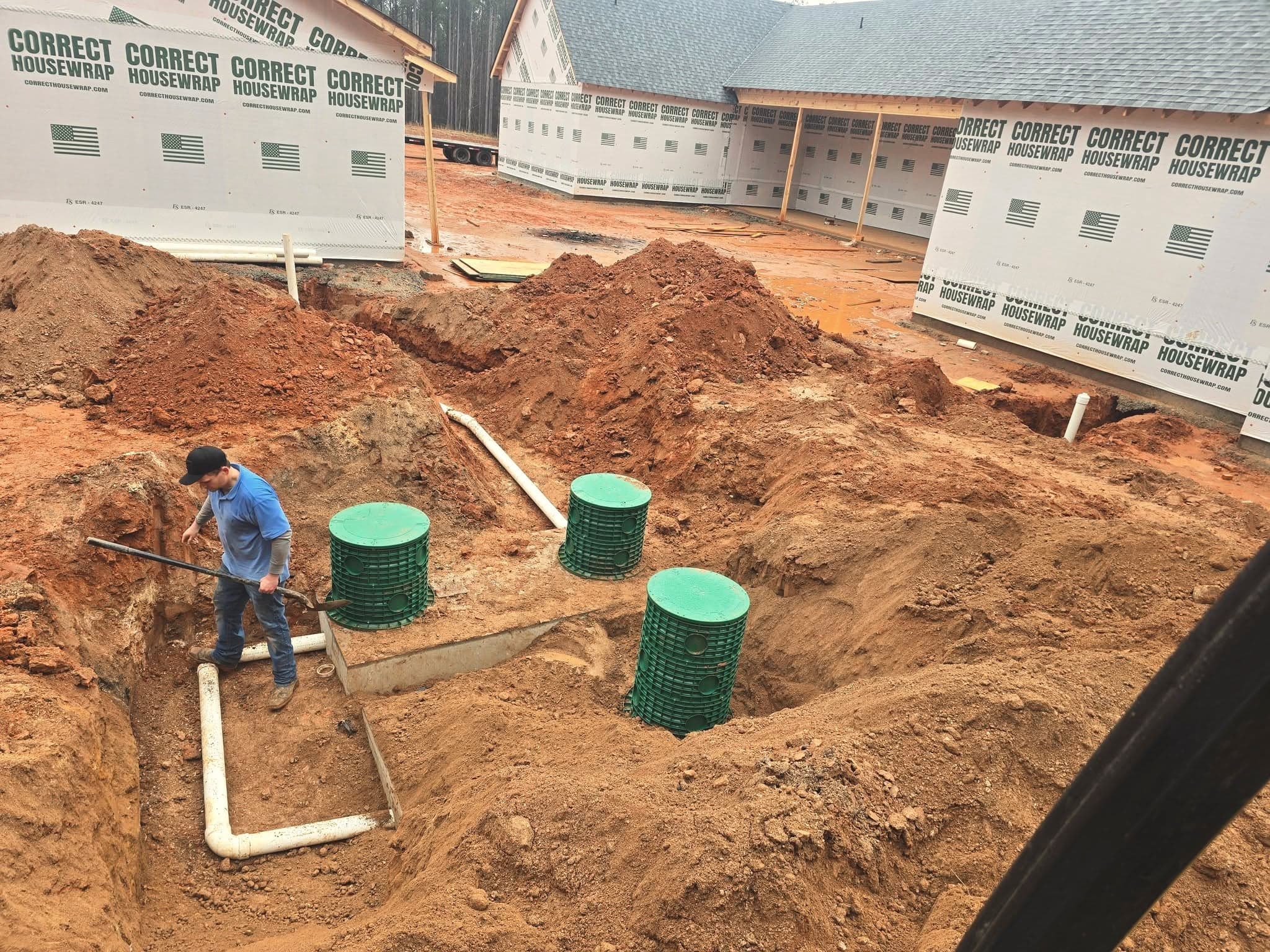
From our job files.

Your options

Repair options, from smallest to largest

Most septic repairs are one of these. Which one fits depends on what we find with the tank open, not on what the symptom looked like from the yard.

OPTION 01

Baffle, tee or effluent-filter replacement

When it fits: The inlet or outlet baffle is cracked, fallen off, clogged or missing, or the outlet filter is packed.

  • Small dig at the tank opening
  • Protects the drain field from solids
  • Often paired with the pump-out
  • The tank must be pumped first
  • If solids already reached the field, the field still needs checking

HomeGuide notes most pros won't do baffle work on a full tank; it gets pumped first (HomeGuide).

OPTION 02

Pipe repair between house, tank and D-box

When it fits: A pipe is broken, separated at a joint, crushed by a vehicle, or packed with roots.

  • Fixes backups at the source
  • New PVC with sealed joints resists roots
  • Needs a trench along the failed run
  • Driveway or patio crossings add restoration work

OPTION 03

Distribution box level, repair or replacement

When it fits: One line is overloaded, the box has settled or cracked, or outlets are blocked.

  • Spreads flow over the whole field again
  • Can bring an overloaded trench back into use
  • A trench that took years of extra flow may still need work

OPTION 04

Pump, float, alarm or panel replacement

When it fits: The alarm is sounding, the pump runs but moves no water, or the float sticks.

  • Restores pumped systems quickly once parts are set
  • Alarm protects the house from backup
  • The pump tank usually needs pumping first
  • Electrical faults upstream of the panel need an electrician

OPTION 05

Riser and lid repair

When it fits: Lids are cracked, sunken or buried deep, or surface water gets into the tank.

  • Stops rainwater getting in
  • Makes every future pump-out and inspection easier
  • A buried tank must be dug to reach the opening

OPTION 06

Tank replacement

When it fits: The tank is structurally failed: collapsed, badly cracked, or undersized for the house under 511-3-1-.05.

  • Brings the tank to current Georgia sizing and two-compartment rules
  • Largest tank-side job
  • Old tank must be pumped and abandoned or removed per 511-3-1-.17(5)

OPTION 07

Connect to public sewer instead

When it fits: The system has failed and public sewer is available (511-3-1-.03(1)).

  • Ends septic maintenance for good
  • Tap and connection fees from the utility
  • The tank must be properly abandoned

See septic-to-sewer conversion.

Homes & businesses

Home systems and commercial systems fail differently

Residential

Residential septic repair

Most home repairs are inlet or outlet baffles, a root-choked building sewer, a settled D-box, or a pump on a house that sits below its field. The GNR application asks whether sewage is backing up in the house or surfacing in the yard (GNR). Tell us which, because it points us to the tank side or the field side.

If you're selling, a repair found during a septic inspection for a home sale still needs its own permit and inspection before closing.

  • Baffles, tees and outlet filters
  • Building sewer and tank-to-D-box pipes
  • Effluent pumps, floats, alarms
  • Risers and lids

Commercial

Commercial septic repair

Churches, shops, offices and restaurants on septic see heavy short bursts of flow, and sometimes kitchen waste. Georgia rule 511-3-1-.03(1)(c) requires facilities whose waste is stronger than 200 mg/L BOD5 and TSS to pretreat it before a conventional or chamber system. A failed outlet baffle at a commercial tank sends that load straight into the field.

Commercial repair permits cost more. GNR lists $600 for a commercial site evaluation, permit and initial inspection, and Walton lists $365 for a commercial repair permit. We plan the work around your hours.

  • Larger or multiple tanks
  • Pump stations and dosing tanks
  • Grease-heavy waste streams
Commercial septic repair

How the job runs

How a septic repair runs, step by step

Georgia requires the repair to be permitted and inspected. Here is the order we work in.
  1. 1

    Call and free on-site estimate

    Call (678) 863-5620. Tell us the symptoms, when the tank was last pumped, and whether you have an alarm or a pump. If sewage is in the house, say so; we'll tell you how fast we can be there.

  2. 2

    Locate and open the tank

    We find the lids, dig to them if there are no risers, and open the tank. County permit records often show where the tank and field are. Our permit-records guide shows where to look.

  3. 3

    Pump and inspect

    Septage is removed by a certified pumper and hauled under a county septage removal permit (511-3-1-.11). With the tank down we check the baffles, walls, inlet and outlet.

    511-3-1-.11Georgia DPH Rules Chapter 511-3-1, On-Site Sewage Management Systems (Jan 2016)

  4. 4

    Trace downstream

    We expose and test the distribution box, and on pumped systems the pump, floats and panel. Only then do we decide whether the field is involved.

  5. 5

    Permit and soil report

    We handle the permit. In Gwinnett, Newton and Rockdale that means a Level 3 soil report from a certified soil classifier, unless one is already on file with GNR. A chosen septic contractor may apply as the owner's agent.

    511-3-1-.03(2)(c)GNR Residential Septic System Repair Permit Application and Requirements (Rev. 2024-05-03)

  6. 6

    Make the repair

    Baffles, pipe, D-box, pump or tank: the failed part is replaced, set level on firm bearing, and joints sealed.

  7. 7

    Inspection before cover

    Environmental Health inspects the repair before it is covered. DeKalb, for example, must be notified for final inspection before the system is covered.

    511-3-1-.03(2)(c)DeKalb Public Health — Septic Systems

  8. 8

    Backfill and risers

    We backfill, add risers where it makes sense so the next pump-out needs no digging, and grade the area so surface water runs away from the lids.

    511-3-1-.05(6)Georgia DPH Rules Chapter 511-3-1, On-Site Sewage Management Systems (Jan 2016)

Permits & the Georgia rules

Georgia septic repair permits, county by county

Every repair runs through the county Environmental Health office. The state rule is the same everywhere; the paperwork, soil report and fee depend on your county. Our Georgia septic permit guide covers new systems too.
  1. 01

    Check whether public sewer is available within 200 feet of the property line or in an abutting right-of-way. If it is, a failing system must connect unless the residential exemption applies.

  2. 02

    Get a Level 3 soil report where required (all GNR counties). An approved report already on file with GNR may be reused.

  3. 03

    File the county repair application. On GNR's form, mark "Repair of Failing System" and whether sewage is backing up or surfacing; your contractor may apply as your agent.

  4. 04

    Allow review and a site visit. GNR asks for 10 working days, and may require an engineered site plan on difficult lots.

  5. 05

    Do the repair within the 12-month permit window and call for inspection before anything is covered.

Georgia rule 511-3-1-.03(2)(c)

Repairs, replacement, or additions to existing systems must be permitted and inspected.
Read the rule

Georgia rule 511-3-1-.03(1)(a)

If an existing on-site sewage system fails, immediate connection shall be made to a public or community sewerage system if such a system is available.
Read the rule

Georgia rule 511-3-1-.17(2)

The property owner shall be responsible for properly operating and maintaining the on-site sewage management system to increase its life expectancy and prevent failure.
Read the rule

How it varies by county

  • Newton County

    GNR Newton Environmental Health, Covington. Level 3 soil report required. Residential site evaluation, permit and initial inspection $275; $400 when it starts from a complaint; reinspection $175. Installing without a permit costs 2 × the permit fees.

  • Gwinnett County

    GNR Gwinnett Environmental Health, Lawrenceville. Level 3 soil report required. Residential $275, or $400 from a complaint; reinspection $175.

  • Rockdale County

    GNR Rockdale Environmental Health, Conyers. Level 3 soil report required. No separate repair line: repairs use the $275 residential site evaluation, permit and initial inspection fee ($600 commercial).

  • Walton County

    Northeast Health District. Residential repair permit $200.00; commercial repair permit $365.00 (effective August 1, 2024). Any addition to an existing system needs a Level III soil report. Ask the office whether your repair does.

  • Morgan County

    Northeast Health District. Residential repair permit $200.00; commercial $300.00 (effective August 1, 2024).

  • DeKalb County

    DeKalb Public Health, Decatur. Repair permit $150. The repair must be permitted before work starts, and only a Georgia DPH-certified contractor may repair the system.

What it costs

What septic repairs typically cost

No two septic repairs cost the same, which is why we price yours on site for free. These are published third-party ranges so you know the size of the numbers before we arrive.

What moves the price

These are published third-party typical market ranges (HomeGuide, 2026) and county fee schedules, not our prices. We give free on-site estimates.

Free estimate: (678) 863-5620
  1. 01Depth and risersA tank with no risers has to be dug out before anyone can pump or repair it. Deep lids add labor on every visit until risers go on.
  2. 02Red clay and accessHand-digging stiff Piedmont clay around a tank is slow; a fenced backyard with no machine access costs more than an open side yard.
  3. 03Permit and soil reportCounty fees run $150 to $400 for a residential repair in the counties above. In GNR counties the Level 3 soil report is a separate bill from a private soil classifier.
  4. 04Whether the field took damageA baffle caught early is a small job. A baffle missing for years can mean field work on top; HomeGuide puts drain field replacement at $5,000 to $20,000 or more in its baffle article.
  5. 05RestorationPipe runs under driveways, patios or landscaping add cutting and replacement that the repair itself doesn't.

Worth knowing

When sewer is close: the 200-foot rule

In the east metro, septic and sewer sit side by side. Cities like Covington, Conyers, Monroe and Snellville run public sewer, and plenty of homes near their service areas still run to a tank. That matters the day a system fails, because Georgia doesn't let you simply repair a failed septic system if public sewer is available.

Rule 511-3-1-.03(1)(a) requires connection when a public or community sewer is available within 200 feet of the property line, or in a right-of-way abutting the property. If an existing system fails, the connection is supposed to be immediate. There is one release valve. Under 511-3-1-.03(1)(b), a residential system under 2,000 gallons per day may be exempted if the repair meets the state manual and the lot has enough area and usable soils, as decided by the County Board of Health.

So before we quote a septic repair near a sewer line, we find out where the nearest main is and whether Environmental Health will allow the repair. If the answer is connect, it is the same kind of digging from our side: a new sewer lateral from the house to the tap, and the old tank pumped and filled or removed under 511-3-1-.17(5). One crew handles both halves, so you aren't coordinating a septic company to close the tank and a sewer contractor to build the lateral. The steps are in our septic-to-sewer conversion guide and on the sewer line installation page.

In the east metro, septic and sewer sit side by side.

Where we do this

SEPTIC REPAIR across the east metro

Every county runs its own permits and utilities. Start with your county's rules, or jump to your town.

FAQ

Septic repair questions

Straight answers, with the rule or record behind them. Still unsure? Call and ask the crew that digs.

(678) 863-5620

Do I need a permit to repair my septic system in Georgia?

Yes. Rule 511-3-1-.03(2)(c) says repairs, replacements and additions to existing systems must be permitted and inspected. That covers baffles, pipes, D-boxes and pumps, not just field work. A routine pump-out alone doesn't need one, per DeKalb Public Health. We handle the permit and call for the inspection.

Source: Georgia DPH Rules Chapter 511-3-1, On-Site Sewage Management Systems (Jan 2016)

Can a broken septic baffle cause drain field failure?

It can. The baffles and T-shaped outlet keep scum and sludge in the tank so they don't travel into the drain field (US EPA). Without an outlet baffle, solids flow into the trenches and help seal the soil. Replacing a baffle early is far cheaper than the field work that follows a missing one.

Source: US EPA — How Your Septic System Works

My septic alarm keeps going off. Is the pump dead?

Not always. The alarm means high water in the pump tank. The cause can be a failed pump, a float stuck or tangled, a tripped breaker, or a clogged pump screen. Cut water use to the minimum and call. Don't open the pump tank yourself, and don't add chemicals. Our septic alarm guide covers the first steps.

How do you know if the problem is the tank or the drain field?

We check it rather than guess. With the tank open we note the liquid level against the outlet, then watch for backflow from the outlet pipe during pumping. Then we inspect the baffles, dig up and water-test the distribution box, and check the pump system. The field is only blamed after those parts check out.

What does a Level 3 soil report have to do with a septic repair?

In Gwinnett, Newton and Rockdale, GNR Public Health requires a Level 3 soil report for repair permits, in force since February 7, 2022. It comes from a state-recognized certified soil classifier and is paid to the classifier, not GNR. If an approved Level 3 report is already on file for your lot, GNR may accept it.

Source: GNR Residential Septic System Repair Permit Application and Requirements (Rev. 2024-05-03)

Will a septic additive fix my backup?

No. Georgia DPH's advisory says additives are not beneficial and can be harmful. Chemical and biological products can push fine solids out to the drain field, and acids can corrode concrete tanks and distribution boxes. A backup has a physical cause, such as a blockage, a failed part or a full tank, and that cause needs a repair.

Source: Georgia DPH — Septic Additives Advisory

My house is near a sewer line. Can I still repair my septic system?

Maybe. If public sewer is within 200 feet of your property line or in an abutting right-of-way, a failing system must connect. A residential system under 2,000 gallons per day may be exempted if a code-compliant repair fits the lot's area and usable soils. The County Board of Health decides, so we check with them before quoting.

Source: Georgia DPH Rules Chapter 511-3-1, On-Site Sewage Management Systems (Jan 2016)

Who pays for septic repairs, the homeowner or the county?

The property owner. UGA Extension puts it plainly: in Georgia the property owner is responsible for the system's operation, maintenance and repairs. Georgia rule 511-3-1-.17(2) says the same. The county's role is to permit and inspect the repair, and to investigate complaints about failing systems.

Source: UGA Cooperative Extension Bulletin 1421 — A Beginner's Guide to Septic Systems

Should I add risers when the tank is repaired?

Usually yes, if your lids are buried. Every future pump-out, inspection or repair starts with digging to the lids, and a riser ends that. Georgia's rules require openings, risers and manholes to keep surface water out, so a riser has to be sealed properly. A loose one lets rainwater fill the tank.

Source: Georgia DPH Rules Chapter 511-3-1, On-Site Sewage Management Systems (Jan 2016)

Sources

Where these facts come from

Rules, costs and local facts on this page link to the agency, code or publisher that states them. Cost figures are third-party market ranges, not our prices — estimates are free.

Reviewed by Atlanta Water & Sewage Solutions · Last updated

  1. 1Georgia DPH Rules Chapter 511-3-1, On-Site Sewage Management Systems (Jan 2016) (2016)
  2. 2GNR Residential Septic System Repair Permit Application and Requirements (Rev. 2024-05-03) (2024)
  3. 3GNR Public Health — Septic Systems (Gwinnett, Newton & Rockdale) (2026)
  4. 4GNR Environmental Health Fee Schedule — Newton County (2026)
  5. 5GNR Environmental Health Fee Schedule — Gwinnett County (2026)
  6. 6GNR Environmental Health Fee Schedule — Rockdale County (2026)
  7. 7Walton County Environmental Health Fees (effective August 1, 2024) (2024)
  8. 8Morgan County Environmental Health Fees (effective August 1, 2024) (2024)
  9. 9DeKalb Public Health — Septic Systems
  10. 10DeKalb Public Health Environmental Health Division Fee Schedule (effective January 1, 2024) (2024)
  11. 11HomeGuide — How Much Does Septic Tank System Repair Cost? (2026) (2026)
  12. 12HomeGuide — How Much Does Septic Baffle Replacement Cost? (2026) (2026)
  13. 13HomeGuide — How Much Does Septic Distribution Box Replacement Cost? (2026) (2026)
  14. 14US EPA — How Your Septic System Works
  15. 15NC State Extension — Septic Systems and Their Maintenance (2026)
  16. 16UGA Cooperative Extension Bulletin 1421 — A Beginner's Guide to Septic Systems (2024)
  17. 17UGA CAES News — Georgia septic systems (2014)
  18. 18Georgia DPH — Septic Additives Advisory
  19. 19Georgia DPH Certified Septic Tank Installers list (dated 9/18/2026) (2026)
  20. 20Georgia DPH Approved Septic Tank Pumpers list (dated 9/18/2026) (2026)

Ready when you are

Need septic repair? Call the crew that digs.

A septic system fails at one part first: a baffle, a pipe joint, the distribution box, a pump or its float. We find that part, get the county repair permit, and fix it so the rest of the system stops paying for it.

(678) 863-5620
  • Georgia DPH-certified installer & pumper
  • Residential & commercial
  • Oxford, GA

Property type
What do you need?
Rather talk? (678) 863-5620
Where's the property?
Is sewage backing up inside? (optional)
Who should we call?

By submitting, you agree we may call or text you about this request. Msg & data rates may apply. Reply STOP to opt out. SMS terms.

Call nowFree Estimate