OPTION 01
Spot repair of the leak
When it fits: A single failed joint, fitting or damaged section on a line that's otherwise sound.
- Shortest shutdown
- Smallest pavement cut
- Older lines that leak once tend to leak again elsewhere
Serving metro Atlanta from Oxford, GA
Georgia DPH-certified septic installer & pumper24/7 Emergency? (678) 863-5620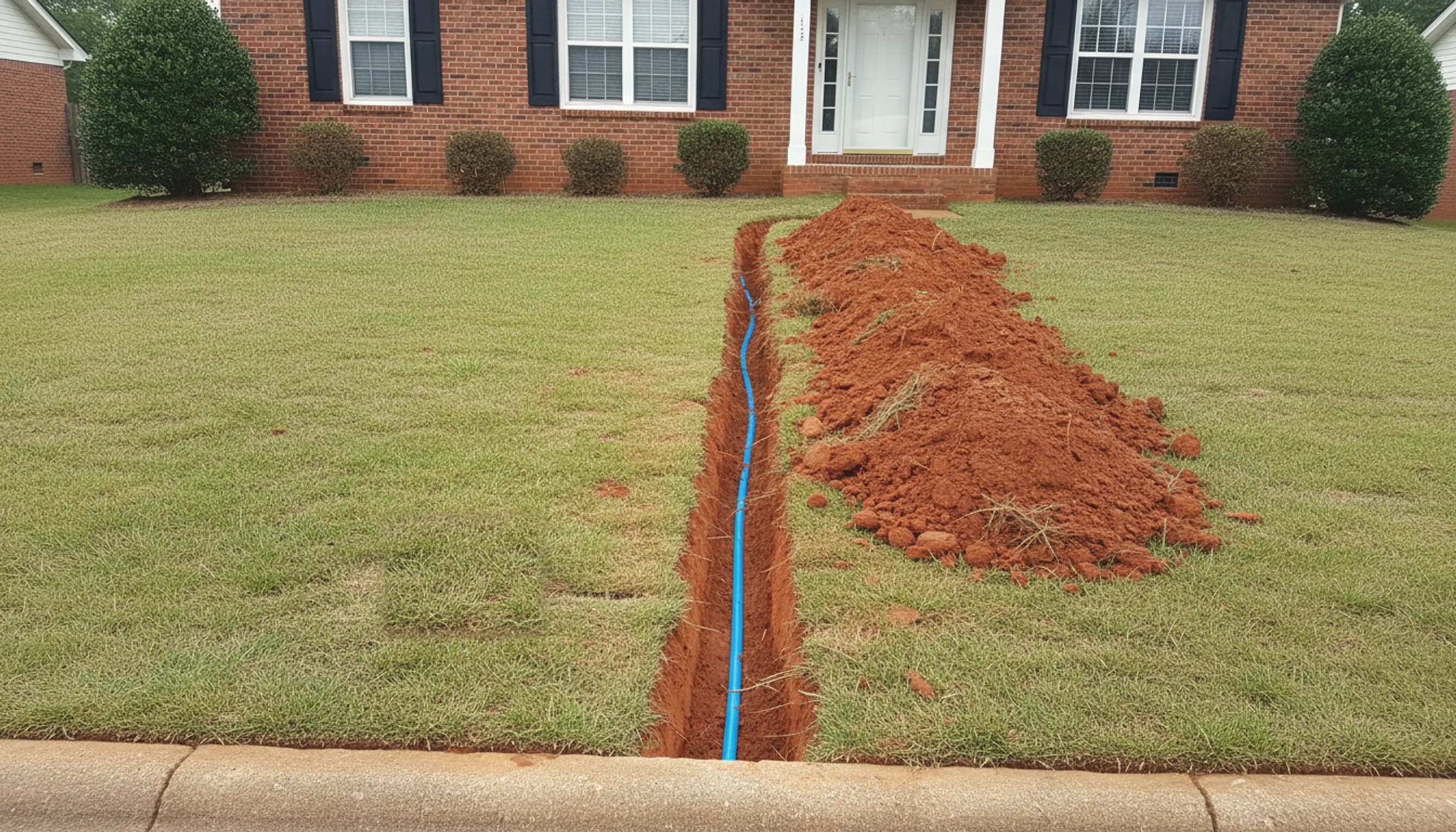
COMMERCIAL WATER LINES · METRO ATLANTA
Get a free estimate
or call (678) 863-5620The short answer
Commercial water line repair fixes the private domestic water service between the utility's meter and a business building. Metro Atlanta utilities, including NCWSA, Gwinnett, Rockdale, DeKalb and Walton County, put everything past the meter on the owner, often including the backflow assembly. Atlanta Water & Sewage Solutions, based in Oxford, GA, excavates, repairs and replaces those lines.
Reviewed by Atlanta Water & Sewage Solutions · Last updated
Who does the work
One crew, the whole line
Key facts
Each row links to the agency, code or publisher it comes from. Tap a source to check it yourself.
| Topic | What it says | Source |
|---|---|---|
| Where the owner's side starts | At the meter under NCWSA, Gwinnett, Rockdale, Walton County and DeKalb rules | NCWSA — Customer vs. NCWSA Responsibilities |
| Backflow assembly testing (Georgia) | Water suppliers must require field tests after installation, repair or relocation, and at least annually, by certified testers | Ga. Comp. R. & Regs. 391-3-5-.13 Cross Connections (Georgia Rules for Safe Drinking Water, via Cornell LII) |
| Backflow assembly location (Gwinnett) | On each service line immediately downstream of the meter, or as close as physically feasible; the customer pays for it | Gwinnett County DWR — Backflow Prevention Policy and Procedures (September 2007), 2007 |
| Service line material (Georgia EPD) | The product used for the service line must be certified to NSF Standard 61 | Georgia EPD Minimum Standards for Public Water Systems (revised March 2021) — §12.5.3, §12.5.4, §12.9, 2021 |
| Covington water tap, 2-inch meter and service | $12,150 (4-inch: $47,750; fire service meter: $2,310) | City of Covington — Tap Fees |
| NCWSA water meter fee, 2-inch | $3,221 (fire line, all meters: $3,780) | NCWSA Water and Sewer Fees (effective July 1, 2025), 2025 |
| DeKalb water meter tap fee, 2-inch | $4,975, plus a $2,000 water access fee (2022 rate sheet) | DeKalb County 2022 Water and Sewer Rates and Service Charges, 2022 |
| Typical market range, main water line replacement | $50–$150 per linear foot, up to $250 in high-cost or deep installs (HomeAdvisor, 2026; not our price) | HomeAdvisor — Main Water Line Replacement Cost (updated June 19, 2026), 2026 |
Plain definitions
Warning signs
Water leaking under your lot? Call (678) 863-5620
Who owns what
Newton County Water & Sewerage Authority (NCWSA)
The owner maintains and repairs the water service line from the meter to the building, including interior plumbing, irrigation and the connection at the meter. NCWSA owns the meter and everything on the street side.↗
Where the line sits: Water meter
Gwinnett County DWR
DWR maintains the main, the pipe to the meter and the meter. Everything on the customer's side, including leaks between the meter and the building and backflow devices, is the owner's to maintain, repair or replace.↗
Where the line sits: Water meter
Rockdale Water Resources
The county owns the service from the main through the meter. The customer owns the line from the meter to the building and the backflow preventer on the customer side of the meter; changes at the meter are made under county supervision.↗
Where the line sits: Water meter
Walton County Water Department
The department is responsible up through the meter. The customer's responsibility starts at the meter and includes the water line, pressure-reducing valves and backflow valves.↗
Where the line sits: Water meter
DeKalb County Watershed Management
The county water system up to and including the meter is county property. Where no service exists, the county taps the main and installs the service line, meter, box and service cock, and the customer connects at that point.↗
Where the line sits: Water meter
City of Monroe
Utility consumers must maintain and keep in good repair all connections and apparatus used with city service; connections are made under city supervision.↗
The whole story
The single biggest cost of a commercial water line repair is often not the pipe. It's the hours the building spends without water. A restaurant can't cook or wash dishes. A medical or dental office can't see patients. A multi-tenant building has several businesses waiting on one valve. So the repair is planned backward from the shutdown window.
Everything that doesn't need the water off happens first. The line gets located, Georgia 811 gets its notice of no less than two business days, the pavement is saw-cut, and the trench is opened to the pipe on both sides of the leak. Fittings and pipe are staged beside the hole. Only then does the water go off, for the cut-out and the new section. On a full replacement, the new line can often be laid alongside the old one and switched over at the ends, so the building stays on the old service until the connection day.
Tenants need notice. If the building has more than one business on a single meter, each one should know the date, the time window and who to call. Put it in writing. A dentist with a morning of patients booked needs more than a day's warning.
Know where your valves are before you need them. Many commercial buildings have a customer-side shutoff near the meter or backflow assembly and another where the line enters the building. If yours are buried, seized or missing, fixing that can be part of the job, so the next leak isn't a call to the utility to shut the meter.
Worth knowing
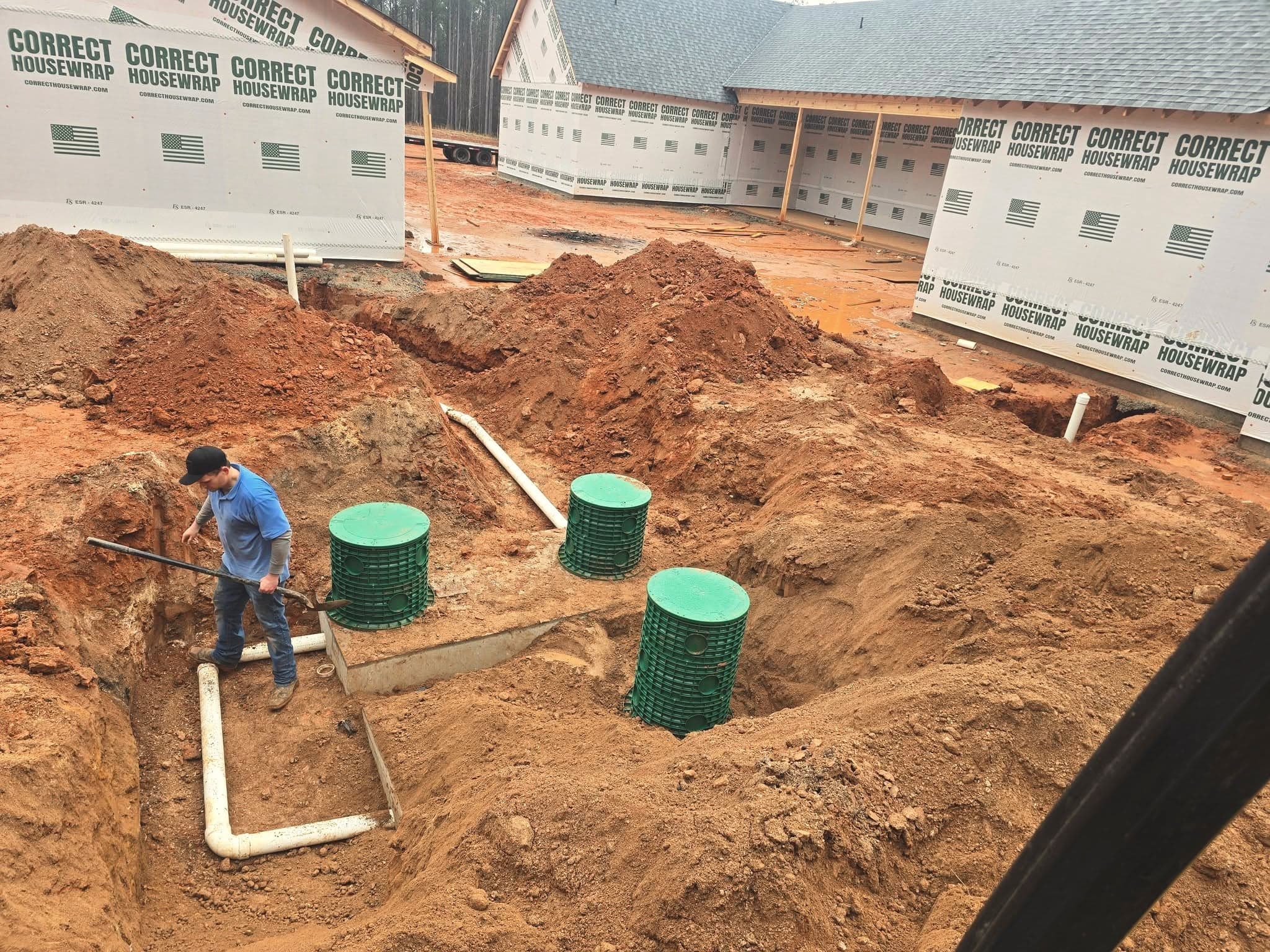
A house on a public system rarely has a testable backflow assembly at the meter. A commercial building often does. Georgia's drinking water rules make each water supplier responsible for keeping contaminants out of its system through cross-connections. Suppliers must require that backflow prevention assemblies be tested after installation, repair or relocation and at least annually, by certified testers (391-3-5-.13).
How that reaches your property depends on the utility. Gwinnett's backflow policy calls it containment: an approved assembly on each service line immediately downstream of the meter, with the customer paying for its purchase, installation, testing, repair and maintenance. The Director decides whether a site needs an RPZ or a double check. RPZs go above ground in a freeze-protected enclosure. Double checks can sit in a meter box or vault (Gwinnett backflow policy). Rockdale and Walton County both put the backflow device on the customer's side, and on the customer's account.
For a water line repair, the assembly is a fixed point in the trench. The new service line has to meet it at the right height and location. Relocating or repairing the assembly triggers a new test under the state rule. Gwinnett requires containment installs to be done by a plumbing, mechanical or utility contractor holding the required license and approved by DWR, and tests to be done by testers on its certified list. We dig and lay the service line. The assembly work and the test are done by the installer and tester your utility accepts. We schedule the trench so they can do their part while it is still open.
A house on a public system rarely has a testable backflow assembly at the meter.
Worth knowing
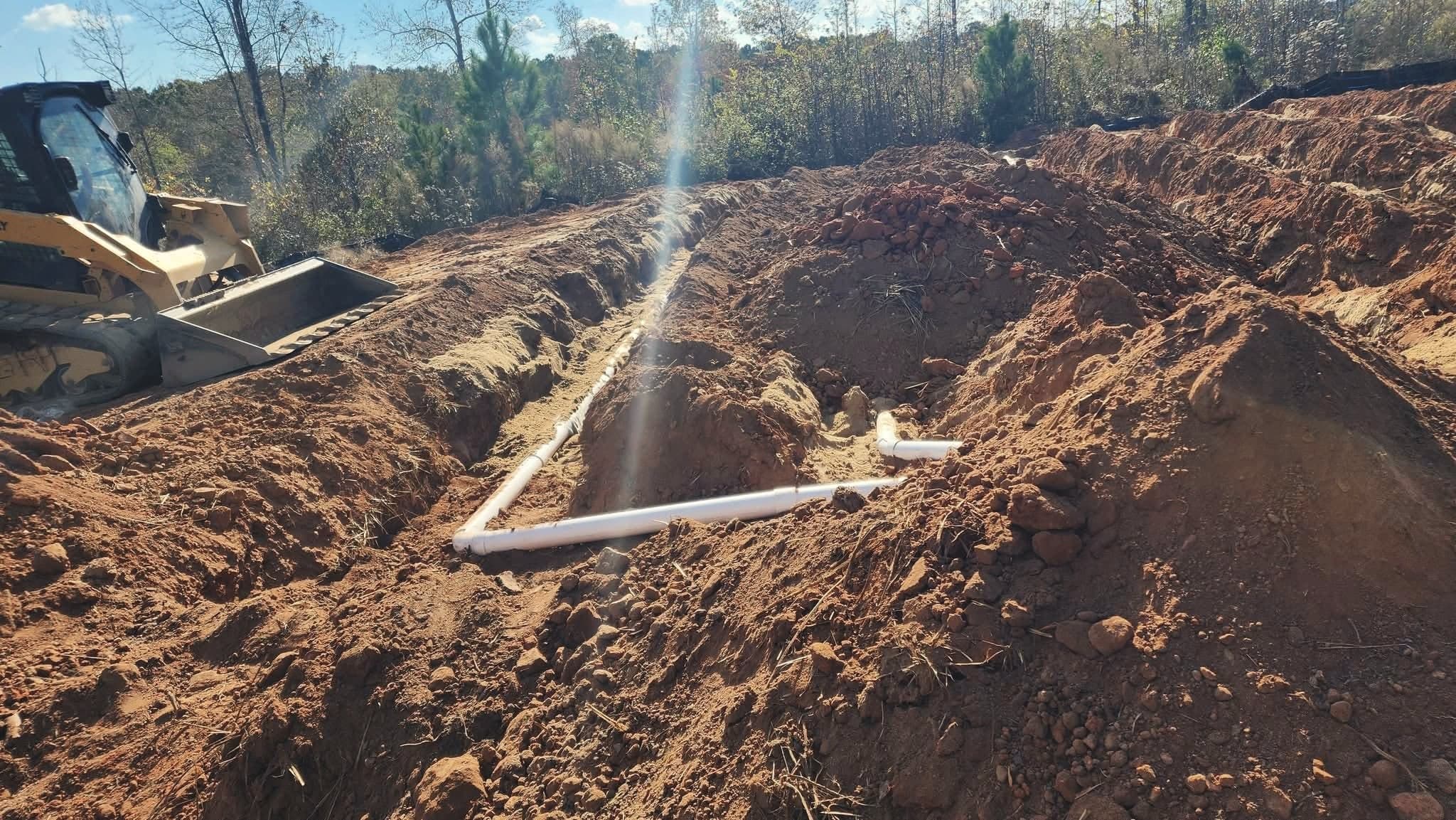
Larger commercial buildings may have two water services: a domestic line for restrooms, kitchens and sinks, and a separate fire line feeding the sprinkler system. Utilities treat them differently. NCWSA prices a fire line at $3,780 regardless of meter size, and Covington lists a fire service meter separately at $2,310. Gwinnett's backflow policy classifies a connection used only for fire protection as dedicated, and one serving both domestic use and fire protection as combination, with its own backflow requirements.
This page is about the domestic water service. We don't work on fire sprinkler lines or fire service connections; those are handled by fire protection contractors under the fire code. If you're not sure which pipe is leaking, that's the first thing we'll sort out on site. Tracing the line to its meter and valve usually answers it.
Your options
OPTION 01
When it fits: A single failed joint, fitting or damaged section on a line that's otherwise sound.
OPTION 02
When it fits: Repeat leaks, deteriorated pipe, or a line that runs under a spot you're about to repave anyway.
OPTION 03
When it fits: The building's use has grown: a restaurant moving into a retail space, added tenants, or new fixtures the old line can't feed.
Tap fees climb steeply with size. Covington lists $3,850 for a 1-inch water tap and $12,150 for 2-inch (Covington tap fees). Ask the utility before you design around a bigger line.
Homes & businesses
Residential
A home's water service is usually a small line from a meter at the street to the house, under a lawn, serving one family, often with no testable backflow assembly. A shutdown mostly means an inconvenient afternoon.
Commercial
A commercial service is often larger, runs under pavement, feeds a backflow assembly the utility requires and tests every year, and may sit next to a separate fire line. A shutdown costs revenue and affects every tenant on the meter, so the repair is planned around the schedule.
How the job runs
Bill spike, wet pavement or low pressure, plus when the building can do without water. Call (678) 863-5620; the on-site estimate is free.
Which utility serves the building, which meter feeds which tenants, and whether the leak is past the meter and so on your side.
Georgia 811 notice goes in no less than two business days ahead. Commercial lots carry gas, power, telecom, storm and sewer lines near the water service.
O.C.G.A. 25-9-3(2), 25-9-6(a)Georgia 811 — Law (Georgia Underground Facility Protection Act, O.C.G.A. 25-9)
Agree on a window, confirm the shutoff valves work, and give written notice to every business on the meter.
Saw-cut, dig to the pipe, and stage pipe and fittings while the water is still on.
Cut out the failed section or connect the new line, using pipe certified to NSF Standard 61 as Georgia EPD requires for service lines.
Work at the meter is done under utility supervision where the utility requires it, and a relocated or repaired backflow assembly gets its test from a certified tester.
391-3-5-.13(6)Ga. Comp. R. & Regs. 391-3-5-.13 Cross Connections (Georgia Rules for Safe Drinking Water, via Cornell LII)
Flush the new pipe, turn the water back on slowly, and watch the meter with the building quiet to confirm the leak is gone.
Compact the trench in lifts and restore asphalt or concrete so the patch carries traffic.
Permits & the Georgia rules
Confirm the utility's ownership line and any customer-side requirements (backflow assembly, pressure-reducing valve, shutoff).↗
In DeKalb, don't let anyone tap a county main without the county's written permission; replacing an existing service line is charged as a new service connection.↗
In Rockdale, make customer-side changes at the meter under county supervision.↗
File the Georgia 811 locate request and wait out the notice period.↗
Have any installed, repaired or relocated backflow assembly field tested by a certified tester and filed with the utility.↗
Georgia rule Ga. Comp. R. & Regs. 391-3-5-.13(6)
“be field tested following installation, repair, or relocation and at least annually thereafter.”
Georgia rule Georgia EPD Minimum Standards §12.9(b)
“The product that is used for the service line must be listed as being certified for conformance with the NSF Standard 61.”
Georgia rule Gwinnett Backflow Policy (containment)
“An approved backflow prevention assembly shall be installed on each service line to a Customer's System immediately downstream of the water meter”
Newton County (NCWSA and Covington)
NCWSA meter fees: $3,082 for 1-inch and $3,221 for 2-inch. Covington water taps: $3,850 (1-inch), $12,150 (2-inch), $26,500 (3-inch), $47,750 (4-inch).↗
Backflow containment installs must be done by a plumbing, mechanical or utility contractor holding the required license and approved by DWR, and tested annually by a tester on the county's certified list.↗
A backflow preventer is required on the customer's side of the meter, owned and maintained by the customer. A new meter at a new development location carries a $200 non-refundable application fee.↗
Water meter tap fees on the 2022 rate sheet: $2,600 for 1-1/2 inch and $4,975 for 2-inch, plus a $2,000 water access fee for all customers.↗
Walton County Water Department places the water line, pressure-reducing valves and backflow valves on the customer's side of the meter.↗
Worth knowing
Georgia EPD's Minimum Standards for Public Water Systems set how new public water mains are tested and disinfected. Pipe is pressure- and leak-tested under AWWA C600 at a minimum of 1.5 times working pressure, and not less than 150 psi. New mains are disinfected under AWWA C651 before they go into or back into service. With the continuous-feed method, water with at least 25 mg/L of free chlorine sits in the main for at least 24 hours. The tablet method is not allowed (EPD Minimum Standards §12.5.3–12.5.4).
Those rules are written for public mains, not for every private service line. But some utilities and site engineers write similar requirements into their specs for large commercial services, and a line serving a food business has a reason to be flushed clean before anyone drinks from it. Ask your utility what testing and flushing it wants on a new or replaced service, and we'll build it into the schedule.
Georgia EPD's Minimum Standards for Public Water Systems set how new public water mains are tested and disinfected.
What it costs
Main water line replacement, typical project
$647–$2,833
per job
HomeAdvisor average $1,703.
Typical market range — HomeAdvisor — Main Water Line Replacement Cost (updated June 19, 2026), 2026
Trenched water line replacement
$50–$250
per linear foot
Typical market range — HomeAdvisor — Main Water Line Replacement Cost (updated June 19, 2026), 2026
Water line repair
$350–$1,700
per repair
Typical market range — HomeAdvisor — Main Water Line Replacement Cost (updated June 19, 2026), 2026
Water line permits
$100–$500
per job
Typical market range — HomeAdvisor — Main Water Line Replacement Cost (updated June 19, 2026), 2026
Backflow preventer installation
$150–$450
per device
HomeAdvisor average $350; mostly residential devices. Large commercial assemblies cost more.
Typical market range — HomeAdvisor — Backflow Preventer Cost (updated June 20, 2026), 2026
Backflow testing
$70–$350
per test
HomeAdvisor: usually $70 to $90, up to $350.
Typical market range — HomeAdvisor — Backflow Preventer Cost (updated June 20, 2026), 2026
These are published third-party typical market ranges (HomeAdvisor, 2026) and utility fee schedules, not our prices. We give free on-site estimates.
Free estimate: (678) 863-5620FAQ
Straight answers, with the rule or record behind them. Still unsure? Call and ask the crew that digs.
(678) 863-5620Yes, with every major utility around Oxford and east metro Atlanta. NCWSA, Gwinnett, Rockdale, Walton County and DeKalb all make the customer responsible from the meter to the building. The utility handles the main, the pipe to the meter and the meter itself.
Only for the cut-out and connection, if the job is planned right. Locating, saw-cutting, digging and staging happen with the water on. On a full replacement the new line can often be laid beside the old one and switched over at the ends. We'll give you the window before work starts.
Often, yes. Georgia requires water suppliers to control cross-connections and to have backflow assemblies tested after installation, repair or relocation and at least annually. Utilities like Gwinnett require an approved assembly right after the meter on commercial services, with the customer paying for installation and testing.
Under Georgia's cross-connection rule, required tests must be done by someone certified in testing backflow prevention assemblies through an approved program. Gwinnett keeps its own list of certified testers. Your utility will tell you whose test reports it accepts.
No. We work on the domestic water service that feeds restrooms, kitchens and sinks. Fire lines are priced and regulated separately by utilities and are handled by fire protection contractors. If you're not sure which pipe is leaking, we can trace it on site.
Georgia EPD requires the product used for a water service line to be certified to NSF Standard 61 for drinking water. Beyond that, the size and material depend on the building's demand and the utility's specifications. We match the new line to what the utility and your building need.
It depends on the utility and size. Covington lists $3,850 for a 1-inch water tap, $12,150 for 2-inch and $47,750 for 4-inch. DeKalb's 2022 sheet lists $4,975 for a 2-inch tap plus a $2,000 access fee. NCWSA's 2-inch meter fee is $3,221.
Source: City of Covington — Tap Fees
Probably underground between the meter and the building. Shut off everything inside after hours and watch the meter; if it still moves, the leak is on the service line or an irrigation branch. Soft or damp pavement along the line route narrows it down.
Keep going
Sources
Rules, costs and local facts on this page link to the agency, code or publisher that states them. Cost figures are third-party market ranges, not our prices — estimates are free.
Reviewed by Atlanta Water & Sewage Solutions · Last updated
Ready when you are
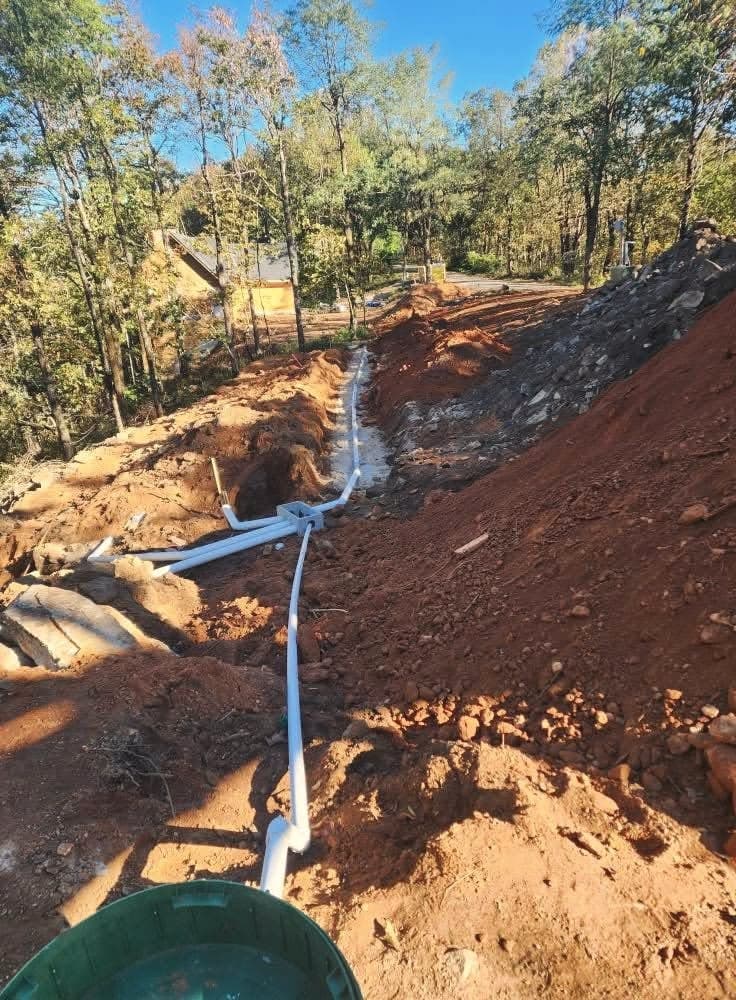
The pipe from the utility meter to your building is yours to fix, and when it leaks under the lot you pay for the water and the damage. We find the leak, plan the shutdown around your business, and repair or replace the service line with as little time off water as the job allows.
(678) 863-5620Free estimate
or call (678) 863-5620