Service · Atlanta, GA
Atlanta commercial sewer repair for restaurant kitchen lines and grease traps regulated by the city's Grease Management Ordinance.
- Georgia DPH-certified installer & pumper
- Residential & commercial
- Local shop in Oxford, GA
Get a free estimate
or call (678) 863-5620The short answer
What governs commercial sewer repair for Atlanta restaurants?
Atlanta's Grease Management Ordinance governs restaurant sewer lines: food service businesses on city sewer need a Watershed Management discharge permit, properly sized grease traps and a set pumping schedule, and the owner's private lateral must stay clear. Repairs usually pair jetting and camera work on grease-choked lines with trap and pipe fixes that keep the permit clean.↗↗
Reviewed by Atlanta Water & Sewage Solutions · Last updated
At a glance
The Atlanta story
Grease is the city's biggest sewer problem
Watershed Management is direct about it: fats, oils and grease from restaurants, schools, nursing homes and day cares contribute to more than half of the blockages or overflows in the city's collection system. That's why the city regulates kitchens trap by trap rather than leaving it to the plumbing code.↗
The pipe between the trap and the public sewer is still the owner's. ATL311 puts the entire service lateral on the property owner, so a grease plug past the trap is a private repair even when it's under the sidewalk.↗
On the record
- FOG contributes to more than half of the city's sewer blockages or overflows, per DWM.↗
Permits · City of Atlanta Department of Watershed Management — Grease Management Program (404-546-1503)
What Atlanta's grease ordinance requires
- 01
Permit first: a food service wastewater discharge permit is required before the city issues a business license, and not having one is grounds to revoke the license.↗
- 02
New outdoor installations: two 1,500-gallon traps in series, 3,000 gallons total; one 1,500-gallon trap may be approved where space is tight or seating is 100 or fewer.↗
- 03
Cleaning: outdoor traps at least every 90 days and indoor traps at least every 14 days, with full removal of contents; top skimming and decanting are banned.↗
- 04
The 25 percent rule: grease and solids must stay below a quarter of the trap's operating depth.↗
- 05
No shortcuts: enzyme, bacterial or chemical additives in a trap or its tributary plumbing are prohibited, and so is pouring fryer oil down any drain.↗
- 06
Paperwork: pump-out manifests stay on site for three years and go in with the annual renewal.↗
Georgia rule Atlanta Code Sec. 154-297.03(a)(4)
“The depth of oil and grease … shall not be equal to or greater than 25 percent of the total operating depth”
More about Atlanta
When the inspector finds a problem
Restaurants in parts of the city served by small public sewers, 8 to 12 inches in diameter, are inspected at least three times a year. A failed trap must be cleaned within three days and is re-checked; a second failure brings a notice of non-compliance.↗
Three notices in 24 months and the commissioner declares the trap a nuisance that has to be corrected. A mechanical grease trap found out of compliance is treated as a nuisance on the spot and must be upgraded to new-installation standards.↗
Restaurants in parts of the city served by small public sewers, 8 to 12 inches in diameter, are inspected at least three times a year.
Warning signs
Kitchen line trouble before it becomes a violation
Seeing two or more of these? Call before it gets worse.
- 1. Floor sinks in the prep area back up during service
- 2. The trap hits the 25 percent mark well before its scheduled pump-out
- 3. Grease or solids showing at the outlet side of the trap
- 4. Slow drains in restrooms that share the building sewer
- 5. Odor at the back door or in the alley
- 6. A cracked or settling trap lid in the drive lane
More about Atlanta
How we handle an Atlanta commercial line
We work before opening or after close. The camera goes in from the cleanout downstream of the trap, and jetting cuts hardened grease so the pipe itself can be judged. Clean pipe with a good slope may just need a tighter pumping schedule; a cracked or bellied run under the alley gets excavated and replaced.
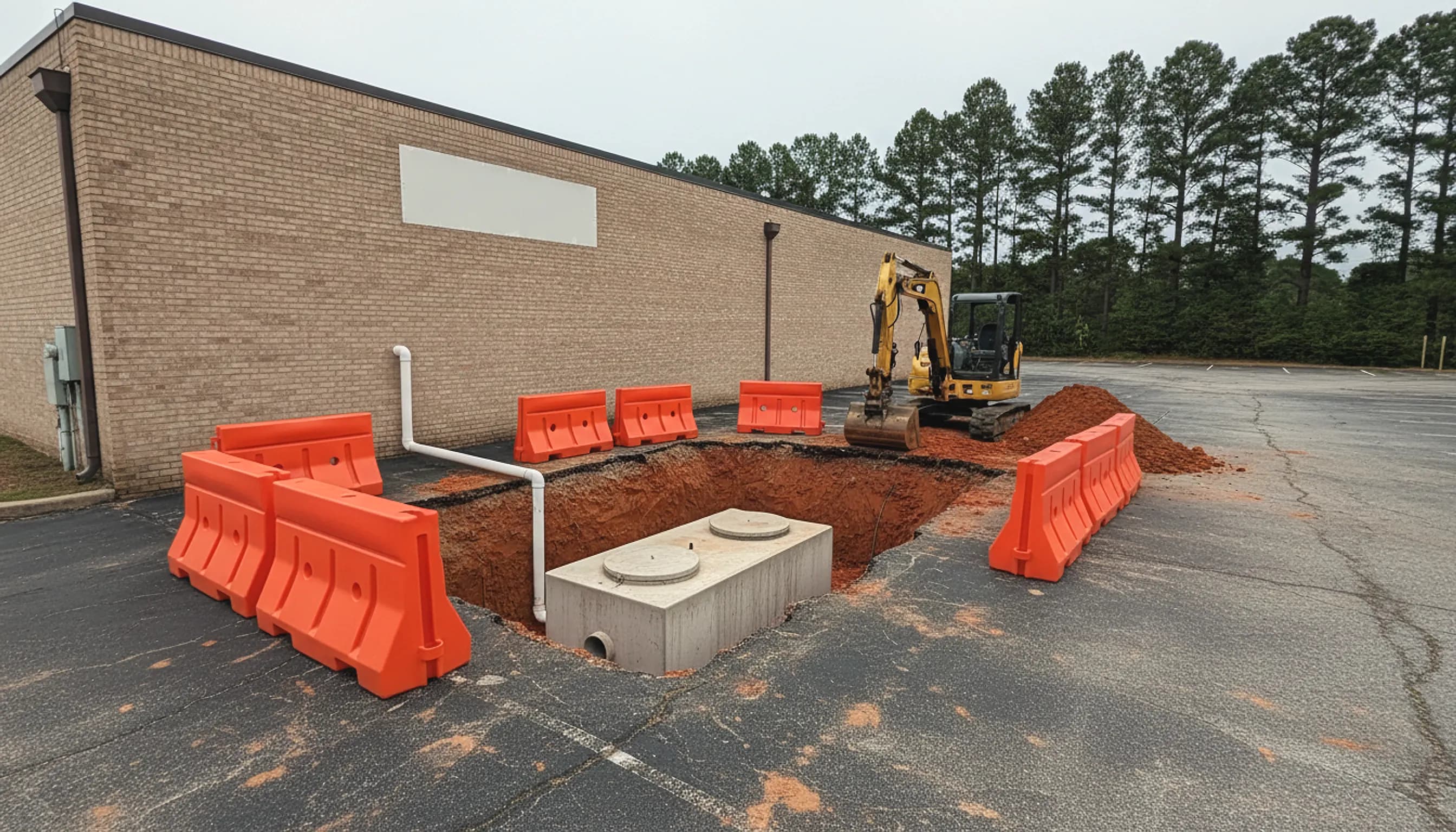
When a trap is undersized, cracked or a mechanical unit that keeps failing, replacing it means designing to the ordinance: outdoor traps with a tee inlet and outlet, a baffle, two manholes and cleanouts, and dishwasher, floor drain and mop sink flow routed to them.↗
New restaurants or big expansions may also need Sewer Capacity Certification from DWM, $1,500 for commercial flows of 2,500 gallons a day or more.↗
We work before opening or after close.
What it costs
Published costs for commercial lines and traps
Grease interceptor, 750–1,500 gallons, installed
$4,000–$8,500
Typical market range — Grease Trap Locator — Grease Trap Installation Cost (updated August 8, 2026), 2026
Sewer line replacement, total project
$1,388–$5,323
Typical market range — HomeAdvisor — Sewer Line Replacement Cost (updated June 19, 2026), 2026
Broken or cracked pipe repair
$600–$1,050
Typical market range — HomeAdvisor — Sewer Line Replacement Cost (updated June 19, 2026), 2026
Sewer camera inspection
$125–$500
Typical market range — HomeGuide — Sewer Line Repair & Replacement Cost (updated December 2025), 2025
What moves the price
These are third-party typical market ranges, not our prices. Every job is quoted after we see it — estimates are free.
Free estimate: (678) 863-5620- 01Two 1,500-gallon traps in series for a new outdoor install
- 02Alley or parking-lot paving over the line
- 03After-hours scheduling around service
- 04Grease hardness and how far it has travelled downstream
FAQ
Atlanta commercial sewer and grease questions
Straight answers, with the rule or record behind them. Still unsure? Call and ask the crew that digs.
(678) 863-5620How much is Atlanta's grease trap permit?
The annual food service wastewater discharge permit is $300 for 0–5 traps, rising $300 for every five more. A failed inspection adds $100 per trap for re-inspection.
How big does a grease trap have to be for a new Atlanta restaurant?
Two 1,500-gallon outdoor traps in series. The commissioner may allow a single 1,500-gallon trap for 100 seats or fewer or where the site is too tight.
How often must we pump our grease trap?
At least every 90 days for outdoor traps and every 14 days for indoor traps, or sooner if the 25 percent rule is reached.
Can we use enzymes to keep the trap clean?
No. The ordinance prohibits bacteriological, chemical or enzymatic treatment of grease traps and the plumbing that feeds them.
Who fixes the sewer line between our trap and the street?
The property owner. ATL311 assigns the whole service lateral to the owner, all the way to the city sewer.
Who do I call about a grease violation notice?
DWM's Grease Management Program at 404-546-1503; its mailing address is 72 Marietta Street, Atlanta 30303.
Source: Grease Management | City of Atlanta Department of Watershed Management
Can an indoor grease trap handle our dishwasher?
No. Indoor traps are only allowed without a dishwasher or food grinder, and dishwasher discharge can't go to one.
Sources
Where these facts come from
Rules, costs and local facts on this page link to the agency, code or publisher that states them. Cost figures are third-party market ranges, not our prices — estimates are free.
Reviewed by Atlanta Water & Sewage Solutions · Last updated
- 1Atlanta Code Ch. 154, Art. V, Div. 4 — Grease Management Ordinance (Secs. 154-297–154-297.03) (Municode, Supp. 107)
- 2ATL311 — What is a Sewer Service Lateral?
- 3Grease Management | City of Atlanta Department of Watershed Management
- 4Construction Site Development | City of Atlanta Department of Watershed Management
- 5Grease Trap Locator — Grease Trap Installation Cost (updated August 8, 2026)
- 6HomeAdvisor — Sewer Line Replacement Cost (updated June 19, 2026)
- 7HomeGuide — Sewer Line Repair & Replacement Cost (updated December 2025)
Ready when you are
Inspector coming back in three days? Get the line and the trap right now.
Call (678) 863-5620 for after-hours camera work, jetting and grease trap line repairs across Atlanta.
(678) 863-5620- Georgia DPH-certified installer & pumper
- Residential & commercial
- Oxford, GA
Free estimate
or call (678) 863-5620