Service · Stonecrest, GA
Stonecrest commercial sewer repair for restaurant grease lines and retail building sewers near the mall.
- Georgia DPH-certified installer & pumper
- Residential & commercial
- Local shop in Oxford, GA
Get a free estimate
or call (678) 863-5620The short answer
Who handles commercial sewer repair for Stonecrest businesses?
A Stonecrest business owns and pays for its building sewer and grease interceptor; DeKalb Watershed Management owns the public main and runs the Fats, Oils and Grease program that inspects food service interceptors. Repairs typically involve camera work, jetting grease-hardened lines, replacing failed pipe under paving, and keeping the interceptor compliant.↗↗
Reviewed by Atlanta Water & Sewage Solutions · Last updated
The Stonecrest story
A retail city with restaurant-grade sewer loads
Stonecrest took its name from The Mall at Stonecrest, the super-regional center at I-20 exit 75 that opened in 2001. The restaurants, food courts and stores that grew up around it put a very different load on sewer pipe than a subdivision does. Kitchens send warm water full of fats down the drain, and as that water cools in the line the grease hardens on the pipe wall.↗
Two decades of that buildup narrows a line until one busy weekend is enough to back it up into a dining room. Parking lots, drive-through lanes and loading areas sit on top of most of these pipes, so fixing them means cutting pavement and keeping the business open around the work.
The retail pattern extends beyond the mall itself along the city's main corridors, including Turner Hill Road, Covington Highway and Rock Chapel Road.↗
Stonecrest took its name from The Mall at Stonecrest, the super-regional center at I-20 exit 75 that opened in 2001.
Permits · DeKalb County Department of Watershed Management
DeKalb's grease rules for Stonecrest kitchens
- 01
Every food service establishment tied into DeKalb's wastewater system must take part in the county Fats, Oils and Grease program, and county compliance inspectors routinely check interceptors and related equipment.↗
- 02
Section 25-257 calls for grease, oil and sand separators wherever a waste stream carries more than 100 mg/l of those materials.↗
- 03
The county must approve an interceptor in writing, it has to sit where an inspector can reach it easily, and the property owner bears its cost.↗
- 04
Before a private sewer line is replaced, a licensed plumbing or sewer contractor obtains a plumbing permit.↗
Georgia rule DeKalb County Code Sec. 25-257
“Grease, oil and sand separators required when wastes carry more than 100 mg/l”
Local facts
Numbers for Stonecrest property managers
Each row links to the agency, code or publisher it comes from. Tap a source to check it yourself.
| Topic | What it says | Source |
|---|---|---|
| Commercial sewer access fee | Set by population equivalent relative to one single-family home, using state tables | DeKalb County 2022 Current Rates — Water and Sewer Rates and Service Charges (via Wayback) |
| Public treatment | Two county plants, Snapfinger and Pole Bridge, plus 67 lift stations | Watershed Management | DeKalb County, GA |
| Commercial septic, if off sewer | DeKalb Public Health installation permit: $400 under 2,000 GPD, $600 over | DeKalb Public Health Environmental Health Division Fee Schedule (effective January 1, 2024) |
| Damage to the main | Owner compensates the county for harm caused while installing or connecting a building sewer | DeKalb County Code Ch. 25, Art. IV, Div. 3 — Building Sewers and Connections (Municode, Supp. 72) |
Warning signs
Early signs of trouble in a commercial line
Seeing two or more of these? Call before it gets worse.
- 1. Floor drains in the kitchen or dish area back up during the lunch rush
- 2. The grease interceptor fills much faster than its normal pump-out schedule
- 3. Sewer odor in the service corridor or at the rear door
- 4. Restroom toilets in a multi-tenant building slow down together
- 5. Sunken or cracked asphalt over the path of the building sewer
- 6. An inspector notes solids or grease downstream of the interceptor
More about Stonecrest
How a commercial repair is run without closing the doors
Scheduling comes first. Work on a restaurant line is planned around service hours, and in shared centers the other tenants need notice. A camera run from the cleanout maps grease buildup, sags and breaks, and high-pressure jetting clears hardened grease so the pipe wall can actually be evaluated.
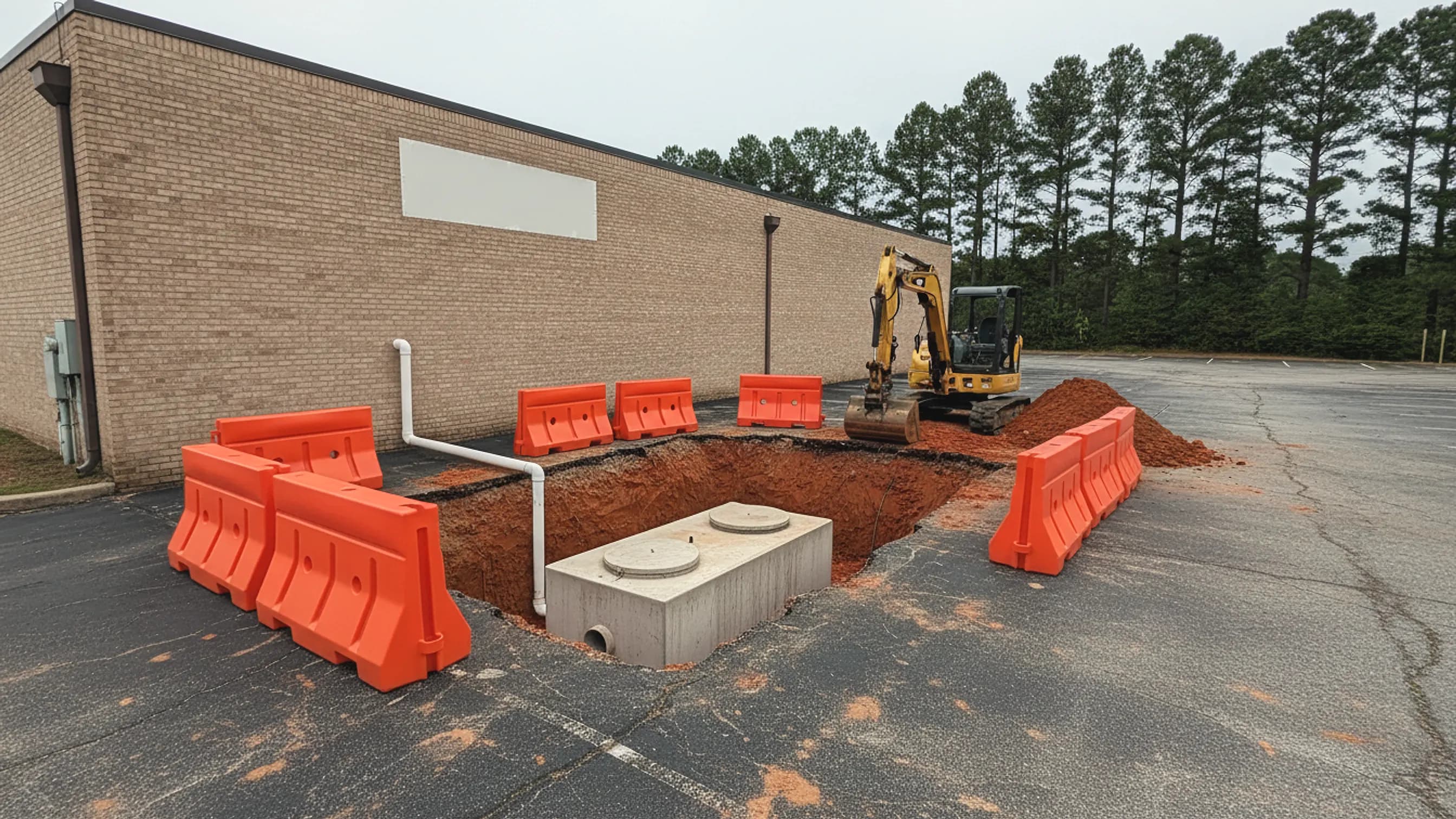
If the pipe is sound, cleaning plus a better interceptor maintenance routine may solve it. If the line has cracked, separated or bellied, the bad section is excavated and replaced. In a parking lot that means saw-cutting asphalt, staging barricades, trenching, laying new pipe on bedding and patching the surface.
When an interceptor itself has failed or is undersized, replacing it needs written county approval under Sec. 25-257, and it has to go where an inspector can open it. We plan the location with that in mind.↗
Scheduling comes first.
What it costs
Published costs for commercial sewer and grease work
Sewer line replacement, total project
$1,388–$5,323
Typical market range — HomeAdvisor — Sewer Line Replacement Cost (updated June 19, 2026), 2026
Broken or cracked pipe repair
$600–$1,050
Typical market range — HomeAdvisor — Sewer Line Replacement Cost (updated June 19, 2026), 2026
Grease interceptor, 750–1,500 gallons, installed
$4,000–$8,500
Typical market range — Grease Trap Locator — Grease Trap Installation Cost (updated August 8, 2026), 2026
Sewer line permits
$400–$1,600
Typical market range — HomeAdvisor — Sewer Line Installation Cost (updated June 17, 2026), 2026
What moves the price
These are third-party typical market ranges, not our prices. Every job is quoted after we see it — estimates are free.
Free estimate: (678) 863-5620- 01Asphalt or concrete cutting and patching over the line
- 02Working around business hours and customer traffic
- 03Pipe diameter and depth on larger buildings
- 04Upsizing or relocating an interceptor to meet county approval
FAQ
Stonecrest commercial sewer questions
Straight answers, with the rule or record behind them. Still unsure? Call and ask the crew that digs.
(678) 863-5620Does Stonecrest have its own grease trap ordinance?
Not that we have found. Grease enforcement for Stonecrest restaurants comes from DeKalb Watershed's FOG program and county code Sec. 25-257.
Source: Commercial Fats, Oils and Grease (FOG) Program | DeKalb County, GA
When is a grease interceptor required?
Under Sec. 25-257, when a waste stream carries more than 100 mg/l of fat, oil, grease or sand. Private living quarters are exempt.
Who pays for the interceptor?
The property owner. The county must approve it in writing, but the owner pays for it.
Will a DeKalb inspector look at our grease equipment?
Yes. The FOG program says compliance inspectors routinely inspect interceptors and related equipment at food service establishments.
Source: Commercial Fats, Oils and Grease (FOG) Program | DeKalb County, GA
How are sewer access fees figured for a commercial building?
DeKalb's 2022 rate sheet bases the non-residential fee on population equivalent compared with one single-family home.
Source: DeKalb County 2022 Current Rates — Water and Sewer Rates and Service Charges (via Wayback)
Where does our responsibility end on a shopping-center lot?
At the edge of private property. DeKalb maintains building sewer connections inside county rights-of-way and sewer easements.
Source: DeKalb County Code Ch. 25, Art. IV, Div. 3 — Building Sewers and Connections (Municode, Supp. 72)
What if our building is not on sewer?
Commercial septic falls under DeKalb Public Health, which charges $400 or $600 for a commercial installation permit depending on daily flow.
Source: DeKalb Public Health Environmental Health Division Fee Schedule (effective January 1, 2024)
Sources
Where these facts come from
Rules, costs and local facts on this page link to the agency, code or publisher that states them. Cost figures are third-party market ranges, not our prices — estimates are free.
Reviewed by Atlanta Water & Sewage Solutions · Last updated
- 1DeKalb County Code Ch. 25, Art. IV, Div. 3 — Building Sewers and Connections (Municode, Supp. 72)
- 2Commercial Fats, Oils and Grease (FOG) Program | DeKalb County, GA
- 3The Mall at Stonecrest - Wikipedia
- 4Census TIGERweb Transportation MapServer — roads intersecting Stonecrest city (place 1373784)
- 5DeKalb County Code Ch. 25, Art. IV, Div. 5 — Sec. 25-257 Separators and interceptors (Municode, Supp. 72)
- 6DeKalb County Planning & Sustainability — Watershed Packet (revised 5/6/25)
- 7DeKalb County 2022 Current Rates — Water and Sewer Rates and Service Charges (via Wayback)
- 8Watershed Management | DeKalb County, GA
- 9DeKalb Public Health Environmental Health Division Fee Schedule (effective January 1, 2024)
- 10HomeAdvisor — Sewer Line Replacement Cost (updated June 19, 2026)
- 11Grease Trap Locator — Grease Trap Installation Cost (updated August 8, 2026)
- 12HomeAdvisor — Sewer Line Installation Cost (updated June 17, 2026)
Ready when you are
Kitchen drains backing up near the mall? Clear it and fix the cause.
Call to schedule a camera inspection around your business hours and get a plan that keeps your interceptor in line with DeKalb's rules.
(678) 863-5620- Georgia DPH-certified installer & pumper
- Residential & commercial
- Oxford, GA
Free estimate
or call (678) 863-5620