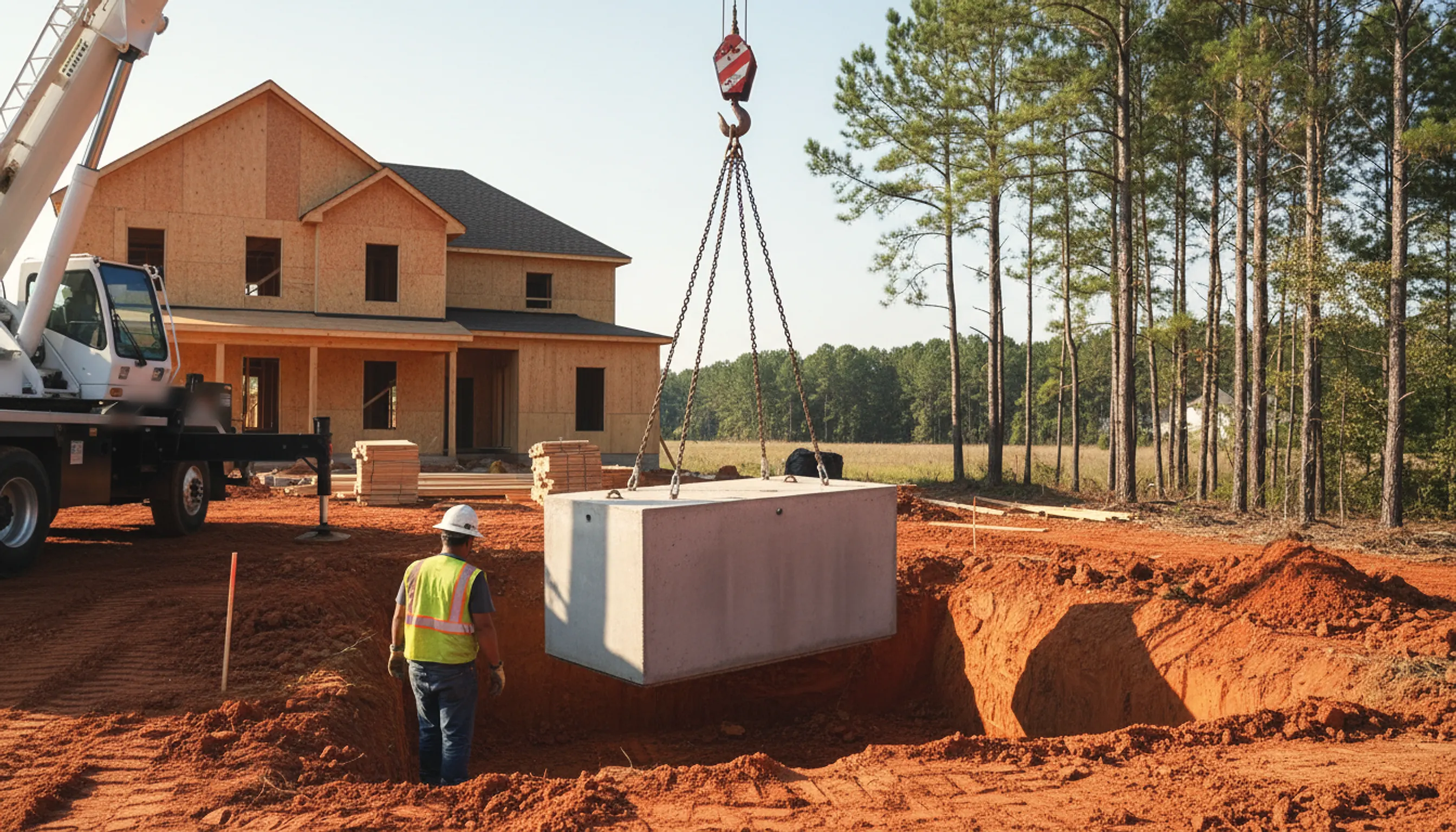
Septic Installation · Dacula, GA
Septic installation in Dacula, much of which sits in a groundwater recharge area where state rules watch septic tanks and drain fields closely.
- Georgia DPH-certified installer & pumper
- Residential & commercial
- Local shop in Oxford, GA
Get a free estimate
or call (678) 863-5620The short answer
What does septic installation require in Dacula, GA?
A new Dacula system needs a Level 3 soil report, a GNR Gwinnett application with lot sketch and floor plans, a 12-month construction permit and an inspection before cover. Much of Dacula lies in a groundwater recharge area, so placing the tank and field on suitable soil matters more than usual. We design, permit and install.↗↗
Reviewed by Atlanta Water & Sewage Solutions · Last updated
The Dacula story
Why Dacula's soil is also its water supply
Dacula's 2050 plan notes that a substantial portion of the city lies within a groundwater recharge area. In Georgia's Piedmont, the plan explains, most groundwater is stored in the soils above the rock, especially where those soils are thick. That is exactly the layer a drain field depends on.↗
Because of that, the state's recharge-area rules list septic tanks and drain fields alongside landfills and chemical storage as land uses to regulate, and the city's work program calls for enforcing septic tank ordinances in recharge areas. A good install here is one that treats effluent in the soil before it ever reaches the aquifer.↗
Dacula also falls inside the large water-supply watersheds of the Alcovy and Apalachee rivers. The plan says their intakes sit more than seven miles downstream, so no extra stream buffers apply under the state's Part 5 criteria, but the setbacks in Georgia's septic rules still do.↗
On the record
- A substantial portion of Dacula lies in a groundwater recharge area, where Georgia DNR rules regulate septic tanks and drain fields among other land uses.↗
- Dacula lies in the large water-supply watersheds of the Alcovy and Apalachee rivers; with intakes more than 7 miles downstream, no Part 5 buffers apply.↗
- Dacula's plan notes that in the Georgia Piedmont most groundwater is stored in overlying soils, particularly thicker soils.↗
Permits · GNR Public Health — Gwinnett Environmental Health Department
From soil test to final inspection in Dacula
- 01
Hire a Georgia-certified classifier for a Level 3 soil report on the planned field area.↗
- 02
Send GNR three copies of a scaled lot sketch, 1 inch = 40 feet or larger, with any creek, pond, well or spring within 100 feet marked, plus a floor plan of each story.↗
- 03
Add an engineered site plan, and a Level 4 soil report for alternative systems, if GNR asks.↗
- 04
Build within the 12-month permit window and leave the system open for inspection.↗
More about Dacula
New builds and replacements in a young town
More than a third of Dacula's homes were built in 2010 or later, and building continues around Harbins Road and the Rowen district. New construction on lots without sewer starts with GNR before the lot is even created, since the county's environmental health involvement begins at the platting stage.↗↗
Replacement installs are the other half of the work: an older system in the Dacula East or South Alcovy areas that can no longer be repaired. There we plan around the existing house, drive and outbuildings, keep the old field's footprint in mind, and confirm no county sewer lies within 200 feet before committing to a new field.↗↗
More than a third of Dacula's homes were built in 2010 or later, and building continues around Harbins Road and the Rowen district.
What it costs
Septic installation ranges in Georgia
Conventional gravity system, 3-bedroom
$6,397–$7,600
Typical market range — Septic & Well Pro — Septic Installation Cost Georgia 2026 (updated June 9, 2026), 2026
Drip irrigation system
$8,000–$18,000
Typical market range — Septic & Well Pro — Septic Installation Cost Georgia 2026 (updated June 9, 2026), 2026
Mound system
$10,000–$20,000
Typical market range — Septic & Well Pro — Septic Installation Cost Georgia 2026 (updated June 9, 2026), 2026
Septic tank alone
$1,200–$3,000
Typical market range — Septic & Well Pro — Septic Installation Cost Georgia 2026 (updated June 9, 2026), 2026
Riser installation
$200–$400
Typical market range — Septic & Well Pro — Septic Installation Cost Georgia 2026 (updated June 9, 2026), 2026
What moves the price
These are third-party typical market ranges, not our prices. Every job is quoted after we see it — estimates are free.
Free estimate: (678) 863-5620- 01Soil depth to rock or seasonal water in the report
- 02Conventional trenches versus an alternative system
- 03Clearing and grading on wooded lots
- 04Distance from the house stub-out to the tank
More about Dacula
Residential and commercial systems
A house follows GNR's residential application at $275. A church, school or business in Dacula's growing commercial areas is assessed at $600 and sized to daily flow, often with larger tanks or pretreatment. We handle both, and we'll tell you early if the lot is better suited to a sewer connection.↗
FAQ
Dacula septic installation questions
Straight answers, with the rule or record behind them. Still unsure? Call and ask the crew that digs.
(678) 863-5620Is Dacula in a groundwater recharge area?
A substantial portion of it is, according to the city's 2050 plan. State rules for those areas regulate septic tanks and drain fields, and the city aims to enforce its septic ordinances there.
Who approves a new septic system in Dacula?
GNR Public Health's Gwinnett Environmental Health office. It needs a Level 3 soil report, a lot sketch and floor plans before issuing a construction permit.
Source: GNR Residential Septic System New Construction Permit Application and Requirements (Rev. 2024-05-03)
Do I need a soil report for a brand-new system?
Yes. GNR has required a Level 3 soil report for all Gwinnett septic permits since February 7, 2022.
What does a new septic system cost in Georgia?
A 2026 Georgia guide lists conventional systems at $6,397 to $7,600 for three bedrooms, with drip and mound systems from $8,000 up to $20,000.
Source: Septic & Well Pro — Septic Installation Cost Georgia 2026 (updated June 9, 2026)
Do Dacula's river watersheds add setbacks?
The city's plan says the Alcovy and Apalachee intakes are over seven miles downstream, so no Part 5 buffers apply. Georgia's septic setbacks from wells and water still do.
I'm splitting land in Dacula. When does GNR get involved?
Before the lot exists. GNR's environmental health role begins when a lot is created, and its 2026 Gwinnett schedule charges $145 per lot to review a subdivision, exemption plat or individual lot for septic suitability.
Source: GNR Environmental Health Fee Schedule — Gwinnett County (effective Jan 1, 2026)
How long does the permit last?
A Georgia construction permit for an on-site system is valid for 12 months, and the work must be inspected before it is covered.
Source: Ga. Comp. R. & Regs. 511-3-1 (On-Site Sewage Management Systems)
Sources
Where these facts come from
Rules, costs and local facts on this page link to the agency, code or publisher that states them. Cost figures are third-party market ranges, not our prices — estimates are free.
Reviewed by Atlanta Water & Sewage Solutions · Last updated
- 1GNR Residential Septic System New Construction Permit Application and Requirements (Rev. 2024-05-03)
- 2City of Dacula — Dacula 2050 Comprehensive Plan
- 3Ga. Comp. R. & Regs. 511-3-1 (On-Site Sewage Management Systems)
- 4GNR Environmental Health Fee Schedule — Gwinnett County (effective Jan 1, 2026)
- 5Census Reporter: Dacula, GA (ACS 2024 5-year)
- 6Septic & Well Pro — Septic Installation Cost Georgia 2026 (updated June 9, 2026)
- 7GNR Public Health — Septic Systems
Ready when you are
Building or replacing in Dacula? Start with the soil.
Call and we'll walk the lot, line up the soil report and permit, and give you a free on-site estimate for your Dacula system.
(678) 863-5620- Georgia DPH-certified installer & pumper
- Residential & commercial
- Oxford, GA
Free estimate
or call (678) 863-5620