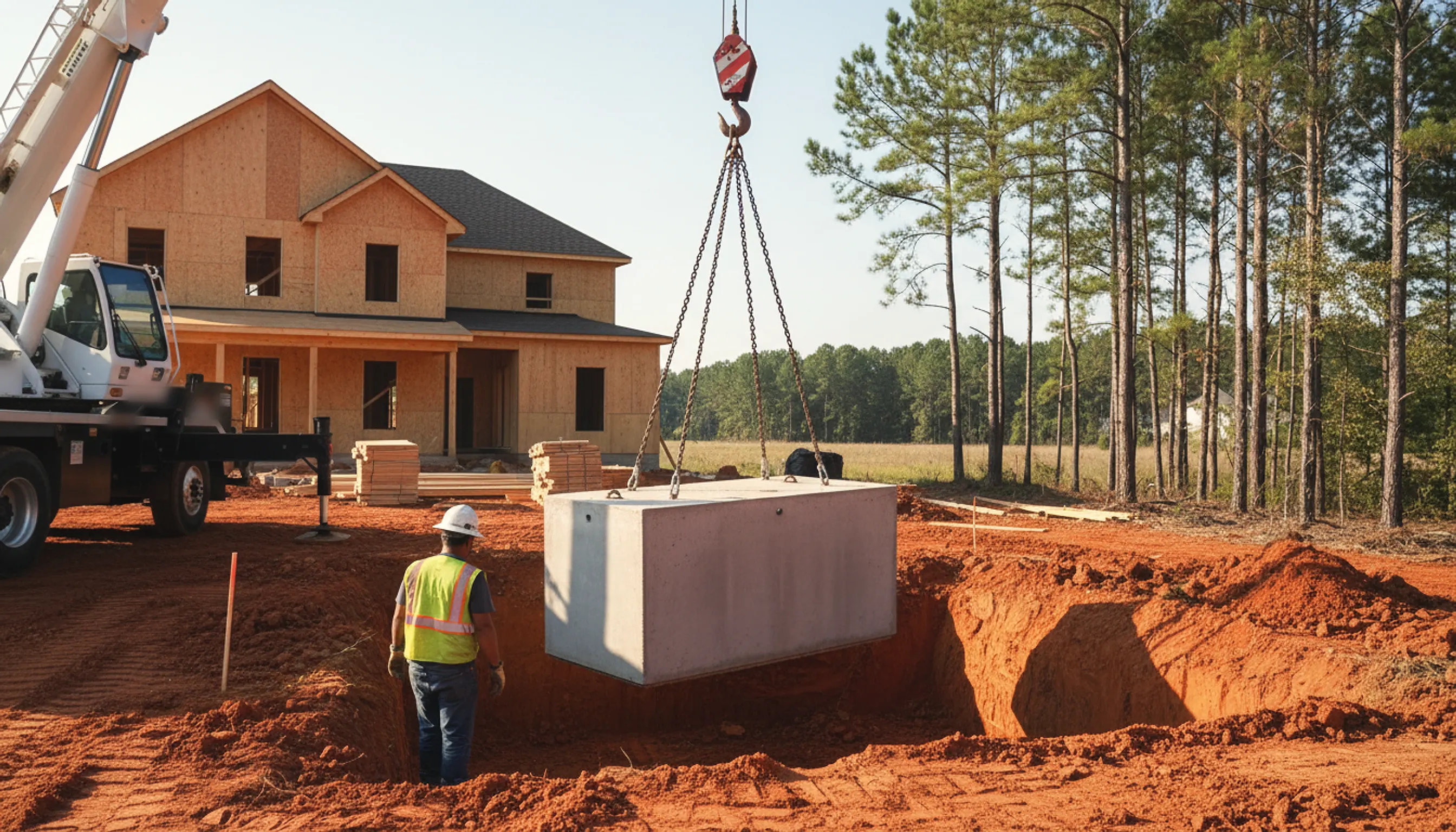
Drain Field Repair & Replacement · Good Hope, GA
Drain field repair and replacement in Good Hope, Georgia, laid out to respect the creeks of the Upper Jacks Creek watershed.
- Georgia DPH-certified installer & pumper
- Residential & commercial
- Local shop in Oxford, GA
Get a free estimate
or call (678) 863-5620The short answer
Can a failing drain field be repaired in Good Hope, GA?
Usually, yes. Walton County issues a $200 residential repair permit, and an Environmental Health Specialist inspects the work. The choice is fixing the existing lines or laying new ones. Good Hope lies inside the Upper Jacks Creek watershed, so any new trench stays at least 50 feet from creeks and 100 feet from wells.↗↗↗↗
Reviewed by Atlanta Water & Sewage Solutions · Last updated
The Good Hope story
Where Good Hope's effluent is headed
Run a drop of water off the town center and it lands in Upper Jacks Creek, a federally mapped subwatershed of about 26 square miles. That feeds the Lower Apalachee River watershed and, beyond it, the Upper Oconee basin. Several small streams wind within a couple of miles of town: Jacks, Indian, Little Sandy and Grubby Creek among them.↗↗↗
That geography explains why a surfacing field here is more than a smell. Effluent that breaks out on a slope has a short trip to a branch, and the county's lot ordinance refuses to count ground within 50 feet of a stream or wetland as usable soil. When a field must move, the new trenches go uphill of that line, not toward it.↗
On the record
Warning signs
How a Good Hope field tells you it's struggling
Seeing two or more of these? Call before it gets worse.
- 1. A bright green stripe pattern across the yard in dry weather
- 2. Spongy ground or seepage on the downhill side of the trenches
- 3. Drains that recover after pumping, then slow again within weeks
- 4. Sewage odor drifting toward a creek or pond edge
- 5. Tire ruts from a truck or tractor that crossed the field
Soil & terrain
Why some fields around town wear out early
The survey scores the town-center Lloyd soil somewhat limited, with depth to rock as the stronger penalty (0.772 on a 0-to-1 scale) and slow water movement next (0.498). Put plainly, the trench bottom and the rock below leave little filtering depth, and water moves through slowly. Fields built to the minimum can saturate after years of wet winters.↗
Not every failure is soil. A tilted distribution box can send most of the flow down one line, overloading it while the others sit dry. Leveling or replacing the box is a far smaller job than a new field, and it is the first thing we check.
Permits · Walton County Environmental Health (Northeast Health District)
The Walton County route for a field repair
- 01
A repair permit comes first; the Specialist inspects the finished lines before backfill.↗
- 02
Adding trench to an existing field counts as an addition, which calls for a Level III soil report plus a $200 final inspection.↗
- 03
Where slopes pass 5 percent or percolation runs slower than 45 minutes per inch, the ordinance asks for more land, which shapes where replacement lines fit.↗
- 04
Ground inside 50 feet of a lake, river, stream or wetland does not count toward usable soil area.↗
What it costs
Drain field price ranges from cost guides
Field line cleaning
$600–$1,100
Typical market range — Angi — How Much Does It Cost to Clean Septic Field Lines? (updated Jul 9, 2026), 2026
Drain field repair or rejuvenation
$1,000–$5,000
Typical market range — HomeGuide — How Much Does a Leach or Drain Field Replacement Cost? (2026), 2026
Replacement leach lines
$20–$45 per linear foot
Typical market range — HomeGuide — How Much Does a Leach or Drain Field Replacement Cost? (2026), 2026
Full drain field replacement
$3,000–$15,000
Typical market range — HomeGuide — How Much Does a Leach or Drain Field Replacement Cost? (2026), 2026
Relocating a field
$5,500–$21,500
Typical market range — HomeGuide — How Much Does a Leach or Drain Field Replacement Cost? (2026), 2026
What moves the price
These are third-party typical market ranges, not our prices. Every job is quoted after we see it — estimates are free.
Free estimate: (678) 863-5620- 01Box releveling versus new trench
- 02Distance uphill to soil clear of creek buffers
- 03Level III soil report when adding lines
- 04Rock met while digging replacement trench
More about Good Hope
Home fields and commercial fields
A household field fails slowly, over seasons. A commercial field, say behind a business on SR-83, is more likely to be overloaded in bursts after a busy weekend or an event. Both use the same county process, but the commercial repair permit is $365, and the design is based on daily gallons rather than bedrooms.↗↗
FAQ
Drain field questions we hear in Good Hope
Straight answers, with the rule or record behind them. Still unsure? Call and ask the crew that digs.
(678) 863-5620Can I just add a few lines to my old field?
Sometimes. In Walton any addition needs a Level III soil report and a $200 final inspection before approval.
Source: Walton County Environmental Health — Service Request Form
How close to the creek can new trench go?
Georgia's rules keep an absorption field 50 feet from a stream's normal water level, and Walton excludes that strip from usable soil.
Source: Georgia DPH Rules Chapter 511-3-1 On-Site Sewage Management Systems (Jan 2016)
Is sewer going to replace my field someday?
Not on current plans. The town's 2022–2026 plan lists none available or planned.
Source: Good Hope Comprehensive Plan 2022-2026 (Georgia DCA)
Why did my field fail when the house isn't old?
Shallow rock under Lloyd soils, a shifted distribution box, or equipment driven over the trenches are common causes around here.
Source: USDA NRCS Soil Data Access — Walton County survey GA297, septic interpretations near Good Hope
What does the county charge for a field repair permit?
$200 for a home and $365 for a commercial property, effective August 1, 2024.
Will pumping more often save a failing field?
It buys time at best. Once the soil is saturated the lines need repair or replacement.
Is your company certified to rebuild fields in Walton?
Yes, we are listed under Walton on Georgia DPH's certified installer list dated 9/18/2026.
Source: Georgia DPH — Certified Septic Tank Installers list (9/18/2026)
State-certified under Walton
Field repairs are installer work. Our company is on Georgia DPH's certified installer list under Walton County, dated 9/18/2026.
Sources
Where these facts come from
Rules, costs and local facts on this page link to the agency, code or publisher that states them. Cost figures are third-party market ranges, not our prices — estimates are free.
Reviewed by Atlanta Water & Sewage Solutions · Last updated
- 1Walton County EH Fees (effective August 1, 2024)
- 2Northeast Health District — Sewage/Septic Systems
- 3USGS Watershed Boundary Dataset — HUC-12 at Good Hope, GA
- 4Georgia DPH Rules Chapter 511-3-1 On-Site Sewage Management Systems (Jan 2016)
- 5USGS Watershed Boundary Dataset — HUC-10 at Good Hope, GA
- 6USGS National Hydrography Dataset — named flowlines near Good Hope, GA
- 7Walton County Board of Health — Minimum Lot Size Ordinance
- 8USDA NRCS Soil Data Access — Walton County survey GA297, septic interpretations near Good Hope
- 9Walton County Environmental Health — Service Request Form
- 10Angi — How Much Does It Cost to Clean Septic Field Lines? (updated Jul 9, 2026)
- 11HomeGuide — How Much Does a Leach or Drain Field Replacement Cost? (2026)
- 12Good Hope Comprehensive Plan 2022-2026 (Georgia DCA)
- 13Georgia DPH — Certified Septic Tank Installers list (9/18/2026)
Ready when you are
Soggy ground over the lines? Find the cause before you dig.
Call (678) 863-5620. We check the tank and distribution box, probe the trenches, then handle the Walton County repair permit.
(678) 863-5620- Georgia DPH-certified installer & pumper
- Residential & commercial
- Oxford, GA
Free estimate
or call (678) 863-5620