
GUIDE · GEORGIA SEPTIC SETBACKS
How close can you build a pool, addition or well to a septic system in Georgia?
- Georgia DPH-certified installer & pumper
- Homes across metro Atlanta
- Emergency line answered 24/7
Get a free estimate
or call (678) 863-5620The short answer
How close can you build a pool, addition or well to a septic system in Georgia?
Georgia rule 511-3-1-.07(3) keeps a drain field 15 feet from a swimming pool, 10 feet from a building with a basement, 5 feet from one without, and 100 feet from any well. The tank must sit 50 feet from wells and should be 10 feet from pools, drives and foundations. County health offices can adjust these distances.
Reviewed by Atlanta Water & Sewage Solutions · Last updated
Who does the work
One crew, the whole line
- Georgia DPH Certified Septic Tank Installer Listed by the Georgia Department of Public Health
- Georgia DPH Certified Septic Tank Pumper Listed by the Georgia Department of Public Health
- Homeowners across metro Atlanta, from our shop in Oxford, GA
Key facts
Septic tank setbacks (Rule 511-3-1-.05(2))
Each row links to the agency, code or publisher it comes from. Tap a source to check it yourself.
Key facts
Drain field setbacks (Rule 511-3-1-.07(3))
Each row links to the agency, code or publisher it comes from. Tap a source to check it yourself.
Plain definitions
Setback vocabulary
- Setback
- The minimum horizontal distance Georgia requires between part of a septic system and a feature such as a well, building or stream.↗
- Hardscape
- Paved or built surfaces such as patios, walks and slabs, which the rules group with drives when setting distances.↗
- Absorption field
- The trenches or chambers where treated effluent soaks into the soil; Georgia holds it farther from wells than the tank.↗
- Geothermal borehole
- A drilled loop for a ground-source heat pump, which the rules treat like surface water for spacing purposes.↗
Permits & the Georgia rules
What the rule text says, and where counties go further
- 01
Pull the septic permit drawing so you know where the tank, lines and field actually are.↗
- 02
Measure from the planned pool, addition or well to the nearest tank wall and trench edge.↗
- 03
Ask Environmental Health whether the project needs a site evaluation before the building permit.↗
- 04
If the system must move or grow, apply for a repair or addition permit before digging.↗
- 05
File a Georgia 811 locate ticket before any machine breaks ground.↗
Georgia rule 511-3-1-.05(2)
“…should be at least ten feet (10') from hardscape, drives, swimming pools and building foundations.”
Georgia rule 511-3-1-.07(3)
“…less than five feet (5') from buildings without basements, other structures, drives, hardscape, and property lines…”
Georgia rule 511-3-1-.05(2)
“The County Board of Health, after site inspection, may allow lesser separation distances or require greater distances than cited herein…”
How it varies by county
In the South River/Yellow River watershed district, Newton's zoning ordinance holds septic tanks and drain fields 150 feet from rivers, lakes and perennial streams, three times the state figure for fields.↗
GNR's 2026 schedule lists a $150 site evaluation for an addition that does not modify the septic system.↗
If an addition does modify the system, GNR requires a Level 3 soil report first, the same as a repair.↗
Walton (Northeast Health District)
Land within 50 feet of lakes, streams and wetlands does not count toward the usable soil a septic lot must have.↗
The county service request form says adding to an existing system requires a Level III soil report and a final inspection.↗
DeKalb Public Health runs its own septic program; ask it about setbacks before building near a tank or field.↗
The whole story
Can I put a pool near my septic system in Georgia?
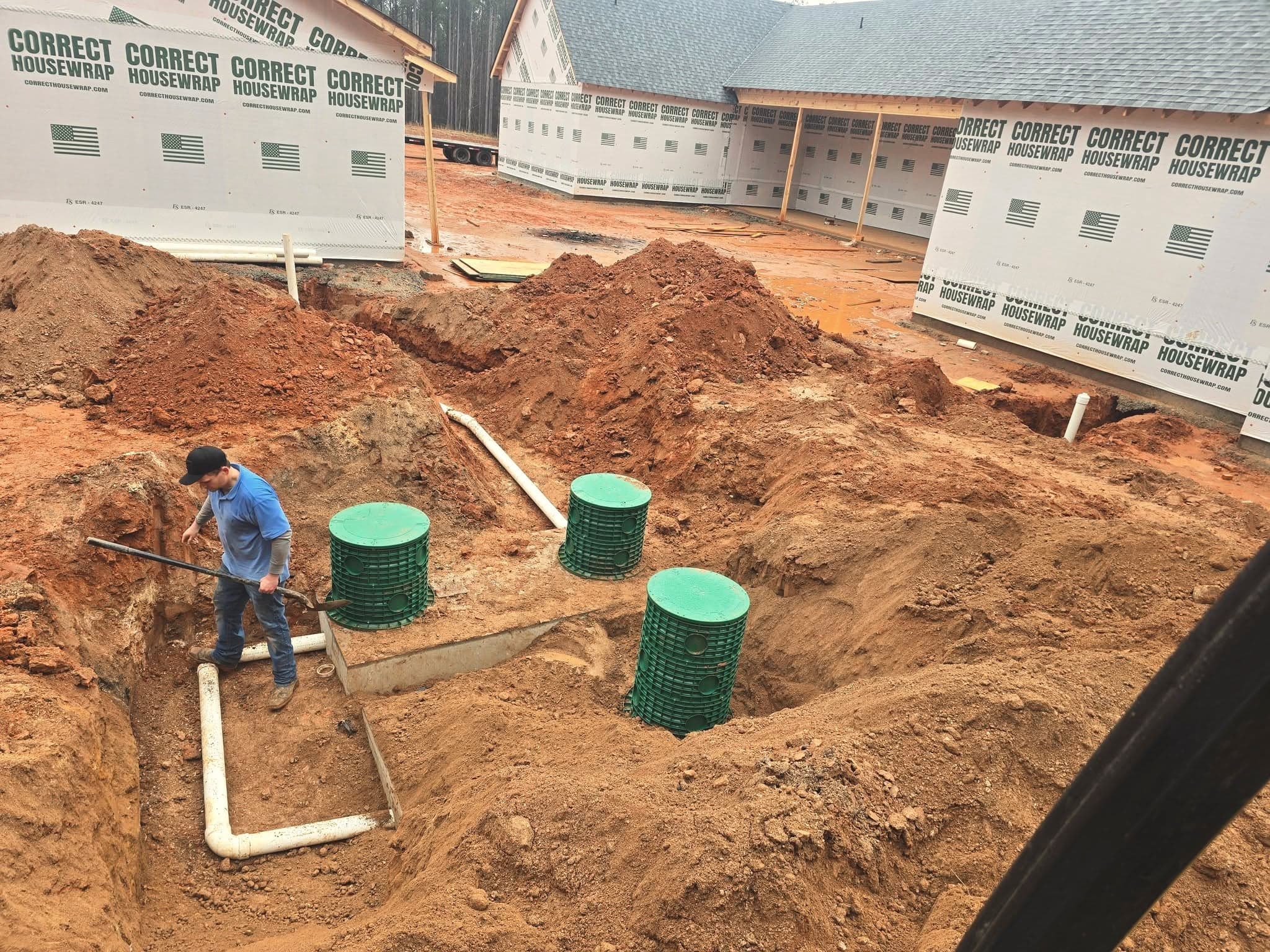
Usually, if you measure first. The tank is supposed to be at least 10 feet from a pool, and the drain field needs 15 feet from a pool foundation. The larger risk is the dig itself: a pool excavation is deep and wide, and a trench line crushed by an excavator or a spoil pile parked over the field can undo a working system.
Plan the equipment route as carefully as the pool. UGA Extension warns against driving or parking over the tank or drain field because the weight can collapse lines and compact soil. Fence off the field before the pool crew arrives, and keep the water feature's own drain and backwash away from the trenches.
Worth knowing
Can I build an addition next to the tank or drain field?
The distances are tighter for the field than many owners expect: 5 feet from a building without a basement, 10 feet if there is a basement. The tank still wants 10 feet of clearance from the foundation for access. The catch with additions is not only distance. A new bedroom can push the house past the tank's rated capacity, which turns a building project into a septic project; our minimum septic tank size guide explains that math.
Never pour a slab over any part of the system. Lids covered by a sunroom or deck become impossible to pump, and Georgia's rules call for ready access for maintenance.
The distances are tighter for the field than many owners expect: 5 feet from a building without a basement, 10 feet if there is a basement.
Worth knowing
How far does a new well need to be from the septic system?
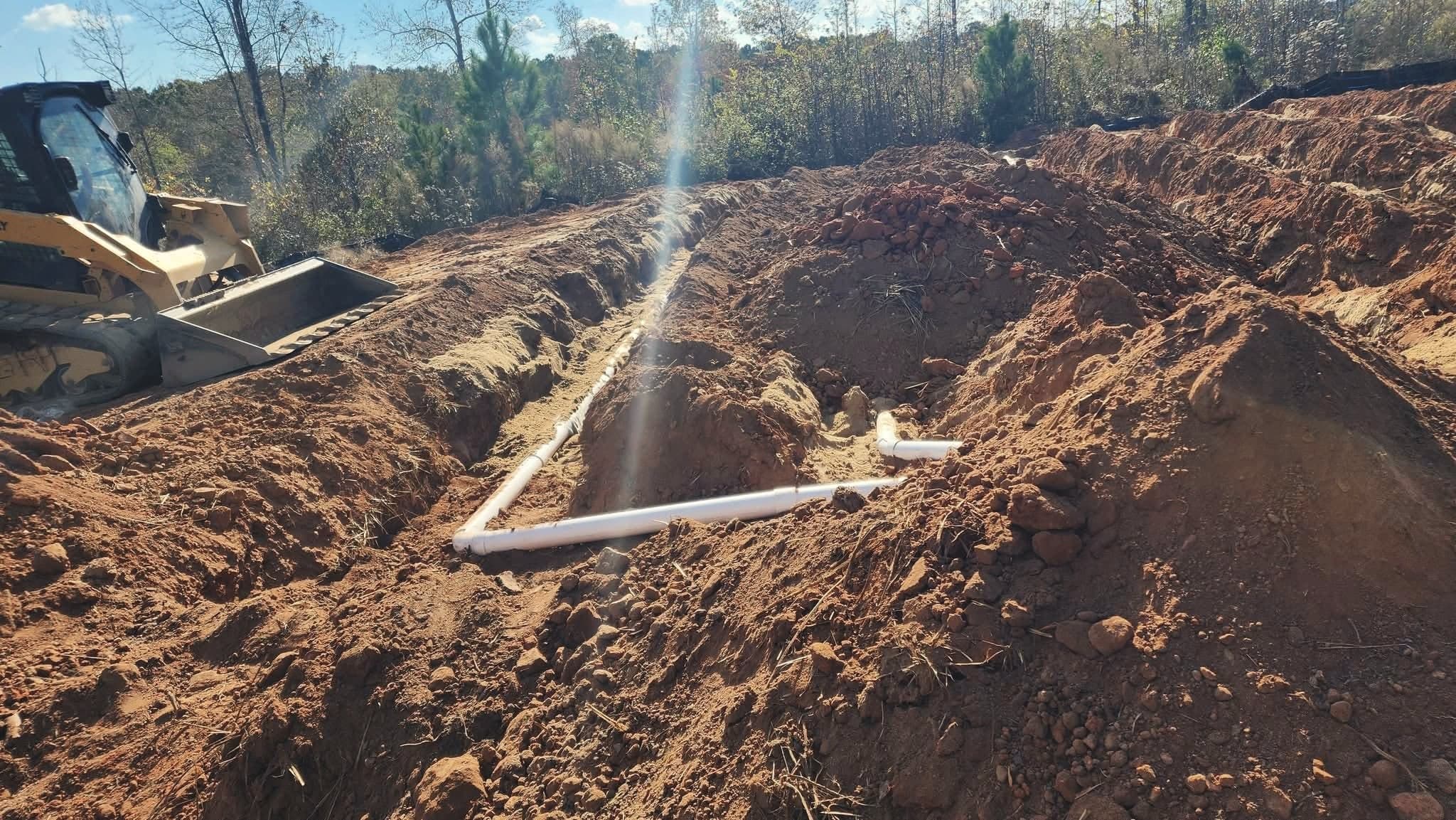
A well is the feature Georgia protects most. It must be 50 feet from the tank and 100 feet from the absorption field, and the tank should sit downhill from the well where the ground allows. On a small lot with an existing system, those two circles can leave very little room, so site the well before you drill, not after.
Water pipes get their own rule. A pressure supply line stays 10 feet from the tank and 10 feet from the field, and if a line must cross the field it runs at least 12 inches above the aggregate inside a sleeve of larger pipe.
FAQ
Georgia septic setback questions
Straight answers, with the rule or record behind them. Still unsure? Call and ask the crew that digs.
(678) 863-5620How far does a septic tank have to be from a house in Georgia?
Georgia's rule says a tank should be at least 10 feet from building foundations, hardscape, drives and swimming pools so it can be reached for maintenance. That clause uses 'should,' while most other tank distances use firm minimums. The drain field has its own spacing: 5 feet from a building without a basement and 10 feet from one with a basement.
How close can a swimming pool be to a drain field?
Rule 511-3-1-.07(3) says no absorption field may be built less than 15 feet from a swimming pool foundation, embankment or drainage ditch. The tank itself should be at least 10 feet from a pool. Measure from the nearest trench edge, and remember the excavation and equipment path need to stay off the field too.
What is the septic setback from a property line in Georgia?
A septic tank cannot be installed less than 10 feet from a property line, and an absorption field must be at least 5 feet from it. Those distances matter when a neighbor wants to fence, build or sell part of a lot, and when an older field sits close to a boundary.
How far must a drain field be from a creek or pond?
Statewide, 50 feet from the normal water level of any stream, impoundment or ponded wetland, and 25 feet for the tank. Some counties go further. Newton's zoning ordinance requires 150 feet from rivers, lakes and perennial streams inside its South River/Yellow River watershed district, so check local rules before you site anything near water.
Can the county approve a smaller setback?
Yes, in limited cases. Rule 511-3-1-.05(2) lets the County Board of Health, after a site inspection, allow lesser separation distances or require greater ones because of unusual topography, lot shape, soil or groundwater. That is a decision for Environmental Health on your specific lot, not something a contractor or owner can grant.
Can I build a driveway over my septic lines?
The rules keep drives 5 feet from a drain field and ask for 10 feet between a tank and a drive. UGA Extension adds that driving or parking over the tank or field can damage or collapse lines and compact the soil. If a new drive must cross the building sewer, plan the route with a contractor first.
Source: UGA Extension Bulletin B1421, septic system care (rev. Oct 18, 2024)
Do I need a permit to build an addition near my septic system?
Often you need a septic sign-off even if the system is not touched. GNR's Newton schedule lists a $150 site evaluation for additions with no septic modification. If the addition does change the system, GNR requires a Level 3 soil report and a permit, and Walton requires a Level III report and a final inspection.
Source: GNR Environmental Health Fee Schedule — Newton County (effective Jan 1, 2026)
Keep going
Related services, counties and guides
- Septic installation and relocation
- Drain field repair and replacement
- Excavation and grading near septic systems
- Septic inspection
- Find your septic tank and permit records
- Minimum septic tank size in Georgia
- Georgia septic permit process
- Homeowner septic checklist
- Newton County septic and sewer
- Rockdale County septic and sewer
- Walton County septic and sewer
- Jasper County septic and sewer
Sources
Where these facts come from
Rules, costs and local facts on this page link to the agency, code or publisher that states them. Cost figures are third-party market ranges, not our prices — estimates are free.
Reviewed by Atlanta Water & Sewage Solutions · Last updated
- 1Georgia DPH Rules Chapter 511-3-1, On-Site Sewage Management Systems (Jan 2016), Rules .05(2) and .07(3) (2016)
- 2Ga. Comp. R. & Regs. 511-3-1 (Georgia Secretary of State rules index)
- 3GNR Public Health — Septic Systems (Gwinnett, Newton & Rockdale) (2026)
- 4GNR Environmental Health Fee Schedule — Newton County (effective Jan 1, 2026) (2026)
- 5Newton County Zoning Ordinance (UDO Chapter 1), working copy with amendments through 07-19-2022, Sec. 420-120 (2022)
- 6Walton County Board of Health — Minimum Lot Size Ordinance
- 7Walton County Environmental Health — Service Request Form (Northeast Health District) (2023)
- 8Georgia 811 — Georgia Dig Law summary (O.C.G.A. 25-9-6, 25-9-7) (2026)
- 9UGA Extension Bulletin B1421, septic system care (rev. Oct 18, 2024) (2024)
- 10DeKalb Public Health — Septic Systems (2026)
Ready when you are
Rather have a pro look at it? Call the crew that digs.
Georgia's rules give the tank and the drain field separate distance tables. Planning a pool, a room addition or a new well starts with knowing which one sits closer to your project.
(678) 863-5620- Georgia DPH-certified installer & pumper
- Residential & commercial
- Oxford, GA
Free estimate
or call (678) 863-5620