24/7 Emergency? (678) 863-5620

SEWER GUIDE · ROOT INTRUSION

How do tree roots get into sewer lines, and how are they fixed?

Trees don't break sound pipe to get in. They find a joint or crack that already leaks moisture and grow toward it. The lasting fix is the opening, not the roots.
  • Georgia DPH-certified installer & pumper
  • Homes across metro Atlanta
  • Emergency line answered 24/7

Get a free estimate

or call (678) 863-5620

Property type
What do you need?
Rather talk? (678) 863-5620
Where's the property?
Is sewage backing up inside? (optional)
Who should we call?

By submitting, you agree we may call or text you about this request. Msg & data rates may apply. Reply STOP to opt out. SMS terms.

The short answer

How do tree roots get into sewer lines, and how are they fixed?

Roots enter a sewer line through a cracked pipe or a joint that has separated, drawn by the moisture escaping from it. Old clay and Orangeburg laterals are most exposed. Cutting the roots out restores flow for a while, but they regrow through the same gap. A lasting fix repairs the failed joint or replaces the damaged run of pipe.

Reviewed by Atlanta Water & Sewage Solutions · Last updated

Key facts

Root intrusion at a glance

Each row links to the agency, code or publisher it comes from. Tap a source to check it yourself.

How roots enter sewer laterals, how the damage is diagnosed and priced, and who owns the pipe, with sources.
TopicWhat it saysSource
Where roots get inFailed joints and cracks, which also let in groundwaterCity of Santa Barbara — Sewer Lateral Defects Visual Glossary (rev. August 2019), 2019
Pipes most affectedOlder clay and cast-iron lines; less common in PVC, per HomeGuideHomeGuide — Sewer Camera Inspection Cost (Dec 19, 2025), 2025
Orangeburg fiber pipeDeforms under soil pressure as it deteriorates; replacement is often the only viable optionCity of Ann Arbor — Orangeburg Sewer Piping
Typical pipe lifeClay and Orangeburg 30 to 60 years; PVC and cast iron 50 to 100, per HomeGuideHomeGuide — Sewer Line Repair & Replacement Cost (updated December 2025), 2025
Camera inspection$125 to $500, typical market range (HomeGuide, 2025)HomeGuide — Sewer Line Repair & Replacement Cost (updated December 2025), 2025
Before clearing a lineCall 811 so buried gas lines are marked; a gas line bored through a sewer can be hit by cleaning toolsAtlanta Gas Light — Call 811 Before You Clear (sewer line safety)
Who owns the lateralIn Gwinnett, the owner is responsible from the house to the right-of-way edgeGwinnett County DWR — Sewer Lateral

Plain definitions

Words you'll hear from the camera operator

Root intrusion
Roots growing into a pipe through an opening, from fine hair-like strands at one joint to a solid mass that blocks flow.
Vitrified clay pipe
Fired clay sewer pipe laid in short sections, so an older lateral has a joint every few feet where roots can enter.
Orangeburg
Bituminous fiber pipe used mid-century that softens and flattens with age, giving roots many openings.
Offset joint
Two pipe sections that have shifted out of line; InterNACHI's standard flags offsets greater than 1/4 inch.
Cross bore
A gas line accidentally drilled through a sewer pipe during trenchless installation, a hazard when cutting tools are run down the sewer.

Warning signs

Signs roots are growing in your sewer line

Root clogs build slowly, so the early signs are easy to write off. Look for a pattern rather than a single slow drain.

Same clog back again? Call (678) 863-5620

  • 1. Every drain in the house slows at onceA single slow sink is usually a local clog. When tubs, toilets and the washer all drain slowly together, the restriction is in the main line.
  • 2. Gurgling toilets when the washer drainsWater pushing past a partial blockage pulls air through nearby traps, and the sound tells you the pipe is narrowed downstream.
  • 3. The same clog returns months after clearingClearing trims what's inside but leaves the opening. Roots regrow through it, often on a yearly cycle that follows the growing season.
  • 4. Wastewater standing in the outdoor cleanoutUnscrew the cleanout cap near the house. If it's full with no water running inside, the blockage lies between there and the main.
  • 5. A big tree between the house and the streetOaks, maples and willows near a clay or Orangeburg lateral are the classic setup, especially over pipe installed decades ago.
  • 6. Backups that get worse after heavy rainThe same gaps that admit roots admit groundwater. Gwinnett cites research that more than 80 percent of inflow and infiltration comes from faulty laterals (Gwinnett DWR).

How the job runs

From recurring clog to a lasting fix

The order matters. Each step narrows the problem down so the repair targets the right few feet of pipe.
  1. 1

    Get the 811 locate before any cutting tool goes in

    Atlanta Gas Light asks that 811 be called before work on any sewer pipe, because mechanical cleaning can puncture a gas line that was bored through the sewer. If a cross bore is suspected, stop and call AGL at 877-427-4321.

    Atlanta Gas Light — Call 811 Before You Clear (sewer line safety)

  2. 2

    Restore flow

    A drain cleaner opens a path through the root mass. This is a temporary step: it relieves the backup and lets a camera travel the line.

  3. 3

    Run a camera through the lateral

    Video shows each joint, where roots enter, the pipe material and any sags or offsets. InterNACHI's scope standard lists root intrusion, offsets over 1/4 inch and more than 1 inch of standing water as reportable.

    InterNACHI — Sewer Scope Inspection Standards of Practice

  4. 4

    Locate and measure the defects

    A locator marks the depth and position of each problem joint on the ground surface, which turns the video into a dig plan.

  5. 5

    Confirm who owns that stretch

    Match the defect's location to your utility's ownership line. Roots in the public main or on the utility's side of the boundary are the utility's to handle.

  6. 6

    Repair or replace, then re-inspect

    Replacing a failed joint or section closes the opening. The finished work is usually filmed again so you have a record of a clean line.

    City of Santa Barbara — Sewer Lateral Defects Visual Glossary (rev. August 2019)

Your options

Clearing, spot repair or replacement?

This comparison is educational. The camera footage, the pipe material and how many joints are affected decide which option makes sense.

OPTION 01

Clearing only

When it fits: Light root hair at one joint in otherwise sound pipe, or as a stopgap while a repair is planned.

  • Fastest way to get drains working
  • No excavation
  • Roots regrow through the same gap
  • Aggressive cutters can damage fragile or Orangeburg pipe

Ann Arbor warns that cutting heads can make deteriorated Orangeburg worse.

OPTION 02

Spot repair of the failed joint

When it fits: One or two root-entry points with healthy pipe on both sides.

  • Closes the opening roots use
  • Small excavation
  • Won't help if most joints are failing

HomeGuide's national repair range is $150 to $3,800 per job (2025).

OPTION 03

Replace the damaged run

When it fits: Roots at many joints, Orangeburg, repeated failures or a lateral near the end of its life.

  • Modern jointed or solvent-welded pipe resists roots
  • Chance to correct sags and add cleanouts
  • Largest dig and restoration cost

Angi reports $55 to $250 per linear foot for full lateral replacement in Atlanta (2026).

OPTION 04

Lining the old pipe

When it fits: A line that keeps its round shape and strength, with roots entering at joints or hairline cracks.

  • Seals joints from inside with limited digging
  • Needs a pipe that hasn't collapsed or flattened
  • Follows existing sags

Angi lists cured-in-place lining at $80 to $250 per linear foot in Atlanta (2026). We mention it for completeness; it isn't a service we list.

What it costs

Published costs for root-damaged sewer lines

Third-party figures to size up a quote. None of these is our price.

What moves the price

The ranges above come from third-party cost publishers and describe typical market pricing, not prices charged by Atlanta Water & Sewage Solutions. A written quote depends on your line, and our estimates are free.

Free estimate: (678) 863-5620
  1. 01Number of root-entry jointsOne bad joint is a spot repair; roots at every joint point to replacement.
  2. 02Where the tree isDigging near a large trunk means working around structural roots, and sometimes rerouting the new pipe.
  3. 03Pipe materialClay can often be patched section by section; Orangeburg usually can't.
  4. 04Ownership boundaryDefects past your utility's line may not be yours to pay for at all.

Who owns what

Roots in the lateral: whose problem is it, by utility?

Roots don't respect property lines, but repair bills do. Here's where local utilities draw them. More detail is in our sewer lateral ownership guide.
Cross-section: house, building drain, sewer lateral, cleanout, property line, tap and public sewer mainSTREETPROPERTY LINECLEANOUTTAPPUBLIC SEWER MAINSEWER LATERALBUILDING DRAINPROPERTY OWNERUTILITY
Green = sewer (APWA uniform color code)Typical handoff here: Right-of-way
Cross-section: water main, meter box, water service line and houseSTREETPROPERTY LINEMETER BOXWATER MAINWATER SERVICE LINEPROPERTY OWNERUTILITY
Blue = potable water (APWA uniform color code)Typical handoff here: Meter
  • Gwinnett County DWR

    Owner maintains the private lateral from the house to the edge of the right-of-way.

    Where the line sits: Right-of-way

  • DeKalb County Watershed Management

    Owner handles the building sewer on private property; DeKalb maintains the part inside county rights-of-way and easements.

    Where the line sits: Property or easement line

  • Rockdale Water Resources

    County keeps the service line from the main to the street right-of-way; the rest belongs to the customer.

    Where the line sits: Right-of-way

  • Newton County Water & Sewerage Authority

    Since March 1, 2021, customers pay to clear building-sewer blockages through the tap at the main.

    Where the line sits: Through the tap

  • City of Covington

    Customers keep their pipes clear from the plumbing to the street line or the city main, whichever is nearer.

    Where the line sits: Street line or main

The whole story

Why are older east-metro neighborhoods so prone to root problems?

Many subdivisions in DeKalb, Rockdale and around Covington went in when clay and fiber pipe were standard, and HomeGuide's 30-to-60-year life estimate for those materials has long since run out on many of them. Ann Arbor's building department dates Orangeburg's use to roughly the early 1950s through the early 1970s (City of Ann Arbor).

Those same streets now have fifty-year-old willow oaks and water oaks shading the front yard, often planted right over the lateral. Red clay holds moisture near the pipe, and a joint that weeps even a little gives roots every reason to move in. When you plant, keep new trees well away from the sewer route; on a septic lot, EPA recommends keeping trees and shrubs off the drain field for the same reason (EPA).
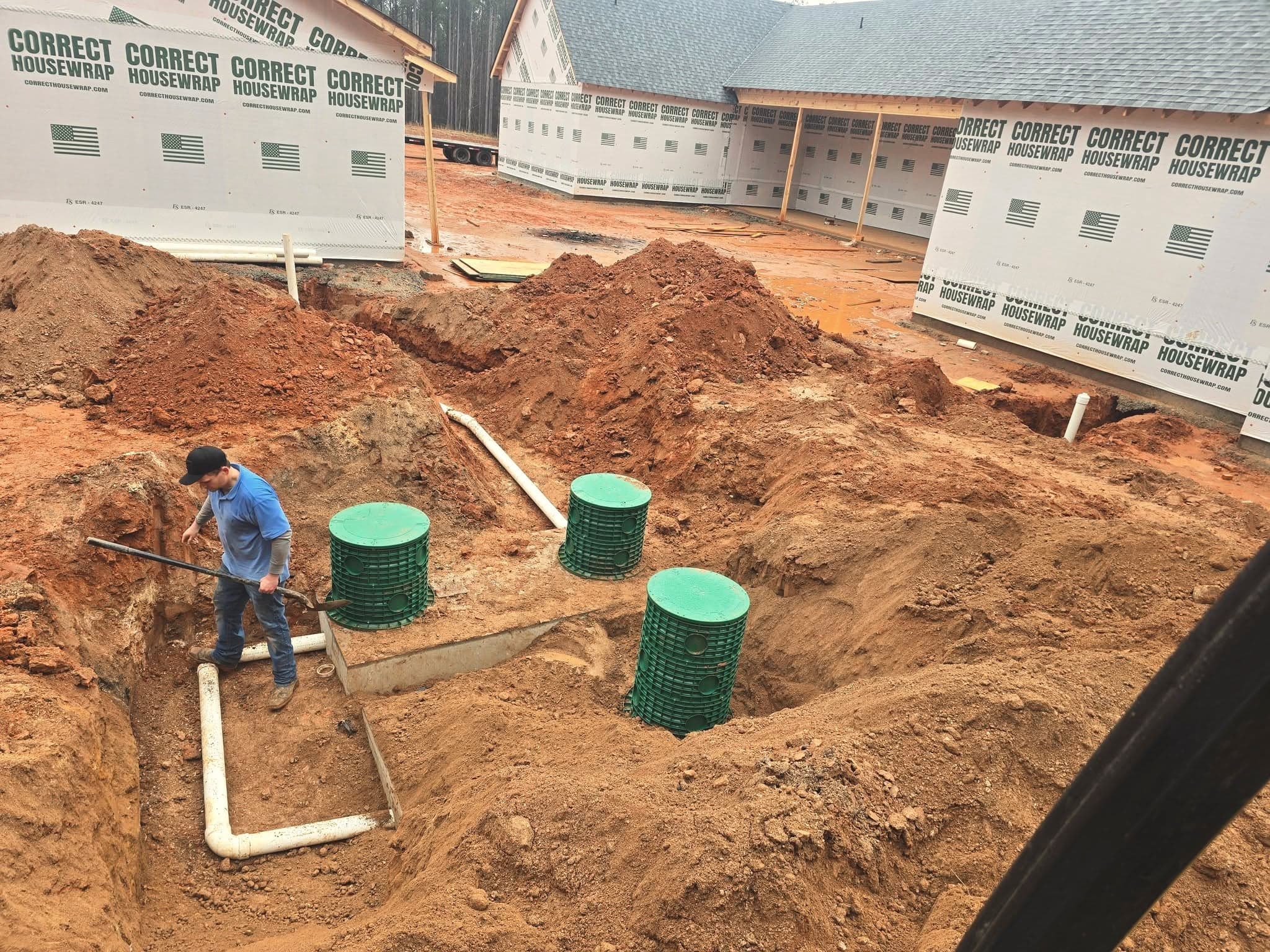
From our job files.

Worth knowing

Do I have to cut down the tree?

Usually not. Once the pipe is sound, roots have no way in, so the fix belongs on the pipe rather than the trunk. Removing a tree doesn't close a separated joint, and the roots left behind decay in place.

The tree matters more to how the repair gets done. A dig close to a large trunk can damage structural roots, so the replacement may be routed around it or placed deeper. That's a conversation to have over the camera footage before anyone picks up a shovel.

Usually not.

FAQ

Tree roots and sewer line questions

Straight answers, with the rule or record behind them. Still unsure? Call and ask the crew that digs.

(678) 863-5620

Can tree roots break a sewer pipe?

Roots mostly exploit openings that already exist, such as a separated joint or a crack. Once inside, they expand as they grow, widening the gap and eventually cracking or displacing weaker pipe. The Santa Barbara lateral glossary lists failed joints as entry points for both roots and groundwater, and sees repair or replacement as the remedy.

Source: City of Santa Barbara — Sewer Lateral Defects Visual Glossary (rev. August 2019)

How do I know if roots are in my sewer line?

Whole-house slow drains, gurgling fixtures and a clog that returns months after clearing are the usual clues. The only way to confirm is a camera inspection. HomeGuide's 2025 range for one is $125 to $500. The video shows whether roots are present, how many joints they've entered and the pipe material.

Source: HomeGuide — Sewer Line Repair & Replacement Cost (updated December 2025)

Will clearing the roots fix the problem for good?

No. Cutting or flushing roots out restores flow but leaves the opening they used. Roots grow back through the same joint, often within a season or two. Clearing is useful to relieve a backup and to let a camera see the line; a lasting fix repairs or replaces the section where the roots enter.

Source: City of Santa Barbara — Sewer Lateral Defects Visual Glossary (rev. August 2019)

Should I call 811 before having my sewer line cleaned?

Atlanta Gas Light asks people to call 811 before any work on a sewer pipe. A gas line installed by boring can pass straight through an existing sewer, and a cutting tool can puncture it. If you suspect that has happened, stop work, leave the area and call AGL's emergency line at 877-427-4321 or 911.

Source: Atlanta Gas Light — Call 811 Before You Clear (sewer line safety)

Who pays for root damage to a sewer lateral in metro Atlanta?

Usually the property owner, for the part of the line they own. Gwinnett, Rockdale and DeKalb put the owner's share out to the right-of-way or easement line. In unincorporated Newton County, NCWSA made customers responsible for clearing blockages through the tap in 2021. Roots in the public main are the utility's responsibility.

Source: NCWSA — Notice of Policy Change: Maintenance of Sewer Service Laterals (2021)

Does my neighbor's tree make them responsible for my sewer line?

Local utility rules make the owner responsible for the lateral serving their building, wherever the offending roots come from. Whether a neighbor owes anything is a civil question, not a utility one. Keep the camera video and photos of the roots, and talk to your insurer or an attorney if you want to pursue it.

Source: Gwinnett County DWR — Sewer Lateral

Is Orangeburg pipe worth repairing if roots are in it?

Rarely. Orangeburg is a fiber pipe that deteriorates and flattens under soil load, and Ann Arbor's building department says replacement is often the only viable option. Cutting roots out of it can make the damage worse. If your camera report shows Orangeburg, expect to discuss replacing that section rather than patching it.

Source: City of Ann Arbor — Orangeburg Sewer Piping

How much does it cost to fix a sewer line damaged by roots?

It depends on how much pipe is affected. HomeGuide's 2025 national range for a repair runs $150 to $3,800 per job. Angi's 2026 Atlanta figures put full lateral replacement at $55 to $250 per linear foot. Permits, depth and surfaces over the line add to either figure.

Source: Angi — How Much Does Sewer Line Replacement Cost in Atlanta, GA? (updated April 2026)

Ready when you are

Rather have a pro look at it? Call the crew that digs.

Trees don't break sound pipe to get in. They find a joint or crack that already leaks moisture and grow toward it. The lasting fix is the opening, not the roots.

(678) 863-5620
  • Georgia DPH-certified installer & pumper
  • Residential & commercial
  • Oxford, GA

Property type
What do you need?
Rather talk? (678) 863-5620
Where's the property?
Is sewage backing up inside? (optional)
Who should we call?

By submitting, you agree we may call or text you about this request. Msg & data rates may apply. Reply STOP to opt out. SMS terms.

Call nowFree Estimate