24/7 Emergency? (678) 863-5620

WATER LINE GUIDE · LEAK DETECTION

What are the signs of a leaking water service line?

The pipe between the meter and your house can leak for months without a puddle. Your meter, your bill and a few simple checks will usually tell you before the ground does.
  • Georgia DPH-certified installer & pumper
  • Homes across metro Atlanta
  • Emergency line answered 24/7

Get a free estimate

or call (678) 863-5620

Property type
What do you need?
Rather talk? (678) 863-5620
Where's the property?
Is sewage backing up inside? (optional)
Who should we call?

By submitting, you agree we may call or text you about this request. Msg & data rates may apply. Reply STOP to opt out. SMS terms.

The short answer

What are the signs of a leaking water service line?

The clearest sign is a water meter that keeps moving while every fixture is off. Other clues: an unexplained jump in the bill, a wet or unusually green strip between meter and house, a sunken spot over the pipe, and weak pressure at every tap. From the meter to the house, repairs are usually the owner's.

Reviewed by Atlanta Water & Sewage Solutions · Last updated

Key facts

Water leak numbers and rules that matter

Each row links to the agency, code or publisher it comes from. Tap a source to check it yourself.

Leak statistics, the meter test, local ownership rules and published repair costs for water service lines, with sources.
TopicWhat it saysSource
Meter testRead the meter, use no water for two hours, read it again; any change probably means a leakEPA WaterSense — Fix a Leak Week
Average household leakageMore than 9,300 gallons wasted a year, per EPA WaterSenseEPA WaterSense — Fix a Leak Week
Serious leaksNine percent of homes have leaks wasting 50 gallons or more per dayEPA WaterSense — Fix a Leak Week
Where your pipe startsAt the meter outlet; Gwinnett, Rockdale, DeKalb, NCWSA and Walton County all own the meter and the street sideGwinnett County DWR — Resident Responsibility
Gwinnett usage tiers (2026)$5.78 per 1,000 gallons up to 8,000, then $8.67, then $11.56 above 12,000Gwinnett DWR Rates and Fee Schedule — January 2026, 2026
Short-section repair$400 to $1,500, typical market range (HomeGuide, 2025)HomeGuide — Main Water Line Repair Cost (Dec 22, 2025), 2025
Full line replacement$2,000 to $5,000 on average, typical market range (HomeGuide, 2025)HomeGuide — How Much Does Water Line Replacement Cost? (Dec. 22, 2025), 2025

Plain definitions

Where the water line runs, and whose it is

Water service line
The buried pipe carrying drinking water from the utility's meter to the house; Georgia's plumbing code requires it to be at least 3/4 inch.
Leak indicator
The small triangle, star or dial on a residential meter face that turns when even a trickle of water passes through.
House shutoff
The owner's valve where the line enters the home; closing it separates indoor plumbing from the buried service line.
Leak adjustment
A partial bill credit some utilities grant after a customer-side leak is repaired and documented.

How the job runs

The two-valve meter test, step by step

This splits the problem in half: inside the house, or underground between the meter and the foundation. It takes a couple of hours of no water use and a flashlight.
  1. 1

    Turn off everything that uses water

    Stop irrigation, ice makers, softeners and anything on a timer. Make sure no toilet is running.

  2. 2

    Read the meter and wait two hours

    Write down the reading or photograph the dial. EPA WaterSense says any change after two hours of no use probably means a leak.

    EPA WaterSense — Fix a Leak Week

  3. 3

    Watch the leak indicator

    If the small triangle or dial is turning while the house is quiet, water is flowing somewhere past the meter right now.

  4. 4

    Close the house shutoff

    Shut the main valve where the line enters the house, then look at the meter again.

  5. 5

    Read the result

    If the meter stops, the leak is inside the house: fixtures, a toilet flapper or a water heater. If it keeps moving with the house valve closed, the leak is on the buried line between the meter and the house.

  6. 6

    Call before anyone digs

    Georgia 811 asks for notice at least 3 business days before digging. Utility locators mark public lines, but the private service line generally isn't marked for you.

    Georgia 811 — The 811 Process

Warning signs

Signs the leak is on the buried line

A service-line leak rarely announces itself. These are the patterns homeowners notice first, roughly in the order they tend to appear.

Meter moving with the house shut off? Call (678) 863-5620

  • 1. A bill that climbs month after monthCompare against the same billing period last year. On tiered rates the leak can push usage into a more expensive block; Monroe's 2026 schedule, for example, reaches $8.19 per 1,000 gallons past 10,000 gallons inside the city (City of Monroe).
  • 2. The meter moves with the house shut offThis is the most reliable homeowner test, and it isolates the underground pipe from indoor plumbing.
  • 3. A strip of lawn that stays green or softLook along the likely path from the meter box to the foundation, especially during a dry spell when the rest of the yard browns.
  • 4. Water in the meter box that never driesSome water after rain is normal. Standing water on a dry week, especially on the house side of the meter, deserves a closer look.
  • 5. Low pressure everywhere at onceA leak or a crushed section upstream of the house robs pressure from every fixture, upstairs and down.
  • 6. Cloudy or rusty water throughoutOlder galvanized steel corrodes inside; InterNACHI puts its useful life at about 20 to 30 years (InterNACHI).
  • 7. A hissing sound near the meter or foundationPressurized water escaping through a small hole can be audible at the meter box or where the line enters the house, especially at night.

Who owns what

Who fixes a leak before or after the meter?

Across the east metro, the meter is the dividing line. A leak on the street side of the meter is the utility's; a leak between the meter and the house is the customer's. Call the utility first if you're unsure which side it's on.
Cross-section: water main, meter box, water service line and houseSTREETPROPERTY LINEMETER BOXWATER MAINWATER SERVICE LINEPROPERTY OWNERUTILITY
Blue = potable water (APWA uniform color code)Typical handoff here: Meter
  • Gwinnett County DWR

    Maintains the main, the pipe to the meter and the meter; the owner repairs leaks between the meter and the home.

    Where the line sits: Meter

  • Rockdale Water Resources

    Owns the service line from the main through the meter; from the meter to the building is the customer's.

    Where the line sits: Meter

  • DeKalb County Watershed Management

    Everything up to and including the meter is county property; a replaced service line is charged as a new connection.

    Where the line sits: Meter

  • Newton County Water & Sewerage Authority

    Owner maintains the line from the meter to the building, including the connection at the meter.

    Where the line sits: Meter

  • Walton County Water Department

    Responsible through the meter; the customer's side includes the water line, pressure-reducing valves and backflow valves.

    Where the line sits: Meter

Your options

Patch the leak or replace the whole line?

The pipe material and its history usually decide this more than the size of the leak.

OPTION 01

Spot repair

When it fits: A single leak in otherwise healthy copper, PEX or PVC, often from a dig strike, a root or a failed fitting.

  • Small excavation
  • HomeGuide's typical range is $400 to $1,500 (2025)
  • Doesn't address old pipe elsewhere on the run

OPTION 02

Full replacement, meter to house

When it fits: Polybutylene, galvanized steel, repeated leaks or pressure problems along the whole run.

  • New pipe end to end
  • Chance to add or replace the house shutoff
  • Longer trench
  • HomeGuide's average is $2,000 to $5,000 (2025)

InterNACHI says polybutylene was made from 1978 to mid-1995 and tends to fail from the inside, so one leak often predicts more.

What it costs

What a service-line leak can cost

Published third-party ranges for the repair itself, plus the local rules that decide how much of the lost water you pay for.

What moves the price

All three ranges are typical national market figures published by HomeGuide, not Atlanta Water & Sewage Solutions pricing. Your line's length, depth and material set the actual cost, and estimates from us are free.

Free estimate: (678) 863-5620
  1. 01Length of the runA house set far back from the road has more pipe to trace and, if replaced, more trench to dig.
  2. 02What's on topDriveways, walks and mature landscaping over the line add removal and restoration.
  3. 03Pipe materialPolybutylene and galvanized usually push the decision toward full replacement.
  4. 04How long it ranEvery month the leak continues adds to the water bill, and leak credits are limited.

The whole story

Why don't Georgia yard leaks always show on the surface?

In sandy ground a broken water line tends to bubble up quickly. East of Atlanta, the pipe usually sits in red clay backfill, and escaping water often follows the looser soil of the original trench or drains down rather than up. A leak can run for a whole billing cycle before a wet spot appears, if one ever does.

That's why the meter test matters more here than a walk around the yard. EPA's WaterSense program estimates that fixing easily corrected household leaks saves about 10 percent on water bills, and a buried service leak is rarely the easy kind. If the meter says water is leaving and the house is dry, trust the meter.

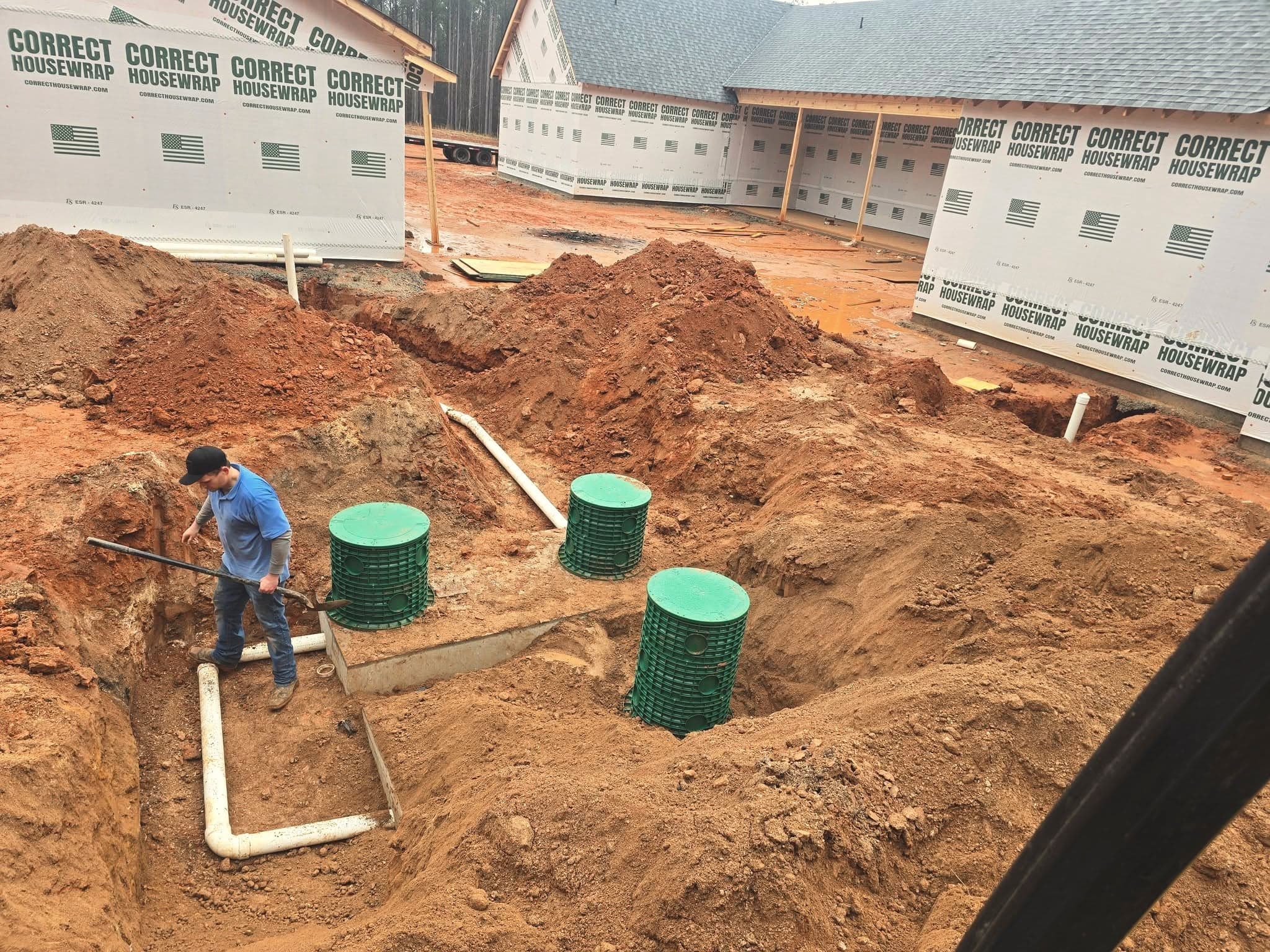
From our job files.

Worth knowing

Will the utility credit my bill for a leak I didn't know about?

Sometimes, with limits. NCWSA in Newton County allows no more than two leak adjustments in any twelve-month period and adjusts only the two highest consecutive months (NCWSA). The City of Covington considers adjustments for leaks on the residence side of the meter and bills the excess at a discounted $3.00 per thousand gallons for the two highest months (Covington leak policy).

Either way, utilities want proof the leak is fixed, so keep the invoice or receipt from the repair. Fix first, then apply. If you're on public sewer billed by water use, ask whether the sewer portion can be adjusted too, since leaked water never went down the drain.

Sometimes, with limits.

FAQ

Water line leak questions

Straight answers, with the rule or record behind them. Still unsure? Call and ask the crew that digs.

(678) 863-5620

How do I know if my water line is leaking underground?

Turn off every fixture and appliance, then watch the meter's leak indicator. Per EPA WaterSense, a reading that changes over a two-hour quiet stretch probably means a leak. If yours moved, close the house shutoff and check again. A meter that still moves with the house valve closed points to a leak in the buried line between the meter and the house.

Source: EPA WaterSense — Fix a Leak Week

Who is responsible for a water leak between the meter and the house?

Usually the homeowner. Gwinnett, Rockdale, DeKalb, NCWSA and the Walton County Water Department all treat the meter as the boundary, so the line from the meter's outlet to the house belongs to the customer. Leaks at the meter or on the street side are the utility's, so report those to them directly.

Source: Gwinnett County DWR — Resident Responsibility

Can a water line leak cause a high water bill with no visible water?

Yes. A buried leak runs around the clock, and in clay soil the water may never surface. EPA WaterSense estimates the average household's leaks waste more than 9,300 gallons a year, and nine percent of homes have leaks losing 50 gallons or more per day. An unexplained bill increase is often the first sign.

Source: EPA WaterSense — Fix a Leak Week

What does a leaking water line in the yard look like?

Look for a strip of grass greener or softer than the rest of the lawn, a spot that stays muddy in dry weather, a depression along the pipe route, or a meter box that holds water between rains. In Georgia clay, water can travel along the old trench, so the wet spot may not sit directly over the leak.

How much does it cost to fix a leaking water line?

HomeGuide's 2025 figures put a short-section main water line repair at $400 to $1,500 and a full replacement at $2,000 to $5,000 on average, with trenched work around $50 to $200 per linear foot. Pipe material, length and what sits on top of the line move the number most.

Source: HomeGuide — How Much Does Water Line Replacement Cost? (Dec. 22, 2025)

Will my utility give me a credit for a water line leak?

Many will consider it after the leak is repaired and documented. NCWSA limits adjustments to two in any twelve months and adjusts the two highest consecutive months. Covington bills the excess at a discounted $3.00 per thousand gallons for the two highest months. Policies differ, so keep your repair receipt and ask.

Source: NCWSA — Help Center: Leak adjustment information (Wayback snapshot Sept. 18, 2026)

Does low water pressure mean my service line is leaking?

It can. Pressure that drops at every fixture at the same time suggests a problem before water reaches the house: a leak, a crushed section, a failing pressure-reducing valve or old galvanized pipe narrowed by corrosion. Low pressure at just one faucet is more likely a local issue such as a clogged aerator.

Source: InterNACHI — Plumbing in Older Homes

Is polybutylene water line more likely to leak?

InterNACHI says polybutylene was produced from 1978 to mid-1995 and can deteriorate from the inside when exposed to certain water disinfectants. Blue PB was mostly used outdoors for cold water, which means service lines. Because it fails along the pipe rather than only at fittings, one leak often signals that the whole run is at risk.

Source: InterNACHI — Polybutylene for Inspectors

Ready when you are

Rather have a pro look at it? Call the crew that digs.

The pipe between the meter and your house can leak for months without a puddle. Your meter, your bill and a few simple checks will usually tell you before the ground does.

(678) 863-5620
  • Georgia DPH-certified installer & pumper
  • Residential & commercial
  • Oxford, GA

Property type
What do you need?
Rather talk? (678) 863-5620
Where's the property?
Is sewage backing up inside? (optional)
Who should we call?

By submitting, you agree we may call or text you about this request. Msg & data rates may apply. Reply STOP to opt out. SMS terms.

Call nowFree Estimate