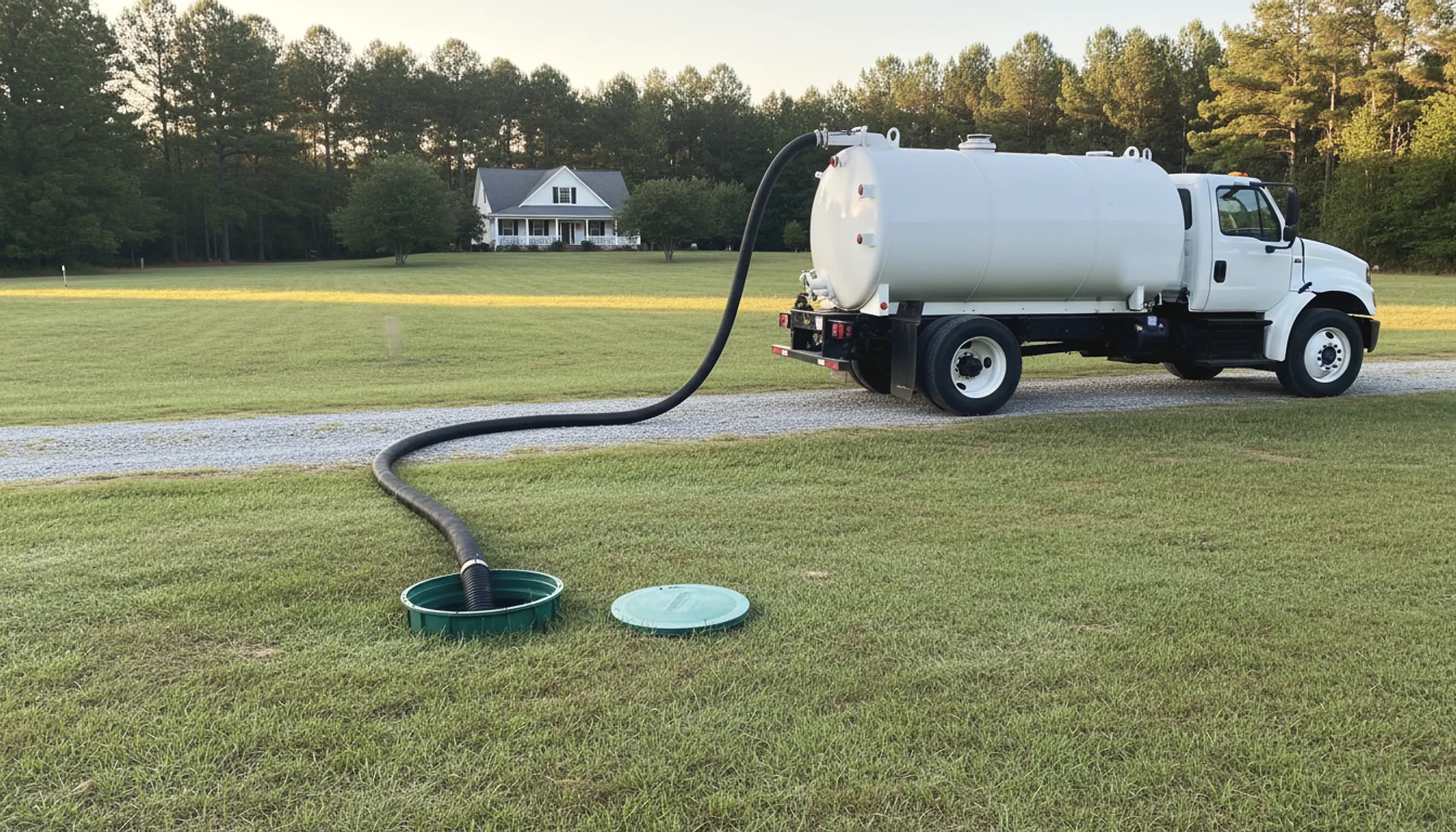
Septic Pumping · Walnut Grove, GA
Septic tank pumping for Walnut Grove, Georgia homeowners, including people who moved from sewered neighborhoods and have never owned a septic system.
- Georgia DPH-certified installer & pumper
- Residential & commercial
- Local shop in Oxford, GA
Get a free estimate
or call (678) 863-5620The short answer
How often should a septic tank be pumped in Walnut Grove, GA?
Walnut Grove homes off the city sewer should have the septic tank pumped every 3 to 7 years, per UGA Extension, sooner with a garbage disposal or a full house. A proper pump-out empties every compartment through its lid and ends with a written condition note. Walton County also asks for pumping proof at resale.↗↗↗
Reviewed by Atlanta Water & Sewage Solutions · Last updated
The Walnut Grove story
For people who never had a tank before
If you moved here from a neighborhood where the toilet simply connected to a city pipe, this setup may be new. In Walnut Grove, the town's sewer is a small land-application system, and many houses on the surrounding roads treat their own wastewater in a buried tank and field.↗
A tank is not maintenance-free. Solids settle to the bottom as sludge, grease floats as scum, and the clearer liquid in between flows to the field. Pumping removes the layers before they reach the outlet. Skip it long enough and solids ride out into the trenches, which is how a few hundred dollars of service becomes a field replacement.↗
The first job is finding the tank. Ask the seller for the county permit drawing. If there isn't one, we locate it from the cleanout and probe.
If you moved here from a neighborhood where the toilet simply connected to a city pipe, this setup may be new.
Median year homes were built
1993
Typical house here is about 33 years old — and so is its original sewer or septic line.
ACS 2020-2024 5-year, table B25035 · Census Reporter API - Walnut Grove, GA (ACS 2024 5-year)
Housing era
Tanks from the early 1990s
Half of Walnut Grove's housing predates 1993, which puts many tanks past thirty years. Concrete that old can have corroded tees, and some tanks predate the effluent filters now standard in Georgia. We check both while the lids are off.↗
Local facts
Your tank, by the numbers
Each row links to the agency, code or publisher it comes from. Tap a source to check it yourself.
| Topic | What it says | Source |
|---|---|---|
| Typical size | About 1,000 gallons for a three-bedroom, two-bath home | UGA Extension Bulletin B1421 — A Beginner's Guide to Septic Systems (Oct 2024) |
| Interval | Every 3 to 7 years (UGA); about every 3 to 5 (DPH Manual) | UGA Extension Bulletin B1421 — A Beginner's Guide to Septic Systems (Oct 2024) |
| Risers on new tanks | Required where more than 12 inches of soil covers the tank | Georgia DPH Manual for On-Site Sewage Management Systems (2026) |
| Walton evaluation | Needs a pump-out inside the last 5 years | Walton County Environmental Health — Service Request Form |
More about Walnut Grove
What happens on pump day
We uncover the lids, pump liquid, sludge and scum out of each compartment, and look at the tees, walls and filter while the tank is empty. Georgia requires the pumper to write down the tank's condition, including damaged or missing parts, and send a copy to the county health office. Keep yours; the next buyer's inspector will ask.↗
If the lids sit a foot or more down, we suggest risers while the hole is open, one over each compartment. It turns every future visit into a lift-the-lid job.
- The pumper's written condition report goes to the owner, with a copy to the local Environmental Health office.↗
We uncover the lids, pump liquid, sludge and scum out of each compartment, and look at the tees, walls and filter while the tank is empty.
More about Walnut Grove
Where the septage goes
Septage has to end up at an approved treatment plant or permitted site. In Walton, Monroe's wastewater rate sheet lists septic hauler discharge at 30 cents a gallon, part of what sits behind any pumping price. Additives do not replace this step; Georgia DPH's advisory says they can push fine solids into the field instead.↗↗
- City of Monroe charges septic haulers $0.30 per gallon to discharge (rate effective January 2025).↗
What it costs
Typical pump-out prices
1,000-gallon tank, Atlanta
$300–$550
Typical market range — Angi — How Much Does It Cost to Pump a Septic Tank in Atlanta? (updated May 5, 2026), 2026
Septic pumping, national
$300–$700
Typical market range — HomeGuide — How Much Does Septic Tank Pumping Cost? (2026 data), 2026
Digging to reach the tank, Georgia
$50–$150
Typical market range — Septic & Well Pro — Septic Pumping Cost Georgia 2026 (updated April 10, 2026), 2026
Effluent filter cleaning, Georgia
$25–$75
Typical market range — Septic & Well Pro — Septic Pumping Cost Georgia 2026 (updated April 10, 2026), 2026
What moves the price
These are third-party typical market ranges, not our prices. Every job is quoted after we see it — estimates are free.
Free estimate: (678) 863-5620- 01How deep the lids are and whether risers exist
- 02A single-compartment tank from the early 1990s versus a newer two-compartment tank
- 03Household size and a disposal feeding the tank
- 04Distance for the hose from the driveway to the tank
Warning signs
Signs the tank needs pumping now
Seeing two or more of these? Call before it gets worse.
- 1. You can't remember the last pump-out, or the seller couldn't
- 2. Drains throughout the house slow at the same time
- 3. The lowest toilet gurgles when the washer drains
- 4. Odor near the tank lid on warm days
- 5. Wet, spongy grass over the tank itself
More about Walnut Grove
Homes and businesses on their own tanks
Households are the bulk of Walnut Grove pumping. A business off the city plant, like an office, church or shop near the SR 81 and SR 138 crossroads, fills its tank faster with daily staff and visitors, and a kitchen adds grease that needs more frequent removal.↗
A DPH-approved pumper, 7 minutes away
Georgia DPH's approved pumper list dated 9/18/2026 includes our company under Walton County, and our Oxford shop is about 3.7 road miles from Walnut Grove.
FAQ
Walnut Grove septic pumping questions
Straight answers, with the rule or record behind them. Still unsure? Call and ask the crew that digs.
(678) 863-5620I just moved to Walnut Grove. How do I know if I'm on septic?
Ask the seller or the city. The town runs a small sewer plant, but many homes around it use tanks. A lid or cleanout in the yard is a clue.
Source: Walnut Grove Comprehensive Plan 2022-2026 (Georgia DCA)
How often should I pump?
UGA Extension says every 3 to 7 years. A big family or a disposal means the shorter end.
Source: UGA Extension Bulletin B1421 — A Beginner's Guide to Septic Systems (Oct 2024)
Do septic additives help?
Georgia DPH advises against relying on them. Biological additives can break solids into fine particles that flow on to the field.
Source: Georgia DPH — Additives and Your On-site Sewage Management System (advisory)
Will I need a pumping record to sell?
If a Walton County evaluation is requested, yes: the county wants proof the tank was pumped within the last five years.
Source: Walton County Environmental Health — Service Request Form
Are risers worth adding?
On a deep tank, usually. New Georgia tanks need them when soil cover passes 12 inches, and they save digging every time after.
Source: Georgia DPH Manual for On-Site Sewage Management Systems (2026)
What should I get in writing?
A condition report noting tees, walls and any missing parts. The pumper must also send a copy to the county.
Source: Georgia DPH Manual for On-Site Sewage Management Systems (2026)
Sources
Where these facts come from
Rules, costs and local facts on this page link to the agency, code or publisher that states them. Cost figures are third-party market ranges, not our prices — estimates are free.
Reviewed by Atlanta Water & Sewage Solutions · Last updated
- 1UGA Extension Bulletin B1421 — A Beginner's Guide to Septic Systems (Oct 2024)
- 2Georgia DPH Manual for On-Site Sewage Management Systems (2026)
- 3Walton County Environmental Health — Service Request Form
- 4Walnut Grove Comprehensive Plan 2022-2026 (Georgia DCA)
- 5Census Reporter API - Walnut Grove, GA (ACS 2024 5-year)
- 6City of Monroe Wastewater Rates 2026 (septic hauler discharge)
- 7Georgia DPH — Additives and Your On-site Sewage Management System (advisory)
- 8Angi — How Much Does It Cost to Pump a Septic Tank in Atlanta? (updated May 5, 2026)
- 9HomeGuide — How Much Does Septic Tank Pumping Cost? (2026 data)
- 10Septic & Well Pro — Septic Pumping Cost Georgia 2026 (updated April 10, 2026)
- 11Georgia DPH — Approved Septic Tank Pumpers list (9/18/2026)
Ready when you are
First septic tank? We'll show you where it is.
Call with your address. We find the lids, pump every compartment and leave a written record for your files.
(678) 863-5620- Georgia DPH-certified installer & pumper
- Residential & commercial
- Oxford, GA
Free estimate
or call (678) 863-5620