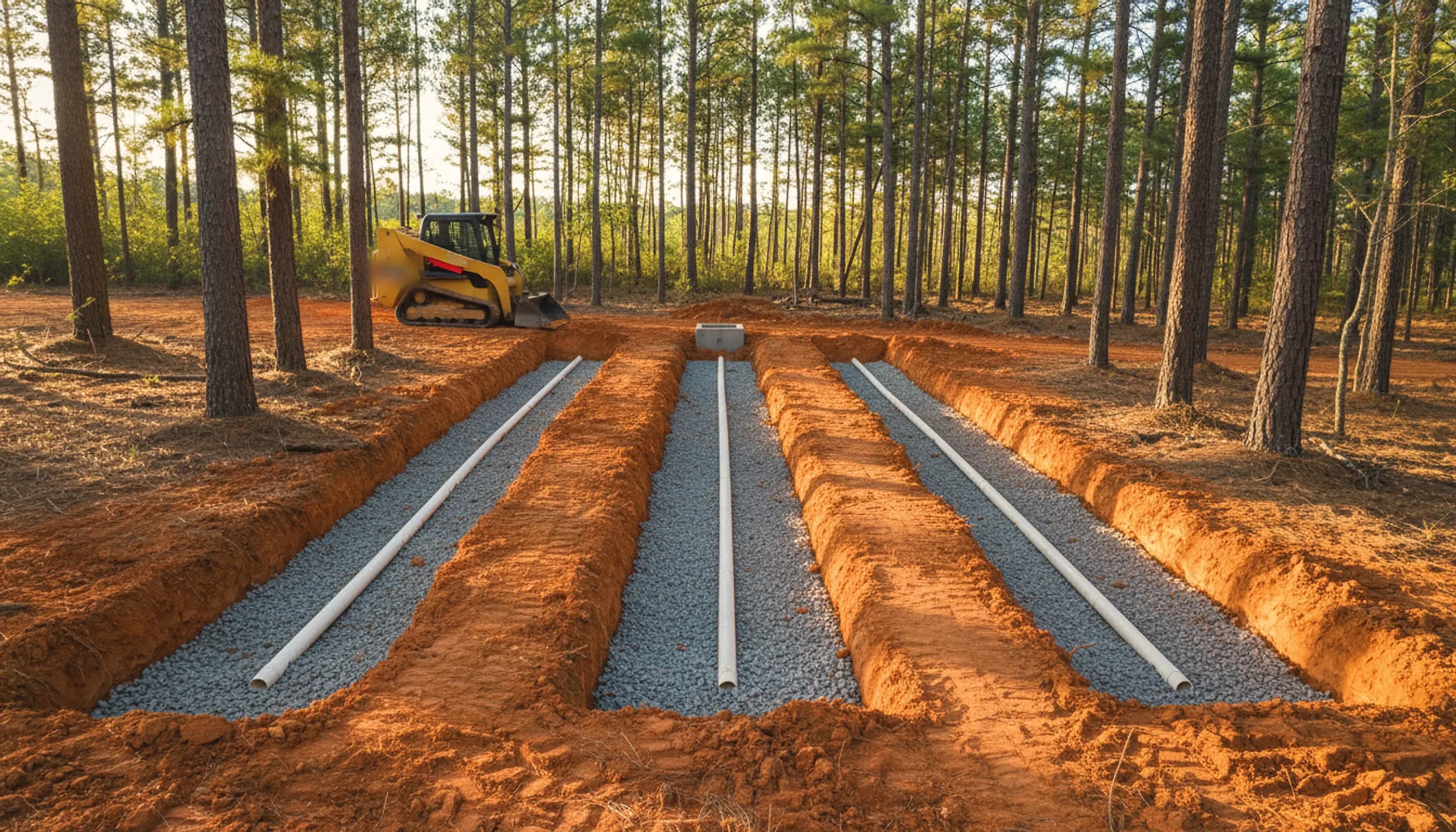
Drain Field Repair & Replacement · Almon, GA
Drain field repair in Almon, Georgia, keeping new trenches 150 feet from streams and letting the soil report set the rest.
- Georgia DPH-certified installer & pumper
- Residential & commercial
- Local shop in Oxford, GA
Get a free estimate
or call (678) 863-5620The short answer
How do you repair a failing drain field in Almon, GA?
An Almon drain field repair needs a GNR Newton repair permit and a Level 3 soil report, then new or extended trenches that respect creek setbacks. In the Yellow River watershed, Newton County keeps drain fields 150 feet from perennial streams. Atlanta Water & Sewage Solutions finds the failure, files the permit and rebuilds the field.↗↗
Reviewed by Atlanta Water & Sewage Solutions · Last updated
At a glance
The Almon story
Streams everywhere, and a county rule that pushes fields uphill
Five named streams are mapped within about two and a half miles of Almon, the Yellow River among them. The Yellow is a 76-mile Ocmulgee tributary that crosses from Rockdale into Newton and ends in Jackson Lake, and Newton County puts its whole watershed, with the South River's, under a protection district.↗↗↗
Inside that district a drain field has to sit 150 feet from any river bank, lake shore or perennial stream shown on the USGS quad map, and the first 100 feet from the bank is meant to stay natural and undisturbed. State rules alone would allow 50 feet. On a lot that falls toward Gum Creek or a smaller branch, the replacement field often moves up the slope, closer to the house.↗↗
On the record
- Newton UDO Sec. 420-120(C): in the South River/Yellow River watershed district, septic tanks and drain fields must be set back at least 150 feet from rivers, lakes and perennial streams.↗
- Sec. 420-120(A): outside development nodes, the same district keeps a 100-foot natural, undisturbed riparian buffer along rivers and perennial streams.↗
Soil & terrain
Good ridge soil, poor bottomland
The ground at Almon's mapped point is Appling, a very deep, well-drained soil with its water table and bedrock below 60 inches. That is decent drain field soil for the Piedmont, but its subsoil is still clay, so fields fail slowly from biomat and overloading rather than from groundwater.↗
Down by the creeks it is a different story. Newton's second-largest map unit is Cartecay and Chewacla soils, frequently flooded, which no one should build a field in. The Level 3 soil report draws that line on your lot.↗
Permits · GNR Public Health — Newton Environmental Health, Covington
An Almon field repair, start to finish
- 01
Pump the tank and dig inspection holes along the trenches to see whether the pipe, the gravel or the soil face has failed.↗
- 02
Commission the Level 3 soil report, or reuse an approved one GNR already holds for the lot.↗
- 03
File the repair application, noting whether sewage is backing up inside or surfacing outside; GNR may ask for an engineered site plan on a tight lot.↗
- 04
Stake the new trenches clear of wells by 100 feet and, in the watershed district, streams by 150 feet.↗
- 05
Build to the permit and call for inspection before backfill; the permit is good for 12 months.↗
Warning signs
Almon drain field warning signs
Seeing two or more of these? Call before it gets worse.
- 1. Spongy ground or grey water at the low end of the field, toward the creek
- 2. Grass over the trenches greener than the rest of the yard in August
- 3. Slow drains that return soon after pumping
- 4. Roots from the wooded lot edge in the distribution box
- 5. Sewage odor on still, humid evenings
What it costs
What Almon field repairs cost
Drain field repair or rejuvenation
$1,000–$5,000
Typical market range — HomeGuide — Drain / Leach Field Replacement Cost (2026), 2026
Drain field repairs, wider range
$2,000–$15,000
Typical market range — Angi — How Much Do New Drain Fields Cost? (2026), 2026
Leach line replacement
$20–$45 per linear foot
Typical market range — HomeGuide — Drain / Leach Field Replacement Cost (2026), 2026
Moving a field to a new spot
$5,500–$21,500
Typical market range — HomeGuide — Drain / Leach Field Replacement Cost (2026), 2026
What moves the price
These are third-party typical market ranges, not our prices. Every job is quoted after we see it — estimates are free.
Free estimate: (678) 863-5620- 01How far uphill the field must move to clear the stream buffer
- 02Tree clearing on wooded Almon lots
- 03Trench length the soil report requires
- 04Access for equipment down a long drive
Local facts
Almon-area rules that shape where a new field fits
Each row links to the agency, code or publisher it comes from. Tap a source to check it yourself.
| Topic | What it says | Source |
|---|---|---|
| Almon overlay, Tier 1 residential | Maximum impervious surface of 40% of gross acreage | Newton County Zoning Ordinance (UDO Chapter 1), working copy with amendments through 07-19-2022 |
| Conservation subdivisions | Required buffers may be used when area is needed to replace a failed septic system | Newton County Zoning Ordinance (UDO Chapter 1), working copy with amendments through 07-19-2022 |
| Watershed stream setback | 150 feet for tanks and drain fields | Newton County Zoning Ordinance (UDO Chapter 1), working copy with amendments through 07-19-2022 |
More about Almon
Residential fields and the occasional commercial one
FAQ
Almon drain field questions
Straight answers, with the rule or record behind them. Still unsure? Call and ask the crew that digs.
(678) 863-5620How close to a creek can my new drain field be in Almon?
Georgia's rules say 50 feet from a stream's normal water level, but in Newton's South River/Yellow River watershed district the county requires 150 feet from perennial streams on the USGS quad map.
Source: Newton County Zoning Ordinance (UDO Chapter 1), working copy with amendments through 07-19-2022
Do I need a permit to replace field lines?
Yes. Repairs and replacements must be permitted and inspected under 511-3-1, and GNR's Newton fee is $275, or $400 if the repair stems from a complaint.
Source: GNR Environmental Health Fee Schedule — Newton County
My subdivision has a no-disturb buffer. Can the new field go there?
In an open space conservation subdivision, Newton's ordinance lets those buffers be used when the area is needed to replace a failed septic system. Stream buffers are a different matter.
Source: Newton County Zoning Ordinance (UDO Chapter 1), working copy with amendments through 07-19-2022
Why did my field fail if the soil drains well?
Appling drains well but has clay below, and solids carried out of an unpumped tank form a biomat that seals the trench floor. NC State Extension describes how that layer thickens until trenches flood.
Source: NC State Extension — Septic Systems and Their Maintenance
How long does the GNR process take?
Allow for the soil report first, then about 10 working days for GNR's review and site visit.
Source: GNR Residential Septic System Repair Permitting Requirements (Rev. 2024-05-03)
What does moving a drain field cost?
HomeGuide's 2026 range to relocate a leach field is $5,500 to $21,500, which includes the new field and supply line.
Source: HomeGuide — Drain / Leach Field Replacement Cost (2026)
Nearby areas
Drain field repair near Almon
Built by a certified installer
Replacing a drain field is installer work under Georgia rules. Atlanta Water & Sewage Solutions is named on the DPH Certified Septic Tank Installer list and the Approved Septic Tank Pumper list, both released September 18, 2026.
Sources
Where these facts come from
Rules, costs and local facts on this page link to the agency, code or publisher that states them. Cost figures are third-party market ranges, not our prices — estimates are free.
Reviewed by Atlanta Water & Sewage Solutions · Last updated
- 1GNR Residential Septic System Repair Permitting Requirements (Rev. 2024-05-03)
- 2Newton County Zoning Ordinance (UDO Chapter 1), working copy with amendments through 07-19-2022
- 3USGS National Hydrography Dataset — named flowlines near Almon
- 4Yellow River (Georgia) - Wikipedia
- 5Georgia DPH Rules Chapter 511-3-1 On-Site Sewage Management Systems (Jan 2016)
- 6USDA NRCS Official Series Description - APPLING
- 7USDA NRCS Soil Data Access — Newton and Rockdale Counties survey (GA649), Newton overlap
- 8NC State Extension — Septic Systems and Their Maintenance
- 9GNR Environmental Health Fee Schedule — Newton County
- 10HomeGuide — Drain / Leach Field Replacement Cost (2026)
- 11Angi — How Much Do New Drain Fields Cost? (2026)
- 12Georgia DPH Certified Septic Tank Installer Companies list (9/18/2026)
- 13Georgia DPH Approved Septic Tank Pumper Companies list (9/18/2026)
Ready when you are
Field soggy down by the creek? WE'LL FIND DRY GROUND FOR THE NEW ONE.
Call for a field evaluation. We map the old trenches, check the stream buffers on your lot, and give a free estimate for repair or relocation.
(678) 863-5620- Georgia DPH-certified installer & pumper
- Residential & commercial
- Oxford, GA
Free estimate
or call (678) 863-5620