24/7 Emergency? (678) 863-5620

GUIDE · PIEDMONT SOILS AND SEPTIC

Why septic systems struggle in Georgia red clay, and what works

The red subsoil under most yards east of Atlanta holds water tightly and passes it along slowly. That single trait explains why local drain fields are long, why some lots need special designs, and why a soil report comes before any septic plan.
  • Georgia DPH-certified installer & pumper
  • Residential & commercial
  • Emergency line answered 24/7

Get a free estimate

or call (678) 863-5620

Property type
What do you need?
Rather talk? (678) 863-5620
Where's the property?
Is sewage backing up inside? (optional)
Who should we call?

By submitting, you agree we may call or text you about this request. Msg & data rates may apply. Reply STOP to opt out. SMS terms.

The short answer

Why do septic systems struggle in Georgia red clay?

Georgia's Piedmont red clay, found in soils like Cecil, Pacolet and Appling, absorbs septic effluent slowly, so drain fields need more trench length and fail sooner when overloaded or saturated. Georgia sizes every absorption field to the soil it sits in, which is why clay lots often need longer fields, larger lots or alternative system designs.

Reviewed by Atlanta Water & Sewage Solutions · Last updated

Key facts

Red clay and septic: key numbers

Each row links to the agency, code or publisher it comes from. Tap a source to check it yourself.

Soil survey data and Georgia rules that explain how Piedmont clay shapes septic design east of Atlanta.
TopicWhat it saysSource
How field size is setBy the wastewater volume and the soil receiving it (Rule 511-3-1-.07(1))Ga. Comp. R. & Regs. 511-3-1 (Georgia Secretary of State rules index)
Cecil red clay layerRoughly 8 to 42 inches below the surface in the typical profile; Piedmont uplandsUSDA NRCS Official Soil Series Description — Cecil series (rev. Nov 2025), 2025
Cecil's share of Newton CountyAbout 45,900 of 178,600 acres of major soil components (~26%)USDA NRCS Soil Data Access — Newton and Rockdale Counties soil survey (GA649), 2026
Largest series in Newton–Rockdale surveyPacolet, about 65,000 acres in GA649USDA NRCS Soil Data Access — Newton and Rockdale Counties soil survey (GA649), 2026
Walton soils rated for absorption fieldsAbout 22% (roughly 46,000 acres) "very limited"; nearly all the rest "somewhat limited"; none "not limited"USDA NRCS Soil Data Access — GA297 Walton County, Septic Tank Absorption Fields interpretation, 2026
Walton lot-size triggerLarger lots required where slopes exceed 5% or percolation is slower than 45 minutes per inchWalton County Board of Health — Minimum Lot Size Ordinance (effective Aug. 18, 2004), 2004
Piedmont rainfall37 to 60 inches a year, per the Pacolet series descriptionUSDA NRCS Official Series Description — Pacolet series
Soil report in GNR countiesLevel 3 report by a certified soil classifier for every septic permit since Feb 7, 2022GNR Public Health — Septic Systems (Gwinnett, Newton & Rockdale), 2026

Plain definitions

Soil terms worth knowing before you build

Piedmont
The Piedmont is the rolling upland between Georgia's mountains and coastal plain, where weathered rock has produced deep, clay-rich subsoils under a thin sandy surface.
Bt horizon
A Bt horizon is a subsoil layer where clay has accumulated over time; in Cecil soils it is the red clay band a drain field trench typically sits in.
Percolation rate
The percolation rate is how many minutes it takes water to drop one inch in a test hole, so a larger number means slower-draining soil.
Loading rate
The loading rate is how much effluent each square foot of trench can accept per day; slow clay gets a low rate, which means more trench.
Limiting layer
A limiting layer is rock, a dense horizon or a seasonal water table that stops effluent from moving down, and it sets how deep a trench can go.

Soil & terrain

The Piedmont soils under east-metro yards

Dig a few inches into almost any lawn between Lithonia and Madison and the color changes from tan to brick red. That red is iron-stained clay, weathered in place from granite, gneiss and schist over a very long time. It is rated well drained, meaning it doesn't stay soggy year-round, but its fine particles and tight pores hand water along slowly. For a septic system, slow is the key word.

The soil series names repeat from county to county. Cecil dominates Walton, where it covers about 41% of the surveyed area, and is the biggest single component in Newton. Pacolet, found on steeper ground, tops the combined Newton and Rockdale survey. Appling adds a strong-brown clay subsoil in Walton and Gwinnett, and Lloyd, a darker red clay loam formed from mafic rock, is the most extensive series in Morgan and Jasper.

Morgan County also has Hard Labor, a series established there in 1998 and rated moderately well drained with moderately low saturated hydraulic conductivity. On lots mapped with it, water moves through the subsoil especially slowly, and a soil classifier will look carefully for signs of seasonal wetness.

  1. Cecil

    Very deep and well drained; red clay subsoil from about 8 to 42 inches; roughly 41% of Walton County's surveyed soil area.

  2. Pacolet

    Very deep, well drained; red clay can start within a few inches of the surface; commonly on 15–25% slopes.

  3. Appling

    Very deep, well drained; strong-brown clay subsoil from about 12 to 48 inches; about 28,800 acres in Walton.

  4. Lloyd

    Very deep, well drained, moderately permeable upland soil from mafic and intermediate rock; Morgan's most extensive series.

  5. Hard Labor

    Moderately well drained with moderately low saturated hydraulic conductivity; series established in Morgan County.

  6. Soil series · USDA NRCS

The whole story

Why clay means a longer, more fragile drain field

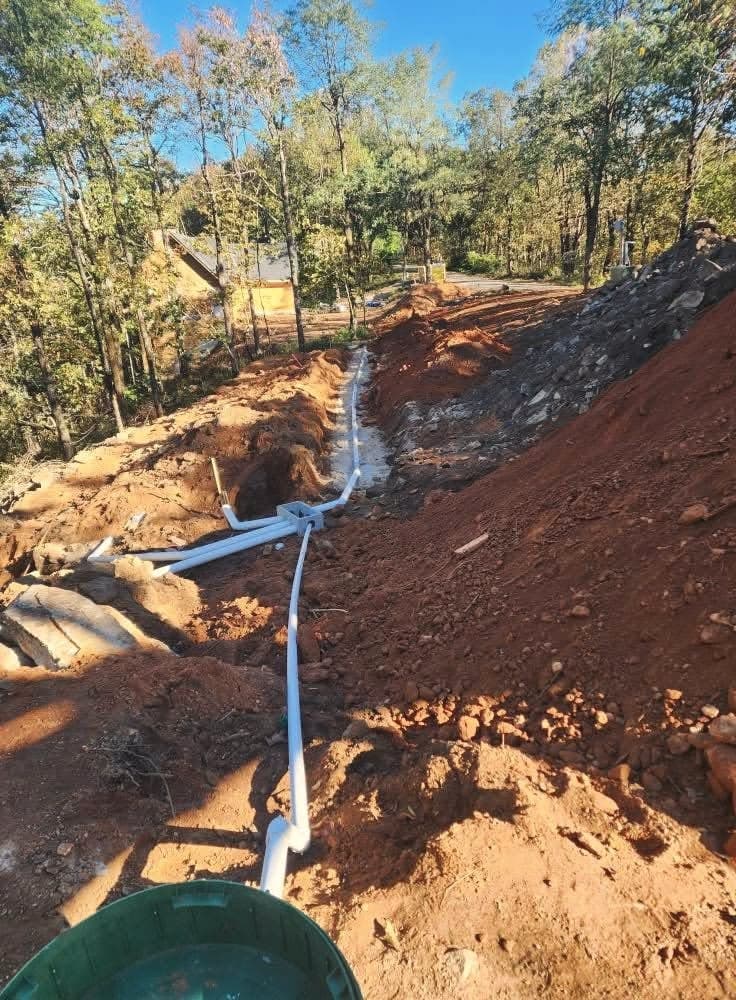
A drain field works by letting effluent seep out of trenches and filter through unsaturated soil. Georgia ties the size of that field to two things: how much wastewater the house produces and how quickly the soil takes it in. When the soil is slow, each foot of trench is assigned a smaller share of the daily flow, and the total trench length grows to make up the difference.

Walton County puts numbers on the problem. Its Board of Health lot-size ordinance calls for larger lots when slopes exceed 5% or when percolation is slower than 45 minutes per inch. State rule permits a conventional or chamber system on tracts of three acres or more where percolation is no slower than 120 minutes per inch; slower ground needs a soil classifier's special study and an engineered site plan.

Clay also leaves less margin. Sandy soil can absorb a surge from a busy weekend; clay cannot. Add the 37 to 60 inches of annual rainfall recorded for the Pacolet series and it is easy to see how a field that works in a dry October struggles in a wet March, when the soil around the trenches is already full of water. Fields sized for fewer bedrooms than a house now has, or fields that took on runoff after regrading, are the first to show it.

That is also why fields here clog in a characteristic way. Solids that escape a neglected tank seal the trench bottom, and in slow clay there is no spare capacity to compensate. Regular pumping and an effluent filter protect the field more in the Piedmont than in faster soils.

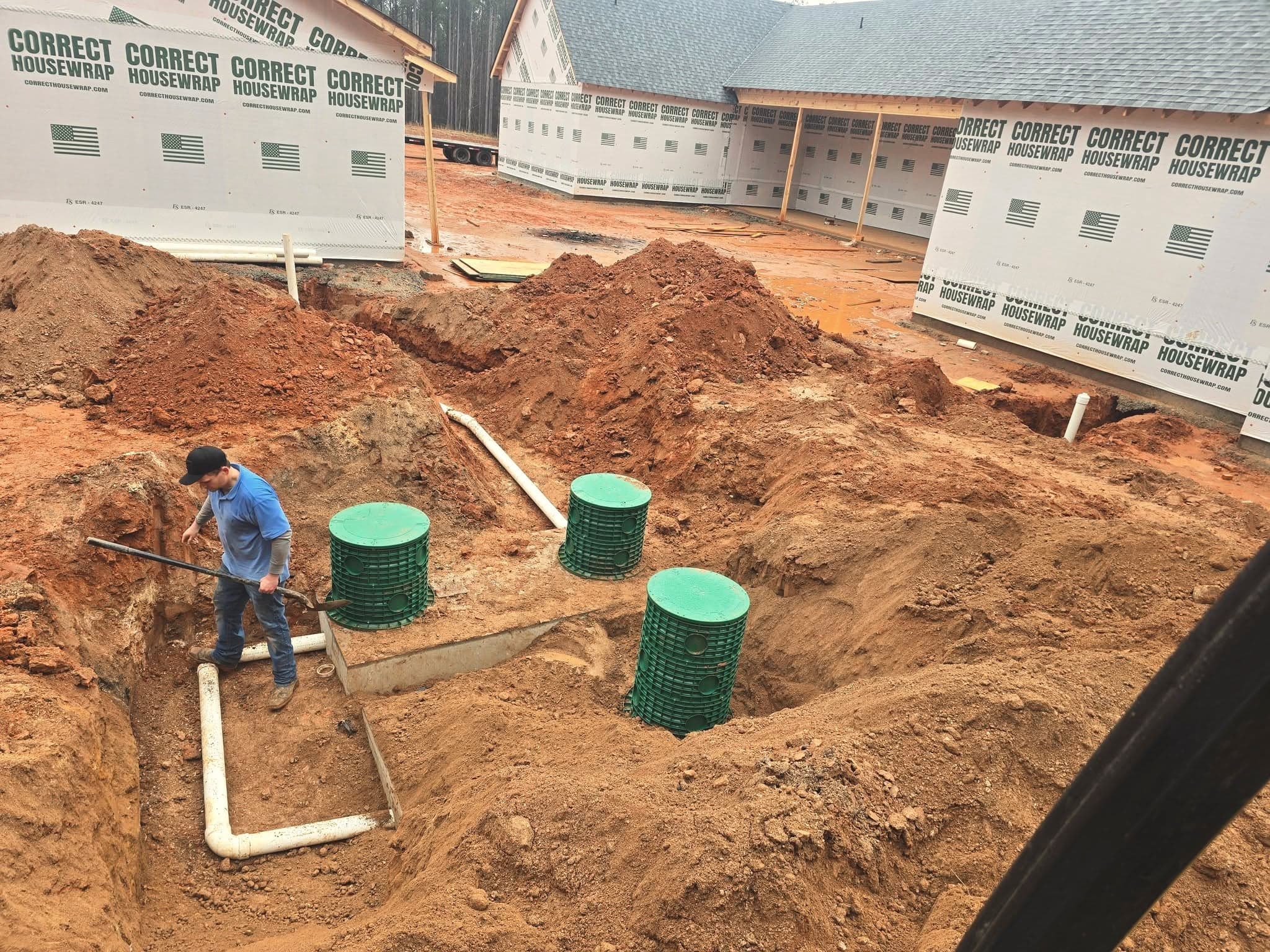
From our job files.

Your options

Septic designs that work on Georgia clay

The soil report usually narrows the choice. Conventional and chamber systems are Georgia's baseline; the rest are alternative systems built to the DPH Manual.

OPTION 01

Longer conventional or chamber field

When it fits: Deep, well-drained clay like Cecil or Appling with enough room for the full trench length plus a reserved repair area.

  • Gravity flow on many lots
  • Chambers avoid hauling gravel onto a soft clay yard
  • Uses a lot of yard
  • Needs an equal-size repair area set aside

OPTION 02

Aerobic treatment unit with drip dispersal

When it fits: Tight lots or shallow clay where trenches won't fit or can't go deep enough.

  • Cleaner effluent before it reaches the soil
  • Shallow drip lines follow the contour
  • Needs power, an alarm and routine service
  • More components to maintain

OPTION 03

Mound

When it fits: A limiting layer sits too close to the surface for in-ground trenches.

  • Builds suitable treatment soil above poor native ground
  • Requires a dosing pump
  • Raised bed is visible and uses imported fill

How the job runs

How to check your own lot on Web Soil Survey

The USDA's free Web Soil Survey gives a first read on any Georgia parcel. It is a planning tool, not a permit document: GNR counties still require a Level 3 soil report, and other counties run their own site evaluation.
  1. 1

    Define your area of interest

    Open Web Soil Survey, zoom to your address, and draw a box or polygon around the part of the lot where a house and drain field could go.

    USDA NRCS Web Soil Survey

  2. 2

    Read the soil map

    Open the Soil Map tab to see which map units fall inside your area. Note the series names, such as Cecil, Pacolet or Appling, and the slope range in each unit name.

    USDA NRCS Web Soil Survey

  3. 3

    Look up the septic rating

    In the Soil Data Explorer, find the sanitary facilities ratings and select septic tank absorption fields. Expect "somewhat limited" or "very limited" on most Piedmont ground; the listed reasons (slow water movement, slope, depth to a restrictive layer) tell you what a classifier will focus on.

    USDA NRCS Soil Data Access — GA297 Walton County, Septic Tank Absorption Fields interpretation

  4. 4

    Check for floodplain soils

    Map units named Chewacla, Cartecay, Toccoa or Congaree with "frequently flooded" in the name mark bottomland. Keep the house and field on the upland soils away from them.

    USDA NRCS Soil Data Access (SSURGO), survey area GA211 Morgan County

  5. 5

    Bring it to the soil classifier

    Share what you found with the certified soil classifier and your installer. Their on-site borings, not the map, decide the loading rate, trench depth and system type on the permit.

    GNR Residential Septic System New Construction Permit Application and Requirements (Rev. 2024-05-03)

FAQ

Red clay septic questions

Straight answers, with the rule or record behind them. Still unsure? Call and ask the crew that digs.

(678) 863-5620

Can you put a septic system in red clay soil?

Yes. Most septic systems east of Atlanta sit in clay subsoils like Cecil and Appling, which are deep and well drained even though they absorb water slowly. Georgia sizes the drain field to the soil, so a clay lot typically gets more trench length. Where clay is shallow, wet or steep, an aerobic unit, drip dispersal or a mound may be needed instead.

Source: Ga. Comp. R. & Regs. 511-3-1 (Georgia Secretary of State rules index)

Why are drain fields in Georgia so long?

Rule 511-3-1-.07(1) requires the absorption area to match both the house's wastewater volume and the soil's capacity to accept it. Piedmont clay accepts effluent slowly, so each foot of trench handles less flow and more feet are needed. Counties also require a reserved repair area, which roughly doubles the ground a system needs.

Source: Ga. Comp. R. & Regs. 511-3-1 (Georgia Secretary of State rules index)

What perc rate is too slow for a septic system in Georgia?

There isn't a single statewide cutoff for every lot. Walton County's lot-size ordinance requires larger lots when percolation is slower than 45 minutes per inch. On tracts of three acres or more, state rule allows conventional or chamber systems up to 120 minutes per inch; slower soils need a soil classifier's special study and an engineered site plan.

Source: Walton County Board of Health — Minimum Lot Size Ordinance (effective Aug. 18, 2004)

Do septic systems fail more after heavy rain in clay?

They can. Clay holds water, and the Piedmont receives 37 to 60 inches of rain a year according to the NRCS Pacolet description. When the soil around the trenches is saturated, effluent has nowhere to go and can back up or surface. Diverting roof and yard runoff away from the field and adding trench length are common fixes.

Source: USDA NRCS Official Series Description — Pacolet series

Is Web Soil Survey enough to design a septic system?

No. Web Soil Survey is useful for a quick look at mapped soils and septic ratings, but map units cover broad areas and can miss what is under your specific spot. In Gwinnett, Newton and Rockdale, GNR requires a Level 3 soil report from a certified soil classifier for every septic permit, and other counties conduct their own site evaluation.

Source: GNR Public Health — Septic Systems (Gwinnett, Newton & Rockdale)

What is the most common soil for septic systems in Walton County?

Cecil. NRCS soil survey data for Walton (GA297) shows Cecil as the dominant series, about 87,300 of 211,400 acres as a major component. The same data rates roughly 22% of the county's soil area very limited for septic absorption fields and almost all the rest somewhat limited, which is why site-specific soil work matters there.

Source: USDA NRCS Soil Data Access — GA297 Walton County, Septic Tank Absorption Fields interpretation

Are chamber systems a good choice in red clay?

Often. Chambers are open-bottom plastic arches that replace pipe and gravel, and Georgia's DPH Manual allows them in many of the same layouts as conventional trenches. On soft clay lots they avoid trucking gravel across the yard and are light enough to set on slopes. The county still requires a full-size repair area, so they don't eliminate the need for room.

Source: Georgia DPH Manual for On-Site Sewage Management Systems (2026)

Ready when you are

Rather have a pro look at it? Call the crew that digs.

The red subsoil under most yards east of Atlanta holds water tightly and passes it along slowly. That single trait explains why local drain fields are long, why some lots need special designs, and why a soil report comes before any septic plan.

(678) 863-5620
  • Georgia DPH-certified installer & pumper
  • Residential & commercial
  • Oxford, GA

Property type
What do you need?
Rather talk? (678) 863-5620
Where's the property?
Is sewage backing up inside? (optional)
Who should we call?

By submitting, you agree we may call or text you about this request. Msg & data rates may apply. Reply STOP to opt out. SMS terms.

Call nowFree Estimate