Septic permits & records
Monroe County Environmental Health Department (North Central Health District)
- Address
- 106 Martin Luther King, Jr. Drive, Forsyth, GA 31029
- Phone
- (478) 993-3081
- Hours
- Monday-Friday 8 a.m.-4:30 p.m.; closed state holidays
Serving metro Atlanta from Oxford, GA
Georgia DPH-certified septic installer & pumper24/7 Emergency? (678) 863-5620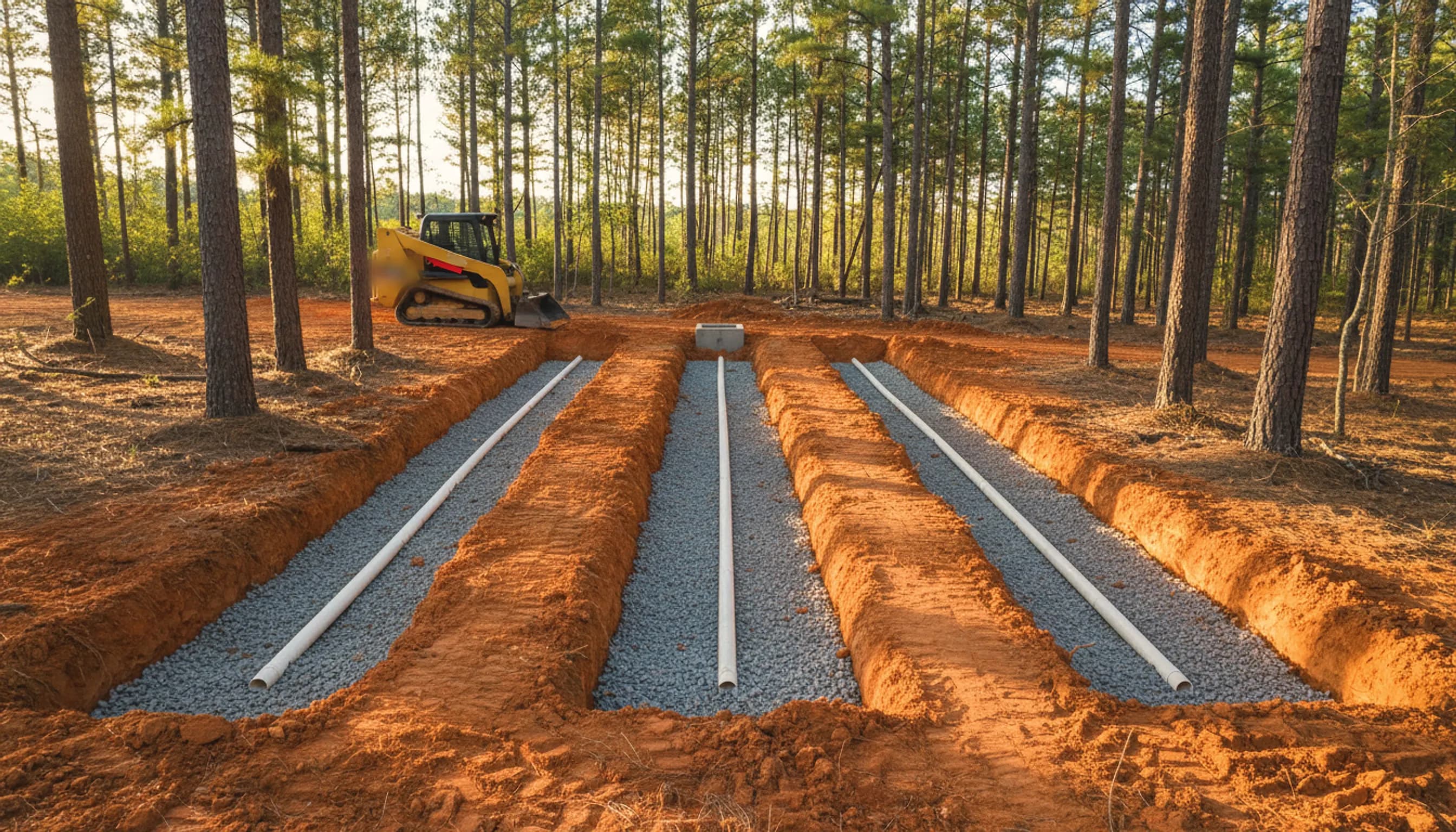
Monroe County · Septic & sewer rules
Get a free estimate
or call (678) 863-5620The short answer
Mostly septic. The City of Forsyth runs the county's only municipal sewer, covering the city and some nearby areas, while the county government sells water but not sewer. Monroe County Environmental Health, a North Central Health District office in Forsyth, permits septic systems. We repair, install and pump systems countywide.↗↗
Reviewed by Atlanta Water & Sewage Solutions · Last updated
Sewer or septic?
The county's joint plan with Forsyth and Culloden explains its own map in one line: commercial land sits mostly inside Forsyth because the city supplies commercially critical utilities like sewer. Monroe County runs two water systems, north and south, but they carry water only.↗↗
Subdivisions do not have to bring sewer with them, either. County rules require it only when a public line is available and costs no more than half again what septic would, so most new lots out in the county are still built around a tank and field.↗
Who to call at the county
Septic permits & records
Local facts
Each row links to the agency, code or publisher it comes from. Tap a source to check it yourself.
| Topic | What it says | Source |
|---|---|---|
| Septic permits | 106 Martin Luther King, Jr. Drive, Forsyth; (478) 993-3081; weekdays 8-4:30 | North Central Health District: Monroe County Environmental Health Department |
| County water systems (EPA) | South Monroe about 16,292 people; North Monroe about 3,472; both purchased surface water | EPA Envirofacts SDWIS: public water systems in Monroe County (PWSID GA207xxxx) |
| Water tap, 3/4 inch | $1,000 with an existing meter box, $2,000 without (effective March 7, 2024) | Monroe County Water System: Water Rates, Fees and Policies (rev. 2-18-25) |
| Juliette water extension | $21 million, built because many wells there were contaminated | Monroe County, Forsyth and Culloden Joint Comprehensive Plan (adopted October 2022) |
| Median year built / mobile homes | 1995 / 1,831 of 11,577 housing units | Census Reporter: Monroe County, GA (ACS 2024 5-year) |
| County created | May 15, 1821, named for James Monroe | Wikipedia: Monroe County, Georgia |
| Population | 27,957 (2020 Census) | Wikipedia: Monroe County, Georgia |
The Monroe County story
For a long time much of rural Monroe drank from private wells, and around Juliette that caught up with people. The joint plan describes a $21 million project to carry county water there because many wells were contaminated, and notes that some residents on private roads still lack service.↗
Juliette itself is best known as the stand-in for Whistle Stop in Fried Green Tomatoes, and nearby Lake Juliette, a 3,600-acre Georgia Power reservoir, draws hunters and anglers. Homes near both are septic properties, often with a well on the same lot, so the spacing between the two matters.↗
County code keeps a new well at least 50 feet from a septic tank and 100 feet from a pit privy, the kind of rule that decides where a replacement field can go on a small rural lot.↗
Permits · Monroe County Environmental Health, North Central Health District
Get an address assigned by Planning and Zoning if the lot does not already have one.↗
Go to Environmental Health for the septic permit, any soil study and a well permit if you need one; the county notes that EH is a state office and fees may vary.↗
Get the driveway permit from the Road Department on Montpelier Road ($100).↗
File the building and zoning application at 38 W. Main Street with house plans and the septic permit attached.↗
Repairs and replacements of existing systems are permitted and inspected under the state rules too.↗
Georgia rule 511-3-1-.03(1)
“available within two hundred feet (200') of the property line”
Soil & terrain
Monroe straddles the Fall Line, where the Piedmont gives way to the coastal plain. Its most common soil is Madison sandy clay loam on 6 to 15 percent slopes, severely eroded, with Cecil and Lloyd close behind, and stony Pacolet-Saw ground on some ridges.↗↗
NRCS puts about 65,600 acres of the county's major soils in the very-limited class for septic absorption fields, roughly three in ten rated acres, and puts most of the rest in the somewhat-limited class.↗
Madison sandy clay loam, 6-15% slopes, severely eroded↗
Largest map unit, 40,995 acres.
Cecil sandy clay loam, 6-10% slopes, severely eroded↗
27,020 acres.
Lloyd sandy clay loam, 6-15% slopes, severely eroded↗
18,570 acres.
Chewacla loam, frequently flooded↗
14,765 acres of bottomland.
More about Monroe County
Monroe County Water is clear about where its job ends. The county fixes leaks from the main to the meter; anything from the meter to the house is the owner's, along with the pressure relief valve and shutoff on the customer side. We replace those service lines.↗
In the water supply watersheds, septic tanks and drain fields stay out of stream setbacks: 150 feet within seven miles of an intake and 75 feet beyond it. Where no public sewer exists, federal records show institutions running their own small plants, including High Falls State Park and the state's public safety training center.↗↗
Monroe County Water is clear about where its job ends.
Towns we serve
Services here
Also available:Septic InspectionEmergency Septic & Sewer Service
FAQ
Straight answers, with the rule or record behind them. Still unsure? Call and ask the crew that digs.
(678) 863-5620Call Monroe County Environmental Health at (478) 993-3081 or visit 106 Martin Luther King, Jr. Drive in Forsyth, weekdays until 4:30. The office also handles soil studies and well permits, and you need the septic permit before the county will take a building application.
Source: Monroe County, GA: Steps to Moving or Building in Monroe County (Feb. 2025)
No county sewer turned up in our research. The county runs two water systems through its contract operator, and the City of Forsyth provides sewer inside the city and in some nearby parts of the county.
You do. Monroe County's water policy says leaks from the meter to the home are the customer's responsibility and leaks between the main and the meter are the county's. The customer also installs the pressure relief valve and customer-side shutoff.
Source: Monroe County Water System: Water Rates, Fees and Policies (rev. 2-18-25)
The county Environmental Health office suggests every 3 to 5 years for an average family, along with conserving water and keeping harsh chemicals and non-biodegradable items out of the system.
Source: North Central Health District: Monroe County Environmental Health Department
Not in the setback. In water supply watersheds, septic tanks and drain fields are barred within 150 feet of a stream inside seven miles of an intake and within 75 feet beyond that.
Source: Monroe County Code Sec. 14-80: Water supply watershed protection district (Municode)
Only when a public system is available and the cost of installing it is no more than 150% of septic for all the lots. Otherwise each lot must have room for an approved on-site system.
Source: Monroe County Subdivision Regulations Sec. 5.9: Installation of utilities (Municode)
A 3/4-inch tap is $1,000 where a meter box exists and $2,000 without one, under fees effective March 7, 2024. Larger meters cost more, and anything over 2 inches is priced by the contractor.
Source: Monroe County Water System: Water Rates, Fees and Policies (rev. 2-18-25)
The contract operator H2O Innovation supervises operations, maintenance and monitoring for both county systems. Operations questions go to (478) 994-7055 and billing to (478) 992-5089.
Sources
Rules, costs and local facts on this page link to the agency, code or publisher that states them. Cost figures are third-party market ranges, not our prices — estimates are free.
Reviewed by Atlanta Water & Sewage Solutions · Last updated
Ready when you are
Tell us where the property is and what is going on. We give free on-site estimates and handle the Environmental Health permit when the job needs one.
(678) 863-5620Free estimate
or call (678) 863-5620