24/7 Emergency? (678) 863-5620

COST GUIDE · SEPTIC VS SEWER · GEORGIA

Is septic or sewer cheaper in Georgia over time?

Sewer costs a little every month and a lot up front if you're connecting. Septic costs almost nothing month to month until a pump-out or a field repair comes due. Here's how the published numbers stack up.
  • Georgia DPH-certified installer & pumper
  • Homes across metro Atlanta
  • Emergency line answered 24/7

Get a free estimate

or call (678) 863-5620

Property type
What do you need?
Rather talk? (678) 863-5620
Where's the property?
Is sewage backing up inside? (optional)
Who should we call?

By submitting, you agree we may call or text you about this request. Msg & data rates may apply. Reply STOP to opt out. SMS terms.

The short answer

Is septic or sewer cheaper in Georgia over time?

A septic system that's pumped on schedule and never needs a new drain field usually costs less over the years than a monthly sewer bill. Sewer wins when the field fails, when lot conditions make repairs costly, or when you're already connected. Converting from septic means paying utility tap fees plus the new lateral.

Reviewed by Atlanta Water & Sewage Solutions · Last updated

Key facts

The published numbers behind the comparison

Each row links to the agency, code or publisher it comes from. Tap a source to check it yourself.

Georgia sewer rates, connection fees and septic upkeep costs from utilities and third-party publishers, with the year of each figure.
TopicWhat it saysSource
Gwinnett sewer (3/4-inch meter)$7.50 monthly base plus $9.43 per 1,000 gallons of water used (Jan. 2026)Gwinnett DWR Rates and Fee Schedule — January 2026, 2026
Monroe sewer, inside city$27.50 monthly base plus $3.63 per 1,000 gallons; $34.76 minimum bill (2026)City of Monroe Wastewater Rates 2026 (residential sewer rates eff. Jan. 1, 2026; tap and connection fees eff. Sept. 11, 2024), 2026
Covington sewer$6 per 1,000 gallons with an $18 minimumCity of Covington — Water Rate Information
Septic customers' sewer chargeNone; DeKalb bills septic homes for water onlyDeKalb County Watershed Management — Services & Billing
Septic pump-out, Atlanta$359 to $1,048 (Angi, 2026); $250 to $375 (Septic & Well Pro, 2026)Angi — How Much Does It Cost to Pump a Septic Tank in Atlanta? (updated May 5, 2026), 2026
How often to pumpRoughly every 3 to 7 years, depending on tank size and household, per UGA ExtensionUGA Extension Bulletin B1421, septic system care (rev. Oct 18, 2024), 2024
Drain field replacement$3,000 to $15,000, typical market range (HomeGuide, 2026)HomeGuide — How Much Does a Leach or Drain Field Replacement Cost? (2026), 2026
Gwinnett septic-to-sewer fee$4,172 for a 3/4-inch meter: $4,147 system development charge plus $25 permitResidential Septic to Sewer Procedure for Unincorporated Gwinnett County

Plain definitions

Cost terms that show up on each side

Base charge
A fixed monthly sewer fee billed whether or not you use water; Gwinnett's is $7.50 on a 3/4-inch meter.
Volumetric sewer rate
A per-1,000-gallon sewer charge calculated from metered water use, since sewage flow isn't metered.
System development charge
A one-time fee for a new connection's share of the utility's water or sewer infrastructure.
Tap fee
What the utility charges to connect a new service to its main; NCWSA charges a $75 sewer tap inspection instead and doesn't make taps itself.
Drain field
The trenches that absorb effluent into the soil; replacing one is the largest cost most septic owners ever face.

What it costs

Side by side: what each option costs

The first group is septic upkeep from third-party publishers. The second is sewer charges and connection fees taken straight from utility schedules. Use both to frame your own numbers.

What moves the price

Septic and conversion figures are typical market ranges from third-party publishers; sewer figures come from utility fee schedules. None of them is an Atlanta Water & Sewage Solutions price. Estimates from us are free.

Free estimate: (678) 863-5620
  1. 01Distance to the mainNCWSA estimates $50 to $100 per foot from the building to the nearest manhole, so a house set far back pays more to connect (NCWSA).
  2. 02Household water useSewer is billed on water used, so a large household pays more every month, and it also fills a septic tank faster.
  3. 03Soil and lotA lot with poor soil or no room for a replacement field turns a septic repair into a bigger project.
  4. 04Whether a main already reaches youWhere the utility must extend a line, NCWSA expects new customers to fund the extension.

The whole story

What does sewer cost a household each year?

Take a household using 5,000 gallons of water a month, a round number chosen for illustration. On Gwinnett's January 2026 schedule, the sewer portion works out to $7.50 plus 5 × $9.43, about $54.65 a month or roughly $656 a year. The same use inside Monroe comes to $27.50 plus 5 × $3.63, about $45.65 a month. In Covington, at $6 per 1,000 gallons, it's about $30 a month.

Those are our calculations from the published rates, not bills, and they leave out water charges, which you pay either way. Over twenty years at today's rates, that household would pay somewhere around $7,000 to $13,000 in sewer charges depending on the utility. Rates tend to change over time, so treat those totals as a floor for comparison rather than a forecast.

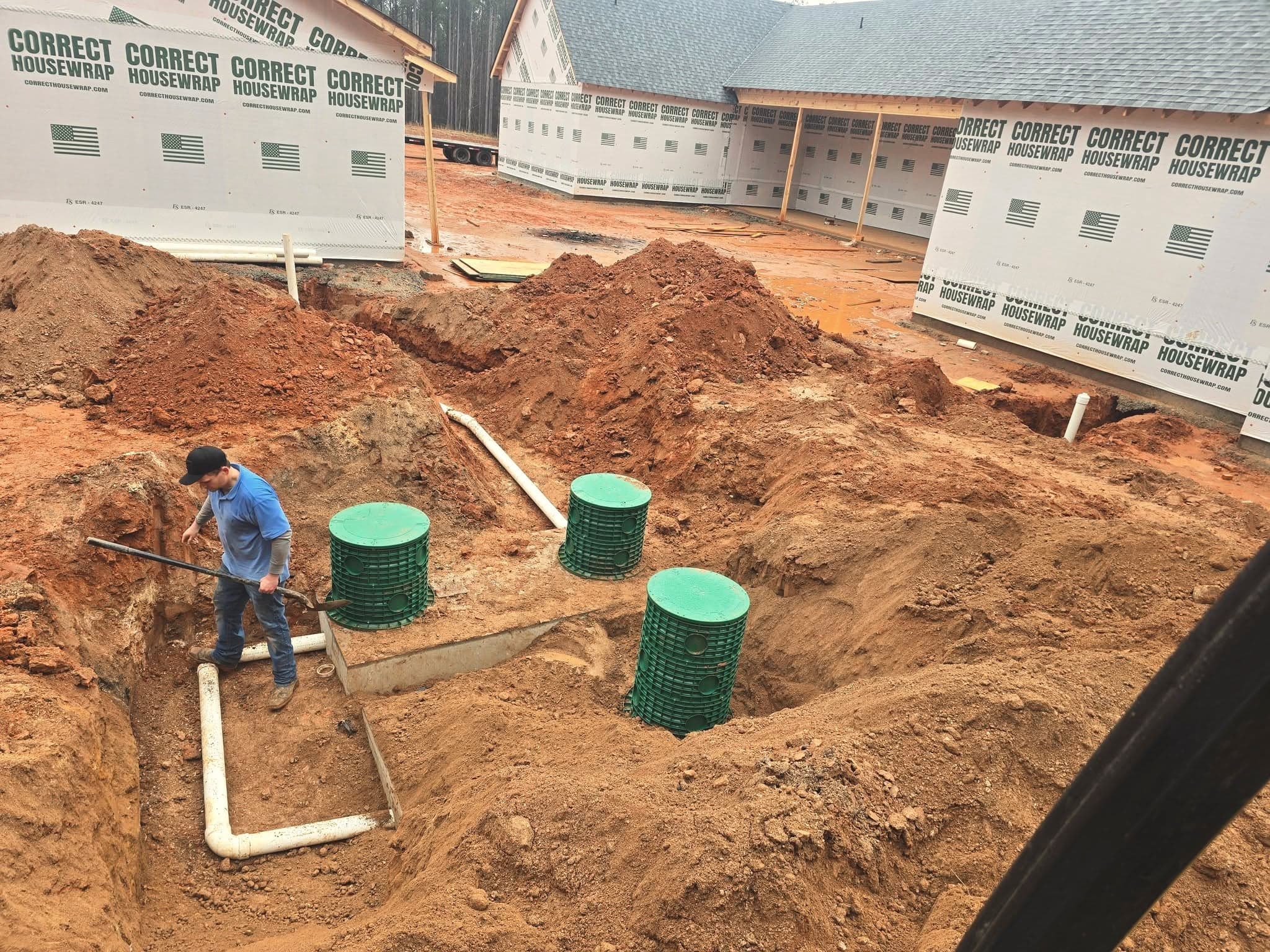
From our job files.

Worth knowing

What does septic cost a household over the same stretch?

UGA Extension's guidance puts pumping at roughly every 3 to 7 years. At Angi's 2026 Atlanta range of $359 to $1,048 per visit, that's three to seven pump-outs in twenty years, or about $1,000 to $7,300 total at today's prices. Add a periodic inspection and the occasional part, and routine septic ownership still tends to land below the sewer totals above. Our pumping frequency guide explains how tank size changes the interval.

The wild card is the drain field. HomeGuide's 2026 range for replacing one is $3,000 to $15,000, before the county permit (Newton's GNR schedule lists $275 for a residential repair). One field failure can erase years of savings, which is why neglect is the most expensive septic habit. Our drain field warning signs guide covers what to watch for.

UGA Extension's guidance puts pumping at roughly every 3 to 7 years.

Your options

Staying on septic vs connecting to sewer

Where you have a real choice, these are the trade-offs. Where sewer is available, Georgia's rule may make the choice for you (see the next section).

OPTION 01

Stay on septic

When it fits: The system works, the field has room, and sewer isn't close enough to require connecting.

  • No monthly sewer charge
  • Pumping every few years is the main recurring cost
  • A failed field is a large, lumpy expense
  • The owner carries all maintenance responsibility

OPTION 02

Connect to sewer

When it fits: A main is at or near your property line, the septic system is failing, or you're adding bedrooms the tank can't handle.

  • No pumping or field replacement ever again
  • The utility maintains the public main
  • Tap or system fees of several thousand dollars
  • The lateral, conversion work and a permanent monthly bill

Your old tank must be pumped and filled or removed under Rule 511-3-1-.17(5).

Permits & the Georgia rules

When Georgia takes the choice out of your hands

The comparison above assumes you get to choose. State rules say otherwise in two cases: when sewer is close enough to the lot, and when an existing system fails and sewer is available.
  1. 01

    Find out whether a public main sits within 200 feet of your property line or in an abutting right-of-way; if so, connection is generally required.

  2. 02

    If a residential system under 2,000 gallons a day fails, the county board of health can exempt it from connecting when a repair meets state criteria and the lot has enough usable soil.

  3. 03

    Before pricing a conversion, get the utility's fee sheet; in Gwinnett, fees are paid at the DWR Central Facility before the septic-to-sewer and plumbing permits issue.

Georgia rule Rule 511-3-1-.03(1)(a)

available within two hundred feet (200') of the property line
Read the rule

Georgia rule Rule 511-3-1-.03(1)(b)

may be exempted from connecting to sewer if the repair or replacement of the system will meet the criteria
Read the rule

How it varies by county

  • Newton (NCWSA)

    New customers fund any sewer extension and hire a design professional whose drawings NCWSA approves before construction.

  • Gwinnett

    The conversion needs a Septic to Sewer Permit from DWR and a Plumbing Only Permit, with inspections at the cleanout tie-in and after the tank is crushed or filled.

  • City of Covington

    The city's tap-fee page lists $3,600 for a 3/4-inch residential sewer tap; the owner builds the line from the house to the property line.

  • DeKalb

    The residential sewer access fee was $1,811.93 on the 2022 rate sheet, the most recent schedule we could locate.

FAQ

Septic vs sewer cost questions

Straight answers, with the rule or record behind them. Still unsure? Call and ask the crew that digs.

(678) 863-5620

Is it cheaper to have septic or sewer in Georgia?

Month to month, septic is cheaper because there's no sewer bill; Gwinnett's 2026 sewer charge alone is $7.50 plus $9.43 per 1,000 gallons. Over decades, septic stays cheaper only if the system is pumped on schedule and the drain field lasts. HomeGuide puts a field replacement at $3,000 to $15,000, which can close the gap quickly.

Source: Gwinnett DWR Rates and Fee Schedule — January 2026

How much is a monthly sewer bill in metro Atlanta?

It depends on the utility and your water use. At 5,000 gallons a month, Gwinnett's 2026 rates work out to about $55 in sewer charges, Monroe's inside-city rates about $46, and Covington's about $30. Those are calculations from published rates, excluding water charges and any future rate changes.

Source: City of Monroe Wastewater Rates 2026 (residential sewer rates eff. Jan. 1, 2026; tap and connection fees eff. Sept. 11, 2024)

How much does it cost to connect to sewer from septic in Georgia?

Expect utility fees plus construction. Gwinnett charges $4,172 for a typical 3/4-inch conversion and NCWSA $3,650 plus a $75 tap inspection. HomeGuide's 2025 national range for the conversion work itself is $3,000 to $15,000. NCWSA estimates $50 to $100 per foot to reach the nearest manhole.

Source: Residential Septic to Sewer Procedure for Unincorporated Gwinnett County

Does a septic system add to or lower home value?

We haven't found a reliable Georgia study that puts a number on it, so we won't guess. What buyers and lenders care about is condition. A recent pumping record and an inspection showing a working tank and field matter more than the system type. Our home-sale inspection guide covers that process.

How often will I pay to pump a septic tank?

UGA Extension suggests roughly every 3 to 7 years, depending on tank size and how many people live in the house. In the Atlanta market, Angi's 2026 range is $359 to $1,048 per pump-out and Septic & Well Pro lists $250 to $375.

Source: UGA Extension Bulletin B1421, septic system care (rev. Oct 18, 2024)

Can I keep my septic system if sewer comes to my street?

Often not. Georgia rule 511-3-1-.03 requires connection when public sewer is available within 200 feet of the property line or in an abutting right-of-way, and requires connecting when an existing system fails and sewer is available. Local ordinances add their own deadlines, so ask your utility once a main is built nearby.

Source: Georgia DPH Rules Chapter 511-3-1, On-Site Sewage Management Systems (Jan 2016)

What happens to the old septic tank after connecting to sewer?

Under Rule 511-3-1-.17(5), the tank must be pumped out by a certified pumper and filled with sand, soil or rock, or removed. Gwinnett's procedure has the tank inspected after it's cleaned out and crushed or filled. Budget for that pumping and backfill as part of the conversion.

Source: Georgia DPH Rules Chapter 511-3-1, On-Site Sewage Management Systems (Jan 2016)

Sources

Where these facts come from

Rules, costs and local facts on this page link to the agency, code or publisher that states them. Cost figures are third-party market ranges, not our prices — estimates are free.

Reviewed by Atlanta Water & Sewage Solutions · Last updated

  1. 1Gwinnett DWR Rates and Fee Schedule — January 2026 (2026)
  2. 2Residential Septic to Sewer Procedure for Unincorporated Gwinnett County
  3. 3City of Monroe Wastewater Rates 2026 (residential sewer rates eff. Jan. 1, 2026; tap and connection fees eff. Sept. 11, 2024) (2026)
  4. 4City of Covington — Water Rate Information
  5. 5City of Covington — Tap Fees
  6. 6NCWSA Water and Sewer Fees (sheet header: effective July 1, 2025) (2025)
  7. 7NCWSA — Connecting to Sanitary Sewer in Unincorporated Newton County (rev. 11/29/2018) (2018)
  8. 8DeKalb County Watershed 2022 Rate Sheet — Water and Sewer Rates and Service Charges (2022)
  9. 9DeKalb County Watershed Management — Services & Billing
  10. 10Angi — How Much Does It Cost to Pump a Septic Tank in Atlanta? (updated May 5, 2026) (2026)
  11. 11Septic & Well Pro — Septic Pumping Cost Georgia 2026 (updated April 10, 2026) (2026)
  12. 12UGA Extension Bulletin B1421, septic system care (rev. Oct 18, 2024) (2024)
  13. 13HomeGuide — How Much Does a Leach or Drain Field Replacement Cost? (2026) (2026)
  14. 14Septic & Well Pro — Septic Installation Cost Georgia 2026 (updated June 9, 2026) (2026)
  15. 15HomeGuide — Sewer Line Installation Cost (updated December 2025) (2025)
  16. 16Georgia DPH Rules Chapter 511-3-1, On-Site Sewage Management Systems (Jan 2016) (2016)
  17. 17GNR Public Health — Newton County Environmental Health Fee Schedule (updated 02/12/26) (2026)

Ready when you are

Rather have a pro look at it? Call the crew that digs.

Sewer costs a little every month and a lot up front if you're connecting. Septic costs almost nothing month to month until a pump-out or a field repair comes due. Here's how the published numbers stack up.

(678) 863-5620
  • Georgia DPH-certified installer & pumper
  • Residential & commercial
  • Oxford, GA

Property type
What do you need?
Rather talk? (678) 863-5620
Where's the property?
Is sewage backing up inside? (optional)
Who should we call?

By submitting, you agree we may call or text you about this request. Msg & data rates may apply. Reply STOP to opt out. SMS terms.

Call nowFree Estimate