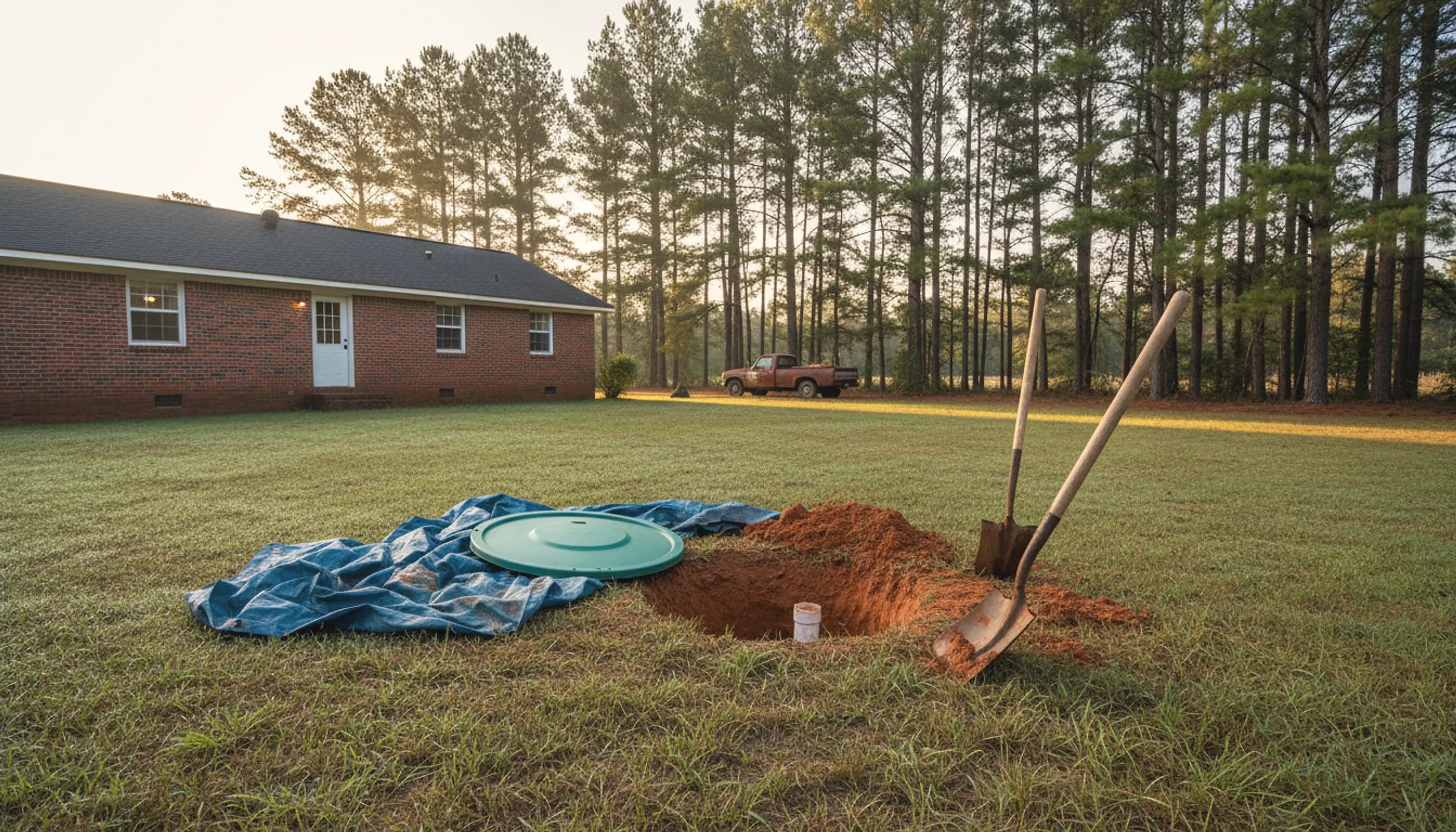
Septic Installation · Bethlehem, GA
New septic system installation for Bethlehem, Georgia lots under Barrow County's usable-soil ordinance.
- Georgia DPH-certified installer & pumper
- Residential & commercial
- Local shop in Oxford, GA
Get a free estimate
or call (678) 863-5620The short answer
How do you get a new septic system installed in Bethlehem, GA?
Every new Bethlehem home without sewer needs its own system; the town bans shared ones. Barrow County Environmental Health approves the site and layout, and its ordinance requires 25,500 square feet of usable soil on public water. Atlanta Water & Sewage Solutions handles the permit, the install and the county inspection.↗↗
Reviewed by Atlanta Water & Sewage Solutions · Last updated
Permits · Barrow County Environmental Health (Northeast Health District), Winder
From bare lot to approved system
- 01
Check the lot against Barrow's ordinance before you close on it: 25,500 square feet of usable soil on public water, 51,000 square feet containing that much usable soil on a private well.↗
- 02
Measure width where the fields will sit. The county wants at least 100 feet on public water and 150 feet on a well.↗
- 03
Call the Winder office for the current application and fee; Barrow's forms are listed as being updated.↗
- 04
The county health department signs off on where the tank and field go. Bethlehem's code defers to that approval and to state and county rules on lot size.↗
- 05
Install to the permit, then hold the trenches open for the county inspection before cover.↗
The Bethlehem story
What Barrow counts as usable soil
The ordinance, first adopted in 2004 and amended in 2018, subtracts a lot before it adds anything. Road right-of-way, easements, slopes over 25 percent, water and land within 50 feet of streams or floodplain all come out.↗
Then the soil map takes another cut. Soils coded F or D do not count, nor does a 20-foot strip around them, nor graded or filled ground. Any area too small for a 50-foot drain line is dropped as well.↗
The county can also ask for more land. Slopes past 5 percent, percolation slower than 45 minutes per inch, or a need for subsurface drainage are all triggers.↗
The ordinance, first adopted in 2004 and amended in 2018, subtracts a lot before it adds anything.
Soil & terrain
Picking the field site on a Bethlehem lot
Cecil sandy loam covers the town center and the gentler south side. It is somewhat limited because water moves slowly, which mostly means longer trenches. A west-side lot is different: Musella cobbly clay loam there is very limited by shallow rock, and an alternative design may be the only way through.↗
North of the center, Chewacla loam along the drainage floods often. Barrow's 50-foot floodplain exclusion usually takes that ground off the table for a field.↗↗
What it costs
Georgia installation costs by system type
Conventional gravity system
$6,397–$7,600
Typical market range — Septic & Well Pro — Septic Installation Cost Georgia 2026 (updated June 9, 2026), 2026
Chamber system
$7,000–$12,000
Typical market range — Septic & Well Pro — Septic Installation Cost Georgia 2026 (updated June 9, 2026), 2026
Low-pressure pipe system
$8,000–$14,000
Typical market range — Septic & Well Pro — Septic Installation Cost Georgia 2026 (updated June 9, 2026), 2026
Mound system
$10,000–$20,000
Typical market range — Septic & Well Pro — Septic Installation Cost Georgia 2026 (updated June 9, 2026), 2026
Site evaluation (soil testing)
$200–$500
Typical market range — Septic & Well Pro — Septic Installation Cost Georgia 2026 (updated June 9, 2026), 2026
Level III soil classification
$500–$1,500
Typical market range — Septic & Well Pro — Septic Installation Cost Georgia 2026 (updated June 9, 2026), 2026
What moves the price
These are third-party typical market ranges, not our prices. Every job is quoted after we see it — estimates are free.
Free estimate: (678) 863-5620- 01Rock on west-side Musella lots
- 02Trench length needed in slow Cecil clay
- 03Room left for the equal-size replacement area
- 04Whether the county asks for a larger lot on a steep site
More about Bethlehem
New homes at the edge of a growing corridor
Growth reaches Bethlehem from outside. The county plan says subdivisions and a medical campus along SR 316 bracket the town, and Southern Woods has gone up on its south side.↗↗
In town, new homes still plan for septic. The code rules out a shared field or a small private plant for a group of lots, so a builder budgets one permitted system per house.↗
On the record
- Bethlehem's code bars privately financed wastewater plants serving more than one home unless the plant meets county standards and will be owned by the county.↗
A certified installer on the state list
Georgia DPH's Certified Septic Tank Installer list, dated 9/18/2026, includes Atlanta Water & Sewage Solutions under Walton County.
FAQ
Septic installation questions from Bethlehem
Straight answers, with the rule or record behind them. Still unsure? Call and ask the crew that digs.
(678) 863-5620How big does a Bethlehem lot need to be for septic?
Barrow's minimum is 25,500 square feet of usable soil with public water, or 51,000 square feet with a well. Bethlehem's code uses whichever rule is larger, the town's or the county's.
Source: Barrow County Board of Health Lot Size Ordinance (amended 2018)
Can a new Bethlehem subdivision use one shared septic system?
No. The 2026 development code prohibits communal on-site sewage disposal; every lot needs its own system.
Source: Unified Development Code, Town of Bethlehem, GA (adopted July 6, 2026)
Where do I apply for a new septic permit?
Barrow County Environmental Health, 63 Lee Street, Winder. Call 770-307-3502 first; the office is open weekdays 8:00 to 4:30, closed at lunch.
Source: Northeast Health District — Barrow County (Environmental Health)
What does a new septic system cost in Georgia?
Septic & Well Pro's 2026 figures run $6,397 to $7,600 for a conventional three-bedroom system and up to $20,000 for mound or aerobic designs.
Source: Septic & Well Pro — Septic Installation Cost Georgia 2026 (updated June 9, 2026)
My Bethlehem lot has rock. Can I still get a permit?
Often, with a different design. West-side Musella soil is very limited by shallow bedrock, so the site evaluation decides between moving the field and an engineered system.
Source: USDA NRCS Soil Data Access — point queries, Bethlehem GA (survey GA606)
Does steep ground change the requirements?
Yes. Barrow may require a larger lot above 5 percent slope, and slopes over 25 percent do not count toward lot area at all.
Source: Barrow County Board of Health Lot Size Ordinance (amended 2018)
Sources
Where these facts come from
Rules, costs and local facts on this page link to the agency, code or publisher that states them. Cost figures are third-party market ranges, not our prices — estimates are free.
Reviewed by Atlanta Water & Sewage Solutions · Last updated
- 1Unified Development Code, Town of Bethlehem, GA (adopted July 6, 2026)
- 2Barrow County Board of Health Lot Size Ordinance (amended 2018)
- 3Northeast Health District — Sewage/Septic Systems
- 4Newcomer's Guide to Bethlehem (Town of Bethlehem, GA)
- 5USDA NRCS Soil Data Access — point queries, Bethlehem GA (survey GA606)
- 6Septic & Well Pro — Septic Installation Cost Georgia 2026 (updated June 9, 2026)
- 7Barrow County Joint Comprehensive Plan with Bethlehem 2025 Amendment
- 8Bethlehem, Ga businesses (Town of Bethlehem)
- 9Georgia DPH Certified Septic Tank Installer Companies list (9/18/2026)
- 10Northeast Health District — Barrow County (Environmental Health)
Ready when you are
Buying or building in Bethlehem? Check the septic ground first.
Call (678) 863-5620. We walk the lot, flag the likely field and reserve area, and file with Barrow County.
(678) 863-5620- Georgia DPH-certified installer & pumper
- Residential & commercial
- Oxford, GA
Free estimate
or call (678) 863-5620