
GUIDE · STORMS & SEPTIC
Why does my septic back up after heavy rain in Georgia?
- Georgia DPH-certified installer & pumper
- Homes across metro Atlanta
- Emergency line answered 24/7
Get a free estimate
or call (678) 863-5620The short answer
Why does my septic back up after heavy rain in Georgia?
Heavy rain fills the soil around the drain field so it cannot take more wastewater, and the tank backs up into the lowest drains. EPA advises not using the system until the field drains and never pumping a tank while the field is flooded. Cut water use, send runoff away, and call if backups continue once the ground dries.
Reviewed by Atlanta Water & Sewage Solutions · Last updated
Who does the work
One crew, the whole line
- Georgia DPH Certified Septic Tank Installer Listed by the Georgia Department of Public Health
- Georgia DPH Certified Septic Tank Pumper Listed by the Georgia Department of Public Health
- Homeowners across metro Atlanta, from our shop in Oxford, GA
Key facts
Rain and septic systems: what the sources say
Each row links to the agency, code or publisher it comes from. Tap a source to check it yourself.
| Topic | What it says | Source |
|---|---|---|
| Using the system during flooding | Hold off until water in the absorption field is lower than water around the house | US EPA — Septic Systems: What to Do after the Flood |
| Pumping a flooded tank | Don't; a tank emptied in saturated ground can shift or float and damage its pipes | US EPA — Septic Systems: What to Do after the Flood |
| Laundry on a rainy day | A saturated field may not absorb several loads in a row | UGA Extension Bulletin B1421, septic system care (rev. Oct 18, 2024), 2024 |
| Downspouts and runoff | Direct roof and surface water away from the tank and drain field | Gwinnett County DWR — Septic Tanks, 2026 |
| Equipment on wet soil | Keep vehicles and machines off the field; compaction cuts its capacity | US EPA — Septic Systems: What to Do after the Flood |
| Piedmont rainfall | 37 to 60 inches a year in the Pacolet series range | USDA NRCS Official Series Description — Pacolet series |
| Typical subsoil | Firm red clay in the Cecil series, which drains slowly | USDA NRCS Official Soil Series Description — Cecil series (rev. 11/2025), 2025 |
Plain definitions
Terms behind a rainy-day backup
- Saturated drain field
- An absorption field whose surrounding soil pores are already full of rainwater, leaving no room for effluent to soak in.↗
- Hydraulic overload
- More water reaching the system than the soil can absorb, whether from rain, leaks or heavy household use.↗
- Surface runoff
- Rain that flows across the ground instead of soaking in; aimed at a field, it adds to the load the trenches must carry.↗
Warning signs
When a rainy-day backup points to a bigger problem
Still backing up once it's dry? Call (678) 863-5620
- 1. Backups continue after a week of dry weatherSoil should drain between storms. If drains stay slow, the field or the line to it may be damaged. See signs a drain field is failing.
- 2. Sewage odor or soggy ground over the field in dry spellsEffluent surfacing without rain means the trenches are not absorbing.
- 3. The lawn over the tank has sunkEPA lists settling as a sign of flood damage worth a professional inspection.
- 4. An alarm on a pump or aerobic systemPowered systems can fail when water reaches controls; our guide to a septic alarm going off explains next steps.
- 5. Every storm brings the same backupRepeated trouble usually means runoff is being aimed at the field or the field sits too low.
How the job runs
What to do while the ground is soaked
- 1
Stop nonessential water use
Postpone laundry and dishwasher loads, take short showers and fix running toilets. Every gallon you skip is a gallon the field does not have to push through wet soil.
UGA Extension Bulletin B1421, septic system care (rev. Oct 18, 2024)
- 2
Don't schedule a pump-out yet
EPA warns against pumping during flooded or saturated conditions. Emptying the tank does not dry the field and can let the tank lift in waterlogged ground.
- 3
Check power before restarting pumps
If water reached a pump chamber, control panel or aerobic unit, have the electrical connections examined before power is restored.
- 4
Keep traffic off the field
Wet clay compacts easily. Keep cars, mowers and equipment off the trenches until the ground firms up.
UGA Extension Bulletin B1421, septic system care (rev. Oct 18, 2024)
- 5
Call once the ground dries if trouble continues
If drains are still slow after the soil drains, have the tank and field inspected. Sewage inside the house is an emergency septic call at any point.
What it costs
What the lasting fixes typically cost
Curtain or yard French drain
$10–$35
per linear foot
Typical market range — HomeGuide — How Much Does a French Drain Cost? (Feb. 5, 2026), 2026
Regrading an average backyard
$1,000–$5,000
per job
Typical market range — HomeGuide — How Much Does Excavation Cost? (Feb. 5, 2026), 2026
Drain field repair or rejuvenation
$1,000–$5,000
per job
Typical market range — HomeGuide — How Much Does a Leach or Drain Field Replacement Cost? (2026), 2026
Drain field replacement
$3,000–$15,000
per job
Typical market range — HomeGuide — How Much Does a Leach or Drain Field Replacement Cost? (2026), 2026
What moves the price
Typical market ranges published by HomeGuide (2026), not Atlanta Water & Sewage Solutions prices. We look at the site first, and the estimate is free.
Free estimate: (678) 863-5620- 01Where the water comes fromA single downspout is a small fix; a whole hillside draining across the field needs a diversion drain.
- 02Field conditionA sound field that only floods needs drainage work; a clogged or crushed one needs repair under a county permit.
The whole story
Why does this happen so often in Georgia clay?
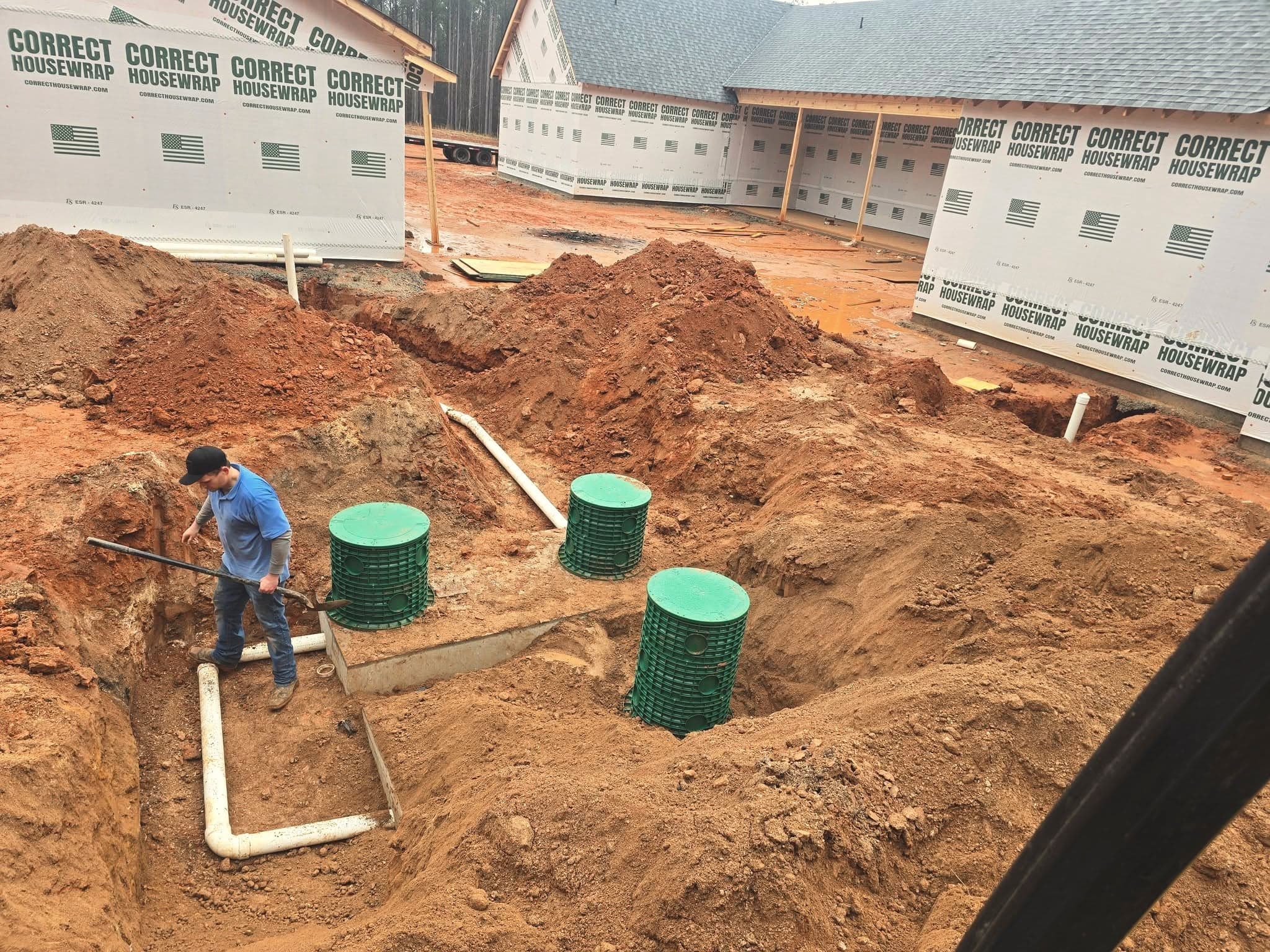
Much of east metro Atlanta sits on Piedmont soils like Cecil, whose subsoil is firm red clay. Clay holds water tightly and releases it slowly, so after a multi-inch storm the ground around the trenches can stay near saturation for days. Georgia sizes each absorption field to the soil it sits in, which is why clay-country fields are already built longer; a wet week simply uses up their margin.
Late winter and spring are the usual trouble season. Storms can arrive back to back, and the field never gets a chance to dry between events. Our red clay septic guide explains how that soil shapes system design.
Worth knowing
How do I stop it from happening every storm?
Start with the roof. Walk the house in the next rain and watch where each downspout empties. Gwinnett County's septic advice is to point downspouts and surface drainage away from the tank and field, and that single change often solves the problem. Extensions, splash blocks or a buried line to daylight downhill all work.
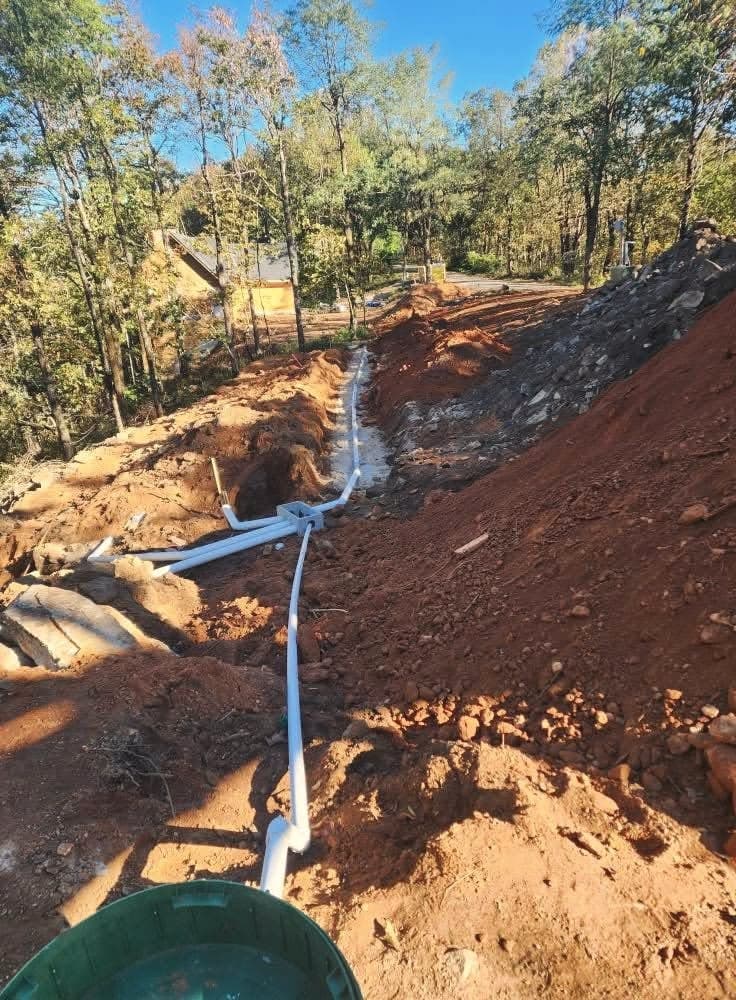
Next, look uphill. If the yard above the field sheds sheets of water across it, a shallow swale or a curtain drain on the uphill side can intercept that flow before it reaches the trenches. Any digging near the system should respect the septic setback rules. If the field is simply too small or too low, a permitted repair is the long-term answer; in Gwinnett, Newton and Rockdale that starts with a Level 3 soil report.
Start with the roof.
FAQ
Septic and heavy rain questions
Straight answers, with the rule or record behind them. Still unsure? Call and ask the crew that digs.
(678) 863-5620Should I pump my septic tank after heavy rain?
Not while the drain field is flooded or saturated. EPA's flood guidance says to avoid pumping in those conditions, because an empty tank in waterlogged ground can shift or float and damage the pipes. Pumping also doesn't fix a wet field; the tank simply refills. Wait until the soil drains, then pump if backups continue.
How long does a drain field take to dry out after rain?
It depends on the soil and how much rain fell. EPA advises not using the system until water in the absorption field is lower than the water level around the house. In slow Piedmont clay that can take several dry days. If drains are still sluggish after the yard has clearly dried out, have the system checked.
Why do my toilets gurgle when it rains?
Gurgling during storms often means the system is full and air is being pushed back through the drains as water struggles to leave the tank. A saturated field is the common reason on a septic home. UGA Extension notes a wet field may not handle several laundry loads on a rainy day, so cut water use until it passes.
Source: UGA Extension Bulletin B1421, septic system care (rev. Oct 18, 2024)
Is it safe to use the toilet when the drain field is flooded?
Use as little water as you can. EPA recommends not using the sewage system until the field water level drops below the level around the house, and conserving water while the system recovers. If sewage is coming up inside, stop using fixtures on that line and call for help, since backed-up wastewater is a health hazard.
Do gutters and downspouts affect a septic system?
Yes. Roof runoff aimed at or near the drain field adds a large volume of water to soil that is also trying to absorb household wastewater. Gwinnett County advises adjusting downspouts and surface drainage so rainfall is carried away from both the septic tank and the field. It is one of the cheapest fixes available.
Does a backup after rain mean my drain field is failing?
Not necessarily. A healthy field in clay can struggle during a wet stretch and recover once it dries. It is more concerning if slow drains persist in dry weather, if the ground over the field stays soggy or smells between storms, or if every rain brings the same backup. Those point to a field that needs inspection.
Source: UGA Extension Bulletin B1421, septic system care (rev. Oct 18, 2024)
Do I need a permit to fix drainage around my septic system?
Ask the county Environmental Health office before grading close to the system. Any repair, replacement or addition to the tank or field must be permitted and inspected by the county under Georgia's rules. In GNR counties a repair permit also requires a Level 3 soil report first.
Source: Georgia DPH Rules Chapter 511-3-1, On-Site Sewage Management Systems (Jan 2016)
Keep going
Related services, counties and guides
- Excavation, grading and drainageDivert runoff away from the field
- Drain field repair and replacement
- Emergency septic and sewer service
- Septic inspection
- Septic pumping
- Signs a drain field is failing
- Red clay soil and septic systems
- Sewer smell in the house
- Homeowner septic checklist
- Newton County septic and sewer
- Rockdale County septic and sewer
- Walton County septic and sewer
Sources
Where these facts come from
Rules, costs and local facts on this page link to the agency, code or publisher that states them. Cost figures are third-party market ranges, not our prices — estimates are free.
Reviewed by Atlanta Water & Sewage Solutions · Last updated
- 1US EPA — Septic Systems: What to Do after the Flood
- 2UGA Extension Bulletin B1421, septic system care (rev. Oct 18, 2024) (2024)
- 3Gwinnett County DWR — Septic Tanks (2026)
- 4USDA NRCS Official Series Description — Pacolet series
- 5USDA NRCS Official Soil Series Description — Cecil series (rev. 11/2025) (2025)
- 6Georgia DPH Rules Chapter 511-3-1, On-Site Sewage Management Systems (Jan 2016) (2016)
- 7GNR Public Health — Septic Systems (Gwinnett, Newton & Rockdale) (2026)
- 8HomeGuide — How Much Does a French Drain Cost? (Feb. 5, 2026) (2026)
- 9HomeGuide — How Much Does Excavation Cost? (Feb. 5, 2026) (2026)
- 10HomeGuide — How Much Does a Leach or Drain Field Replacement Cost? (2026) (2026)
Ready when you are
Rather have a pro look at it? Call the crew that digs.
Rain does not break a septic system, but it can take the drain field offline for days. Here is what is happening underground, what to do while the ground is soaked, and when a backup means something more.
(678) 863-5620- Georgia DPH-certified installer & pumper
- Residential & commercial
- Oxford, GA
Free estimate
or call (678) 863-5620